Wednesday

not understanding


the human genome project was recently completed and, from what i can tell, discovered that folks under the skin are 99.9% the same. so, i guess my question is- why are we still using the same tired excuses for going to war? why not just come right out and say it's fueled by the desire for satisfying the base emotions of greed and power? don't we have anything better to do- like clean up the planet or fight disease and poverty?

Sunday

Albany's Mayor For Life: An Interview With Erastus Corning Biographer Paul Grondahl

The topic below was originally posted in my blog, the Intrepid Liberal Journal as well as the Independent Bloggers Alliance, The Peace Tree, The Wild Wild Left and Worldwide Sawdust.

Erastus Corning 2nd
was elected mayor of Albany, New York eleven times, serving forty-two consecutive years, an unsurpassed tenure in American political history. Even before birth, Corning’s destiny as Albany’s “mayor for life” was scripted. As pillars of the WASP establishment, Corning men were expected to attend Groton and Yale and assume positions of leadership in industry and politics. One could say that the Corning family was noblesse oblige on steroids: an assumption that with wealth, power and prestige come social responsibilities. Yet the noblesse oblige represented by the Cornings had a dark side as their class established an oligarchy in Albany to preserve their status and power.

In the 1920s, the financial, institutional and industrial strength represented by the Corning dynasty forged an omnipotent alliance led by a salty tongued Irish working class political boss named Dan O’Connell. This unlikely union of the well bred Corning family and the O’Connell clan of Irish saloonkeepers initially bonded through cock fighting! Eratus’s father Edwin served as Lt. Governor in the late ‘20s and collaborated with O’Connell until poor health forced him to step away from politics.

When Edwin Corning died in 1934, Dan O’Connell became a surrogate father for the future mayor. As Albany’s political boss, O’Connell paved the way for Corning to assume the reins and become mayor at the age of thirty-two in 1941. Corning served until he died in 1983. Ironically, this powerful man who battled Thomas Dewey, sparred with Nelson Rockefeller and mentored Mario Cuomo, never enjoyed the power of self-determination.

A complex and lonely soul, Corning presided over a fiefdom of cronyism, corruption and stability. He mingled easily with the working class that the O’Connell-Corning machine kept obedient while enjoying the exclusive privileges of men in his social class. As other cities peaked with post war development and endured social turbulence in the 1960s, Albany remained virtually unchanged. And the citizens of Albany continued to return Corning to power.

Paul Grondahl, an award winning journalist with the Albany Times Union skillfully captured the “shadow" and “light” of Corning’s rule, as well as his convoluted private life in his book, Mayor Erastus Corning: Albany Icon, Albany Enigma. Originally published in 1997, Grondahl’s biography about Corning was just released in paperback by the State University of New York Press.

William Kennedy, the Pulitzer Prize winning author of Ironweed, writes in the introduction that,
“This is an important book for Albany, for anyone interested in political power. It widens our vision (with a view from inside City Hall) of the O’Connell Democratic organization, which controlled Albany from 1921 until the Mayor died in 1983, making it the longest-running boss machine in American political history.”
Grondahl agreed to a podcast interview with me over the telephone about his book and Erastus Corning. Our conversation lasted forty-five minutes as we discussed the public figure, the political machine he served and his private life. Please refer to the media player below.


This interview can also be accessed via the Itunes store at no cost by searching for “Intrepid Liberal Journal.”

Wednesday

darfur- take action!


most folks know that the situation in darfur is desperate. the news is never good there- and i guess i continue to wonder about how human beings can view other humans as objects to be tortured and killed. i think folks get numbed to the mindless genocide around the world and it is all too easy to write these impoverished places off. the 'oh well, let them kill each other if they want to' mentality amazes me- especially from 'bleeding heart' liberals and 'pro-life' conservatives. we allegedly went into iraq (in the third incarnation of reasons i think) to save those poor folks from the horrors of living under saddam hussein. why, then, are we not preemptively going into darfur to save those folks from the janjaweed? and no- that isn't a name from a star wars movie. the west has completely ignored africa- except to plunder its natural resources. we bribe or intimidate whoever we have to to get what we want- and to hell with the indigenous peoples.

the un has coalition troops ready to go- but then- we get the news that blackwater has reared its ugly head yet again. yes, since they have done such a fine job in iraq, apparently, they want to make a few billion dollars more in darfur. so, not only do we have to pressure our government to get involved in darfur- we have to pressure them to NOT send the blackwater thugs to darfur. nice.

for some resources and info on darfur- quaker dave at the quaker agitator- has some good ones on his sidebar.

instantkarma.org has information and petitions to sign- but please, take a moment and think about what africa means to the world. we agreed after world war 2 to never allow genocide happen again. more than 2 million people are displaced and hundreds of thousands are living in refugee camps. no hard data exists as to the death toll, but experts are convinced it's also in the hundreds of thousands. how many folks have to die before it is called a 'terrorist act?'

Talk by Naomi Wolf - The End of America

Tuesday

BUSH VERSUS JESUS


Despite your faith, despite your politics, despite your beliefs,
this video (in its entirety) will make the hair on your neck stand up...

Sunday

An Interview With Iranian Expert and Journalist Barbara Slavin


The topic below was originally posted on my blog, the Intrepid Liberal Journal as well as The Peace Tree, the Independent Bloggers Alliance and Worldwide Sawdust.

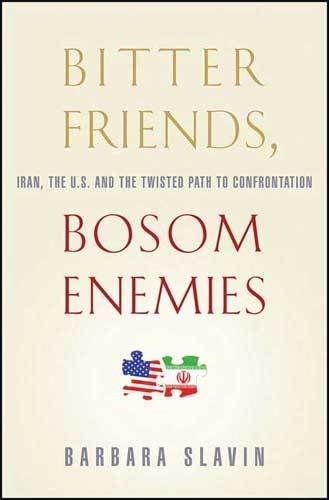
Barbara Slavin, senior diplomatic correspondent for USA Today since 1996 and author of the recently published book, Bitter Friends, Bosom Enemies: Iran, the U.S., and the Twisted Path to Confrontation (St. Martin’s Press), writes that,

“Iran and the United States are like a once happily married couple that has gone through a bitter divorce. Harsh words have been exchanged – husband and wife have come to blows and employed others to inflict more punishment. Apologizing is hard and changing behavior even harder. This relationship is unequal, with one side or the other feeling more vulnerable at any given time and afraid the other will take advantage of concessions.”

Currently, the public faces of both nations, presidents George W. Bush and Mahmoud Ahmadinejad, have been content to throw rhetorical bombs and raise the diplomatic temperature – increasing the likelihood of war. Indeed, at times it appears that conservative hardliners in both countries are eager for conflict as a means to maintain their respective grips on power.

The journey from the CIA backed coup that overthrew Iran’s democratically elected leader Mossadeq in 1953 and replaced him with the Shah, to the Islamic Revolution of 1979 and current tensions is replete with ill conceived schemes that damaged both nations. Slavin, using her extensive contacts among the powerful inside Iran and the United States, documents missed opportunities for reconciliation between both countries during the administrations of the first President Bush as well as Bill Clinton and George W. Bush.

The combination of her remarkable access to people such as Madeline Albright, Condelezza Rice, Iranian reformers like former President Mohammad Khatami, longtime establishment figures such as Ali Rafsanjani, as well as dissidents like Akbar Ganji and everyday citizens, allows Slavin to shed sunlight on a nation most Americans know very little about. She is also the first newspaper reporter from the United States to interview Iranian President Ahmadinejad.

Slavin has accompanied three secretaries of State on their official travels and reported from Iran, Libya, Israel, Egypt, North Korea, Russia, China, Saudi Arabia and Syria. She is also a regular commentator for U.S. foreign policy on National Public Radio, the Public Broadcasting System's Washington Week In Review and C-Span. This month, she joined the U.S. Institute of Peace as a Jennings Randolph fellow, to continue her research on Iran. Slavin also serves as a member of the Council on Foreign Relations.

Prior to joining USA Today, Slavin was a Washington-based writer for The Economist and the Los Angeles Times, covering domestic and foreign policy issues, including the 1991-93 Middle East peace talks in Washington. From 1985-89, she was The Economist's correspondent in Cairo. During her career, Slavin has traveled widely in the Middle East, covering the Iran-Iraq war, the 1986 U.S. bombing of Libya, the political evolution of the Palestine Liberation Organization and the resurgence of Islamic fundamentalism. Earlier in the 1980s, Slavin also served as The Economist's correspondent in Beijing and reported from Japan and South Korea.

Prior to moving abroad, she worked as a writer and editor for The New York Times Week in Review section and a reporter and editor for United Press International in New York City.

Slavin agreed to a podcast interview with me about her book, Iran and their turbulent relationship with the United States. Please refer to the media player below. Our conversation is just under thirty minutes. This interview can also be accessed via the Itunes Store by searching for “Intrepid Liberal Journal.”

united; solidarity; peace

oct27.org web button

those words mean working together for peace. on october 27th, massive demonstrations will take place in boston, chicago, jonesboro, tn, los angeles, new orleans, new york, orlando, philadelphia, salt lake city, san francisco, and seattle- not to mention in other communities across the country. for more information- go to the 'fall out against the war' website:

http://www.oct27.org

cross posted at life's journey

Sunday

Are Voters Irrational: An Interview With Economist Bryan Caplan

The topic below was originally posted in my blog, the Intrepid Liberal Journal as well as The Peace Tree, the Independent Bloggers Alliance and Worldwide Sawdust.

People across the political spectrum routinely question the senses, intelligence and values of their fellow voters. A decade ago conservatives chafed, as President Bill Clinton remained popular in spite of the Monica Lewinsky scandal. In recent years liberals like myself seethed while Republicans maintained one-party dominance in spite of their incompetence and criminal policies. They’re also citizens who challenge the wisdom of any voter who supports the two-party duopoly.

Bryan Caplan, an economist at George Mason University and co-editor of EconLog challenges the rationality of voters with his book, The Myth of the Rational Voter: Why Democracies Choose Bad Policies (Princeton University Press). Caplan, a libertarian, contends that democracies fail because of voters themselves rather than favorite scapegoats such as special interests. He argues that voters are regulated by four irrational prejudices:

1. Too little faith in the free market;
2. A distrust of foreigners;
3. Undervaluing the conservation of labor;
4. Unjustified pessimism that the economy is going from bad to worse.

Referencing those four biases are a reoccurring theme of Caplan’s book that skillfully mixes economics, political science, and psychology to analyze how voters think and the public policies that result from what they want. Overall his book is compelling and provocative. On July 30th, Nicholas Kristof of the New York Times referred to Caplan’s book as “the best political book this year.”

I concur with Caplan that for too many voters ideology is analogous to religious faith and evidence doesn’t penetrate their entrenched worldviews. However, as a liberal I disagree with Caplan’s equating skepticism about the free market or free trade agreements with irrationality.

In my opinion the free market isn’t appropriate for all sectors of the economy such as healthcare or education and free trade has too many imbalances that require attention. Furthermore, I believe too many conservative/libertarian economists ignore the hidden economy that isn’t measured by the Gross Domestic Product or quarterly statements. Caplan of course disagrees and I suppose by his definition I’m one of those irrational voters.

Each of us can become imprisoned by our own belief systems and it’s healthy to challenge our perspectives. Caplan graciously agreed to a podcast interview with me over the telephone about his controversial book. Our conversation was approximately forty minutes. Please refer to the media player below. This interview can also be accessed via the Itunes store by searching for "Intrepid Liberal Journal."

Friday

Amish Grace


It's now been a little over a year since the horrific Nickel Mines tragedy, when an extremely disturbed man murdered several Amish schoolchildren.

Then there's the Amish response. They visited the man's wife and children. They visited his father. They cried with them. They attended the man's funeral. They donated money. They mourned others' losses as well as their own. Anger would have been completely understandable, but instead they offered compassion.

That's a completely different moral and emotional vocabulary than, to speak for myself, I'm used to. I understand it as a concept, I've tried to practice it myself at times, but I can't say I've found myself in that sort of world too often. I certainly don't see that sort of reflection or maturity tempering current war-mongering. I think it takes a particular type of petulance, callousness and vanity to eagerly clamor for violence, even when the likely disastrous consequences are intellectually if not emotionally clear. Meanwhile, it takes a certain kind of grace to face someone with that sort of attitude honestly, yet still respond in a positive way.

As Hilzoy observed in her post "Liberating Iraq," (linked previously here):

Violence is not a way of getting where you want to go, only more quickly. Its existence changes your destination. If you use it, you had better be prepared to find yourself in the kind of place it takes you to. Forgiveness does not mean the absence of grief, and losing a child, especially to violence, is one of the harshest of blows. The Amish community still has its pain, and some of the surviving victims still have significant if not severe health problems.


The actual shooting was astoundingly tragic. If there's something sad at this anniversary, besides its continuing effects, it's that the Amish response is so startling and unusual. If there's something hopeful, it's that their grace is both startling and inspiring. I find true virtue does give me pause, and the best way to honor the dead is to invite in that sort of reflection.

Here's NPR's fine coverage on the anniversary and listener's responses. Here's the Bill Moyers Journal piece on the same story, which also focuses on the book Amish Grace.

(Cross-posted at Vagabond Scholar and The Blue Herald)

Sunday

A Tale of Myanmar


She moved rapidly over the ground
Alongside the Salween trench where hell dogs
Slathered their steel lips in conquest; beasts
Collecting the night’s wordless skies.

She fell hard upon the scorched ground,
Her slender legs slapping the stony loam.
I cradled her wet face against my chest
To gentle her howling heart. She smiled
And stroked my face, then her mouth leapt
Upon mine and our hands curved into flames
As we pushed deep into the brush.

Wordless, we spoke of our hopes and fears;
The beasts hard upon our backs,
The children and their mother’s shriek,
The lifeless weeping stirred by the heartless.

The sick and the dying were with us,
Between our moving lips and fingers,
Upon our union of sweat and flesh
Underneath the forlorn heavens.
And within our merger of silence we knew,
At long last, there was no more need to run.


© 2007 mrp/thepoetryman


This story and link is dated but seems rather relevant...
India influences Myanmar (Burma) and Bangladesh for Gas supply
possibly through Bangladesh pipe line - January 11, 2005


Thank you to Ko Htike's Prosaic Collection for the videos.


Free Burma Coalition


Thursday

blog for burma


What is it about the underdog that appeals to the american sense of justice? Since our revolution, and when it suited us, we have always supported the underdog in foreign relations. Not that it's a bad thing, necessarily, but i think sometimes we miss the bigger picture. When most folks think about the recent unrest in Burma (Myanmar), they see the military crackdown and the monks being rounded up- not anymore since journalists have been killed and threatened and the internet turned off. They don't necessarily look at the bigger picture. What caused the whole thing to blow?

The usual suspects- greed, power and oil. If you look to most of the issues anywhere in the world, you see the unholy trinity. From the middle east to south america to africa- to now southeast asia, you find big international corporations and greed for huge profits. To what end, i have no idea. So supporting the burmese folks and the monks is a noble ideal. Let's ask ourselves how to make that stick. The military runs their country and their government- and they knew what they would face if they protested. The monks knew what they would face if they protested. Yet-- they did it anyway.

Perhaps that's what should appeal to us as americans- and fellow citizens of the planet. People willing to stand up in the face of adversity and fight for changes in our country, surely, but for the world too. You see, it isn't just about the little country of burma, it is about all of us standing together and working to end the forces of greed. We need to take the power out of the hands of the international corporations and put it back into the hands of people. While solidarity is a good start, let's do what we can to pressure governments and the united nations to stop the bloodshed in burma. My posts for the other countries that the world has forgotten about will be saved for another day.


cross posted at the sirens chronicles and life's journey

Tuesday

Stopping the Iraq Occuaption


Stopping the Iraq Occupation and the Attack on Iran PDA works inside the Democratic Party and on Capital Hill -- and outside in grassroots movements for peace and social justice. Thanks to our outside grassroots mobilizing, more lawmakers inside Congress are signing the Iraq Peace Pledge, telling President Bush that they'll only fund the U.S. military in Iraq for "the protection and safe redeployment of all our troops out of Iraq."

70 members of Congress signed the original letter in July; the number of signers is now 86 and growing.

With organizations from the National Organization for Women (NOW) to Democratic Socialists of America (DSA) recently sending out alerts to their base, the grassroots petition backing the Iraq Peace Pledge has now been signed by 50,000 people. If you haven't signed it yet, feel free to do so now. Please forward this email to five friends. And tell your own Congressmember and Speaker Pelosi to back the Iraq Peace Pledge.

As neoconservatives in the White House threaten to widen the Iraq war disaster into a far bigger disaster by attacking Iran, PDA chapters across the country need to gear up for the National Peace Mobilization on October 27 in 11 cities: Boston, Chicago, Los Angeles, New Orleans, New York, Orlando, Philadelphia, Salt Lake City, San Francisco, Seattle and Jonesborough, TN.

PDA needs to have a visible presence at the Oct. 27 events, which are being organized by the United for Peace & Justice coalition. "Fall Out Against the War!" is the rallying cry. PDA needs to show our colors.

More info: PDAmerica

LinkWithin

Related Posts with Thumbnails