Friday

The New (York City) Anti-Semitism:
Reinstate Debbie Almontaser to the Kahlil Gibran International Academy

Any intelligent observer can easily discern that the “new” anti-semitism today has little connection with discrimination against Jews. Anti-semitism nowadays is mostly about deplorable discrimination and racist attacks against Arabs. Right now in New York, the Likudnik thought police are trying their darndest to designate Arabic words like intifada and madrassa (which simply means ’school’ in Arabic, regardless of religious affiliation) treasonous. Madrassa does not mean ‘religious‘ school.

We see this playing out in the trumped-up brouhaha about the Kahlil Gibran International Academy, wherein Debbie Almontaser, the head, was branded a terrorist for not apologising enough (for the Likud-Zionists’s liking) about the word ‘intifada’ (which simply means ’shaking off’) on a T-Shirt–worn by someone else! The racist bullying and defamation resulted in Almontaser resigning.

This reflects poorly on NYC, which has a rich history of cosmopolitanism, the same American tradition that brought Kahlil Gibran, the timeless Lebanese-born poet and philosopher, to the shores of the US where he made such a lasting impact upon the world of literature.

As Anthony DiMaggio notes, Daniel Pipes is one of the reactionaries spouting utter rubbish about Arabic, such as: “Arabic-language instruction is inevitably laden with pan-Arabist and Islamist baggage” and “Muslims tend to see non-Muslims learning Arabic as a step toward an eventual conversion to Islam…”

Islamophobe Pipes fails to mention that the most populous Muslim country is Indonesia (pop: 242 million), whose national language is Bahasa Indonesian. He neglects to mention that there are a great many Christian Arabic speakers too, such as myself. Yes, Arab culture is attached to Islam—since when then is that a crime?–but also to Christianity and Judaism, too. The demonisation of Islam and of Arabic as a language by ignoramuses and ideologues such as Pipes and Bella Rabinowitz is all in service of the terror-blather that has hijacked public discourse in the United States.

Samuel Freedman is one of the very few voices in the MSM to more accurately document the affair, as Richard Silverstein observes.

Press Picks:

Al Jazeera news clip (Thanks Ressentiment):

Crossposted at PeoplesGeography.com

Bush Loses War on Terrorism; Begins War on Iran

Post by


Bush pimps a possible nuclear strike on Iran, though a panel of experts claim his "war on terrorism" is all but lost. What Bush will not tell you is that the world has become a much more dangerous place because of his administration's incompetent and boneheaded policies.
Foreign-policy experts deem US national-security strategy in disrepair, the war in Iraq alarmingly off course, and the world increasingly more dangerous for Americans. In the third Terrorism Index, more than 100 of America's most respected foreign-policy experts see a world that is growing more dangerous, a national security strategy in disrepair, and a war in Iraq that is alarmingly off course.

Six years after the terrorist attacks of Sept. 11, 2001, just 29 percent of Americans believe the United States is winning the war on terror—the lowest percentage at any point since 9/11. But Americans also consider themselves safe. Six in 10 say that they do not believe another terrorist attack is imminent. Likewise, more than 60 percent of Americans now say that the decision to invade Iraq was a mistake.


US Losing War on Terror, Experts Say in Survey

The fact that world terrorism is always worse under GOP regimes is not a coincidence. It is by design that GOP regimes cause, inspire and aggravate world terrorism. The Iran/Contra scandal is a notable instance in which the GOP terrorists were very nearly brought to justice.

Bush's threats have given nations cause to arm. Secondly, the US has a record of arming nations only to turn on them later for having armed. As nonsensical at that would seem on its face, it has nevertheless been the case, most notably with both Iran and Iraq. Saddam Hussein, for example, was a US puppet, armed and protected by the US until he lowered the price of oil.

If Iran is an armed threat, we have the incompetent, criminal GOP to blame. Sadly, the Iran/Contra "affair" seems all but forgotten. Briefly, the regime of Ronald Reagan sold arms to Iran, an avowed enemy of the US. The proceeds were then funneled to a terrorist organization that decimated Nicaragua in the 1980s. The word for that is high treason. Here's the brief summation of the activities of Ronald Reagan's criminal conspiracy to arm an avowed enemy of the US.


The underlying facts of Iran/contra are that, regardless of criminality, President Reagan, the secretary of state, the secretary of defense, and the director of central intelligence and their necessary assistants committed themselves, however reluctantly, to two programs contrary to congressional policy and contrary to national policy. They skirted the law, some of them broke the law, and almost all of them tried to cover up the President's willful activities.


Final Report of the Independent Counsel for Iran/Contra Matters, Lawrence Walsh

The US has a history of financing and encouraging terrorism. Bush, meanwhile, claims to pursue a peaceful resolution with regard to Iran. Hitler made similar statements about Poland before his own SS staged a "Polish attack" on a radio tower inside German territory. The Reichstag Fire was most certainly not Hitler's last and only "false flag" operation, nor 911 Bush's.

Statements by Bush that he prefers to avoid war with Iran are not in character. Bush's thinking reflects that of the radical, right wing ideologues that surround him. Among them --the conservative think tank, the the American Enterprise Institute.

I admire AEI a lot. After all, I have been consistently borrowing some of your best people. More than 20 AEI scholars have worked in my administration.


One of those scholars wrote an op-ed for the L.A. Times entitled "We Must Bomb Iran , in which he made the absurd case that diplomacy has done nothing to stop the Iranian nuclear threat. What diplomacy? Only a "show of force", says AEI, is the answer.

We can prepare to live with a nuclear-armed Iran, or we can use force to prevent it. Former ABC newsman Ted Koppel argues for the former, saying that "if Iran is bound and determined to have nuclear weapons, let it." We should rely, he says, on the threat of retaliation to keep Iran from using its bomb. Similarly, Newsweek International Editor Fareed Zakaria points out that we have succeeded in deterring other hostile nuclear states, such as the Soviet Union and China.

And in these pages, William Langewiesche summed up the what-me-worry attitude when he wrote that "the spread of nuclear weapons is, and always has been, inevitable," and that the important thing is "learning how to live with it after it occurs."

But that's whistling past the graveyard. The reality is that we cannot live safely with a nuclear-armed Iran. One reason is terrorism, of which Iran has long been the world's premier state sponsor, through groups such as Hamas and Hezbollah. Now, according to a report last week in London's Daily Telegraph, Iran is trying to take over Al Qaeda by positioning its own man, Saif Adel, to become the successor to the ailing Osama bin Laden. How could we possibly trust Iran not to slip nuclear material to terrorists?

Joshua Muravchik, American Enterprise Institute, November 19, 2006

The same, sorry cast of characters said the same thing about Saddam Hussein. The spectre of a huge mushroom cloud was summoned repeatedly. But, of course, there were no WMD in Iraq. There was no nuclear threat. Bush is the puppet who cried Wolfowitz!
Saddam's main strength - his ability to control his people through extreme terror - is also his greatest vulnerability. The overwhelming majority of his people, including some of his closest associates, would like to be free of his grasp if only they could safely do so. As the recent account of a defector from Saddam's nuclear program makes clear, even Iraqis who help Saddam build nuclear weapons can't escape from the constant threat of torture and death, for their families as well as themselves.

A strategy for supporting this enormous latent opposition to Saddam requires political and economic as well as military components. It is admittedly more complicated than launching a few cruise missile attacks. Perhaps it is more complicated than this Administration can manage, but it is eminently possible for a country that possesses the overwhelming power that the United States has in the Gulf.


--Paul Wolfowitz, Statement to the House National Security Committee Hearings on Iraq , September 16, 1998

Wolfowitz was dead wrong! History will, of course, prove Bush and company to have been wrong about everything of which it was most certain.

Therein lies the problem. When a real threat presents itself, Bush will not, should not be believed. Bush has squandered his credibility on a gambit, the purpose of which was the seizure of Iraqi oil fields. Oil is central to administration policy with regard to Iraq. Over the years, there have been many dictators throughout the world that were not attacked by the US. But when was the last time the US invaded a nation that did not have vast oil fields?

If Bush never attains credibility, it would make no differences to me. I never believed a word he said anyway. I didn't have any money riding on Bush's "credibility". Rather, the danger is to the American people and the world, where survival depends upon the ability of a people to make intelligent assessments. In an ideological world, the only moral dictum that makes sense goes like this: behave in such a way that what is true can be verified to be so. By contrast, the Bush administration believes truth to be whatever you can sell.

A student of the Reagan regime might have predicted the many failures of the Bush administration. Reagan's "presidency" was very nearly as disastrous but the former movie star had better "press agents". Certainly, "terrorism" grew worse over the course of Reagan's occupation of Lebanon. Indeed, like Iraq today under Bush, Lebanon became a magnet for "terrorists who grew more active during the US occupation. They eventually won. Like Bush today, Reagan's definition of victory was defined with meaningless slogans -- "you can run but you can't hide".

Reagan, in fact, lost his war against "terrorism". He was literally forced to withdraw when the marine barracks was attacked. Terrorism grew worse until the ascension of Bill Clinton. Bush, however, hopes to recoup his losses by playing yet another hand in which the stakes are raised to cover his losses. I don't care how Bush otherwise gambles --but NOT with my future, not with country, NOT with my life, not with the very future of the world. Yes, I do take it personally. Yes, I am personally threatened by Bush and so, too, every other freedom loving American. And, yes I am not objective about proven liars, mass murderers and war criminals. And, yes, I am working to bring his sorry ass to trial for capital crimes in America, war crimes and crimes against humanity abroad.

At some point, those who exploit terrorism will try to have it both ways. These demagogues will say that terrorist are succeeding and that there is a threat, statements made to justify dictatorship, oppression, the maintainence of their own illegitimate exercised power. At last, however, the liars must be held to account. Either the war on terrorism is working or it is not. In Bush's case the war was phony but now threatens to inspire real terrorism, real resistance to an illegitimate American hegemony. In the early days, we are always inclined to believe official accounts. But when no progress is made, it becomes increasingly difficult to believe two conflicting stories that attacks still constitute a threat to national security but, don't worry, we are making progress! Both are lies.

Tuesday

Thank you for supporting Gulf Coast residents

Dear Peace Tree Readers,
Thank you for supporting Gulf Coast residents as they fight to rebuild their lives. We will be delivering the signatures to the appropriate Senators when they are all back from vacation.
Please forward the below email on to your friends, family and colleagues.
Warmest regards,
Jamiah Adams and Paris Marron
Brave New Foundation


Dear Friends,
Tomorrow marks the two year anniversary of Hurricane Katrina, and still there are tens of thousands of families without homes. 30,000 families are scattered across the country in FEMA apartments, 13,000 are in trailers, and hardly any of the 77,000 rental units destroyed in New Orleans have been rebuilt. To share some of these people's stories, we have put together a short film, "When the Saints Go Marching In.

During the making of this video, we heard the heartbreaking stories of good people unable to return home. We have heard the story of the Aguilar family who lost their home to the storm and only received $4,000 in payments from their insurance company. We have met Mr. Washington, an 87-year-old man and former carpenter, who owned three homes prior to the storm. He is still living in a FEMA trailer today. And weve met Julie, who could have returned to her job and normal life, if the government had opened up the public housing units that she had lived in prior to the storm. You can watch their stories here:

Watch the video/

There is something very specific you can do to help. Sign the petition urging the Senate to pass the Gulf Coast Recovery Bill of 2007 (S1668). The bill is expected to come to a vote after Labor Day. Its passage will be an important step toward rebuilding the infrastructure in the Gulf Coast region.

Sign the petition

Please pass the video on and encourage people to sign the petition. It's important we all support the Gulf Coast region's right to return home and put the needed resources toward rebuilding these families' lives.

Two years after Katrina and thousands are still w/o homes

Low and middle income families have lost ground in what the Census Bureau called an uneven economic recovery. Only persons of retirement age or those in the very highest income brackets made gains. Everyone else lost ground during Bush's so-called "recovery". The Census Bureau called "unprecedented" the increase in poverty for working American households.

The new Census figures are disappointing for the fifth year of an economic recovery -- showing a significant decline in poverty for people over 65 but no significant decline in poverty for children or adults aged 18 to 64, and only a modest improvement in median income. In 2006, the poverty rate remained higher, and median income for non-elderly households remained $1,300 lower, than in 2001, when the last recession hit bottom. It is virtually unprecedented for poverty to be higher and the income of working-age households lower in the fifth year of a recovery than in the last year of the previous recession. --New Census Bureau Data on Income and Health Insurance, Robert Greenstein, Executive Director, Center on Budget and Policy Priorities In the same report: "...the number of Americans without health insurance increased 2.2 million in 2006". The number of uninsured children now exceeds 600,000. Recent progress in this area stalled in 2005, reversed in 2006 --the year Bush cut funding for State Children's Health Insurance Program.

This is an ongoing story and the worst is yet to come.

This is particularly noteworthy because the President has vowed to veto legislation that the House and Senate passed (in different versions) that would resume progress in this area and shrink the number of uninsured children by 3 to 4 million. In addition, on August 17, the Administration unveiled a controversial new policy that would force many states to cut back their SCHIP programs, forcing up to several hundred thousand more children into the ranks of the uninsured. Today's sobering data on the rising number of uninsured children should prompt the President to rethink his positions on children's health insurance.

--New Census Bureau Data on Income and Health Insurance, Robert Greenstein, Executive Director, Center on Budget and Policy Priorities

The numbers above were predicted. They are just what we might have expected from a man like Bush, so utterly lacking empathy, humanity, compassion. Bush is no cowboy. He's a carpet bagger, a spoiled frat boy who never grew up, never had to, never did an honest day's work for an honest dime.

Tomorrow marks the two year anniversary of Hurricane Katrina, and still there are tens of thousands of families without homes. 30,000 families are scattered across the country in FEMA apartments, 13,000 are in trailers, and hardly any of the 77,000 rental units destroyed in New Orleans have been rebuilt.

To share some of these people's stories, BraveNew has put together a short film, "When the Saints Go Marching In." During the making of this video, we heard the heartbreaking stories of good people unable to return home. We have heard the story of the Aguilar family who lost their home to the storm and only received $4,000 in payments from their insurance company. We have met Mr. Washington, an 87-year-old man and former carpenter, who owned three homes prior to the storm. He is still living in a FEMA trailer today. And we've met Julie, who could have returned to her job and normal life, if the government had opened up the public housing units that she had lived in prior to the storm.

--Brave New Foundation

Above report from The Existentialist Cowboy...


Sunday

Lessons from Past Western Incursions in the Middle East
~Juan Cole~

Government Lies About the Drug War: A Podcast Interview With Criminal Justice Professor Matthew Robinson

The topic below as originally posted on my blog, the Intrepid Liberal Journal as well as the Independent Bloggers Alliance and Worldwide Sawdust.

The “war on drugs” doesn’t consume as much oxygen in the public square as it used to. In September 1989, President George Herbert Walker Bush, spoke from the Oval Office, held up a plastic bag filled with white contents and announced,

“This is crack cocaine seized a few days ago in a park across the street from the White House . . . It could easily have been heroin or PCP.”
For Bush this speech was public relations homage to an issue that dominated the media and politics during the 1980s. It also impacted Bush’s 1988 presidential election campaign. The near hysteria about the “crack” epidemic in particular resulted in the Anti-Drug Abuse Act of 1988. This act established The White House Office of National Drug Control Policy (ONDCP). According to their website,
“The principal purpose of ONDCP is to establish policies, priorities, and objectives for the Nation's drug control program. The goals of the program are to reduce illicit drug use, manufacturing, and trafficking, drug-related crime and violence, and drug-related health consequences. To achieve these goals, the Director of ONDCP is charged with producing the National Drug Control Strategy. The Strategy directs the Nation's anti-drug efforts and establishes a program, a budget, and guidelines for cooperation among Federal, State, and local entities.”
The General Accounting Office reported that as of 2000, ONDCP’s annual budget was almost $20 billion. Depending on whether one factors local incarcerations and law enforcement costs we continue to spend billions annually. So as tax payers, how are we to assess the ONDCP’s performance? Are they having any success at achieving their goals? Do they have the right goals? Is ONDCP accomplishing anything useful or simply justifying its own existence and sustaining the prison industrial complex?

Understandably, we have other things on our minds these days. The “war on terror” has dwarfed the “war on drugs” in recent years and unlike 1988, receiving little attention from presidential candidates this time around. However, given the health repercussions of drugs on society as well as the impact on our justice system, foreign policy, and economy, a thorough analysis of the ONDCP’s efforts are in order.

One interesting cost-benefit analysis of the drug war was posted online by Brian C. Bennett, who in 2005 concluded that,

“trying to stop people from using drugs is still costing us more than three times as much as the drug abuse itself.”
Two Appalachian State University professors provide another sobering analysis: Matthew B. Robinson, Associate Professor of Criminal Justice and Renee G. Scherlen, Associate Professor of Political Science. Their book, Lies, Damned Lies, and Drug War Statistics: A Critical Analysis of Claims Made by the Office of National Drug Control Policy (State University of New York Press) primarily focuses on data published by the ONDCP from 2000-2006. They also provide an instructive historical overview about America’s war on drugs dating back to 1875 and illustrate the common themes of racism, media hyperbole and bureaucratic self-interest that have helped define this country’s drug policies.

Robinson, an author of six books, including most recently, Death Nation: The Experts Explain Capital Punishment, agreed to a podcast interview with me about his book and the war on drugs. Please refer to the media player below. This interview is just over thirty minutes and can also be accessed at no cost via the Itunes Store by searching for "Intrepid Liberal Journal."


Voices From the Gulf

1

Thursday

Dr. Michael Parenti:
"Capatalism & Globalisation"

This video may be from 2002 but it is very relevant to today and quite telling of Parenti's vision.

Wednesday

ZEITGEIST, The Movie - Official Release ...

Do not miss this movie...

Democracies Do Not Always Make Societies More Civil

Democracies do not always make societies more civil -- but they do always mercilessly expose the health of the societies in which they operate.

Robert Kaplan, The Coming Anarchy

baghdad bombing

CAUTION: Some very strong images within...
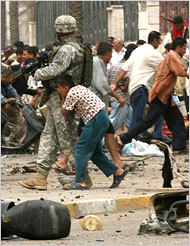
An Iraqi child hides behind a soldier during a bombing in Baghdad


congolese war rages
death in the congo civil war

The Civil War in Congo continues to rage despite elections since 2003.

statistics of iraqi civilian deaths


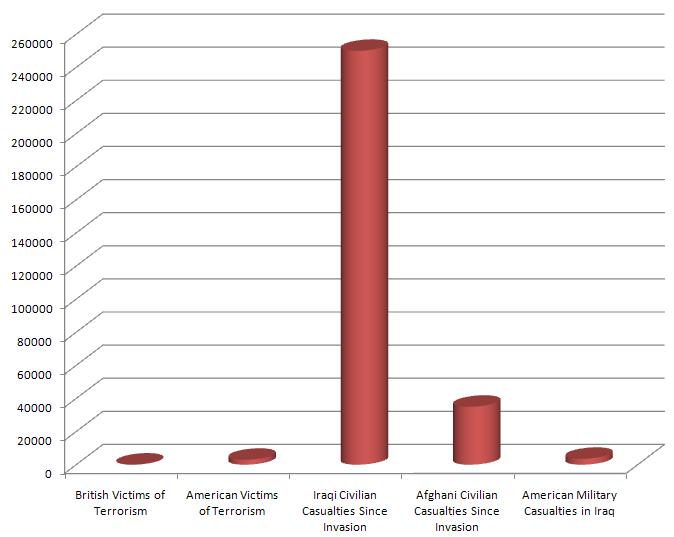
Every 9.62 days, there is an equivalent amount of casualties in Iraq & Afghanistan as September 11th.

slide18.jpg
021215_nablus_schoolgirl.jpg


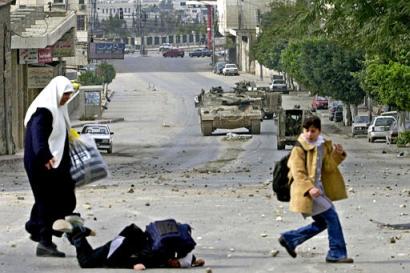
Pictures of the Israeli military Occupation in the Palestinian territories


african americans in congress
latin americans in congress


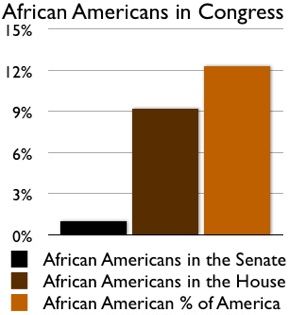
Underrepresentation of Minorities in the US Government

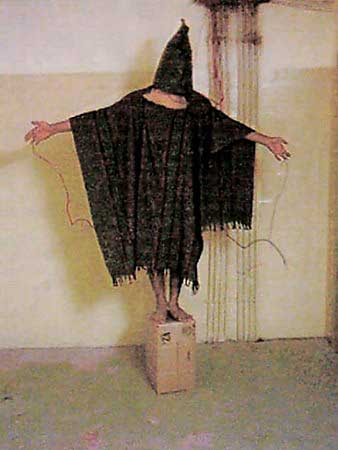
abu ghraib prison abuse


Abu Ghraib Prison Abuse

Rwandan Genocide
rwandan genocide


The Rwandan Genocide, after multi-party parliamentary elections, Hutu extremists murdered almost a million Tutsi's with machetes and small arms as the international community looked on.


Originally on PBH.

MAXED OUT (Going for broke!)

At stake in Sudan

A rare chance for Darfur. The global consequences could hardly be greater...

Tuesday

Augustus Bush

WARNING! Very disturbing... WARNING!


While democratic government is better than dictatorships and theocracies, it has its pitfalls. FSM Contributing Editor Philip Atkinson describes some of the difficulties facing President Bush today.


Conquering the Drawbacks of Democracy
By Philip Atkinson

President George W. Bush is the 43rd President of the United States. He was sworn in for a second term on January 20, 2005 after being chosen by the majority of citizens in America to be president.

Yet in 2007 he is generally despised, with many citizens of Western civilization expressing contempt for his person and his policies, sentiments which now abound on the Internet. This rage at President Bush is an inevitable result of the system of government demanded by the people, which is Democracy.

The inadequacy of Democracy, rule by the majority, is undeniable – for it demands adopting ideas because they are popular, rather than because they are wise. This means that any man chosen to act as an agent of the people is placed in an invidious position: if he commits folly because it is popular, then he will be held responsible for the inevitable result. If he refuses to commit folly, then he will be detested by most citizens because he is frustrating their demands.

When faced with the possible threat that the Iraqis might be amassing terrible weapons that could be used to slay millions of citizens of Western Civilization, President Bush took the only action prudence demanded and the electorate allowed: he conquered Iraq with an army.

This dangerous and expensive act did destroy the Iraqi regime, but left an American army without any clear purpose in a hostile country and subject to attack. If the Army merely returns to its home, then the threat it ended would simply return.

The wisest course would have been for President Bush to use his nuclear weapons to slaughter Iraqis until they complied with his demands, or until they were all dead. Then there would be little risk or expense and no American army would be left exposed. But if he did this, his cowardly electorate would have instantly ended his term of office, if not his freedom or his life.

The simple truth that modern weapons now mean a nation must practice genocide or commit suicide. Israel provides the perfect example. If the Israelis do not raze Iran, the Iranians will fulfill their boast and wipe Israel off the face of the earth. Yet Israel is not popular, and so is denied permission to defend itself. In the same vein, President Bush cannot do what is necessary for the survival of Americans. He cannot use the nation's powerful weapons. All he can do is try and discover a result that will be popular with Americans.

As there appears to be no sensible result of the invasion of Iraq that will be popular with his countrymen other than retreat, President Bush is reviled; he has become another victim of Democracy.

By elevating popular fancy over truth, Democracy is clearly an enemy of not just truth, but duty and justice, which makes it the worst form of government. President Bush must overcome not just the situation in Iraq, but democratic government.

However, President Bush has a valuable historical example that he could choose to follow.

When the ancient Roman general Julius Caesar was struggling to conquer ancient Gaul, he not only had to defeat the Gauls, but he also had to defeat his political enemies in Rome who would destroy him the moment his tenure as consul (president) ended.

Caesar pacified Gaul by mass slaughter; he then used his successful army to crush all political opposition at home and establish himself as permanent ruler of ancient Rome. This brilliant action not only ended the personal threat to Caesar, but ended the civil chaos that was threatening anarchy in ancient Rome – thus marking the start of the ancient Roman Empire that gave peace and prosperity to the known world.

If President Bush copied Julius Caesar by ordering his army to empty Iraq of Arabs and repopulate the country with Americans, he would achieve immediate results: popularity with his military; enrichment of America by converting an Arabian Iraq into an American Iraq (therefore turning it from a liability to an asset); and boost American prestiege while terrifying American enemies.

He could then follow Caesar's example and use his newfound popularity with the military to wield military power to become the first permanent president of America, and end the civil chaos caused by the continually squabbling Congress and the out-of-control Supreme Court.

President Bush can fail in his duty to himself, his country, and his God, by becoming “ex-president” Bush or he can become “President-for-Life” Bush: the conqueror of Iraq, who brings sense to the Congress and sanity to the Supreme Court. Then who would be able to stop Bush from emulating Augustus Caesar and becoming ruler of the world? For only an America united under one ruler has the power to save humanity from the threat of a new Dark Age wrought by terrorists armed with nuclear weapons.


Big thanks to Hullabaloo for the transcript.

Wednesday

How the Democrats paid dearly for doing what was right while the GOP profited from evil

Richard Nixon is as well known for his Southern Strategy as he is
for Watergate, the secret bombing of Cambodia, and the burglary of
Democratic Headquarters at Watergate. Nixon's Southern Strategy turned
a solid Democratic South into GOP occupied territory. It was not,
however, a simple appeal to bigotry that did it. It required the
Democrats do what was right while Nixon strategists plotted what was
wrong. They succeeded. GOP appeals to hatred and prejudice are
well-practiced by now.

Nevertheless, I am less appalled than surprised to find in the US a level of hatefulness that we dared hope had been laid to rest in the battlefields of the Civil War. In Monroe,
LA, for example, I found in the only large bookstore in town, a huge
section devoted to various Civil War books, most of which dealt with
how the South had been betrayed. Across town, just a stone's throw by
big city standards is the Civil War Cemetary, a more sobering reminder
of tragedy. Farther afield, down the road is Vicksburg, MS

where the forces of U. S. Grant had approached from the Mississippi River from Memphis only to learn that Vicksburg could never be taken by a direct assault. Grant's Vickburg seige came to symbolize the
ideological stand-off as well. Having grown up in the far reaches of Commanche country, I was not prepared to learn that, in the South, to this day, there is still found a lingering resentment that can only be felt by those who are occupied by a foreign power.

It was among the disaffected descendants of the Civil War south that the GOP found
manna, a strategy often falsely attributed to Kevin Phillips who was nevetheless its most articulate voice.

From now on, the Republicans are never going to get more than 10 to 20 percent of
the Negro vote and they don't need any more than that... but Republicans would be shortsighted if they weakened enforcement of the Voting Rights Act. The more Negroes who register as Democrats in the South, the sooner the Negrophobe whites will quit the Democrats and become Republicans. That's where the votes are. Without that prodding from the blacks, the whites will backslide into their old comfortable arrangement with the local Democrats. --Kevin Phillips
It must be remembered that this "Negro vote" had been the GOP's to lose. They were, after all, the party of Lincoln. To be fair to the South, it was the "Radical Republicans" --not Lincoln --who had imposed the harsh reconstruction that turned the South into occupied territory faring
little better than Iraq. The era of "reconstruction" is best known for the terrorist organization it spawned: the Ku Klux Klan.

It would be a mistake to ascribe to the North some mythical moral superiority although it is true that the economies of 11 states making up the Confederacy were dependent upon slavery to produce and harvest the crops, most famously, cotton. Slavery, to be sure, was illegal in the north but only a handful actively opposed it. Martin Scorsese probably got it right; Lincoln was probably as despised in New York as he had been in the deep south.

Not every division in America is traced directly to the civil war, though you will find, to this day,
many who will defend the institution of slavery. Others still resent
the harsh reconstruction. It was Nixon's evil genius that his campaign was able to overcome the natural resentment of his party's role in "reconstructing" the South. That the Democrats would pay dearly for having done the right thing may explain the party's timidity today.
Democrats have historically paid high prices for being or doing right. LBJ famously said that he was, in fact, forever ceding the South to the GOP.

A long story is, of necessity made short. The legacy of Nixon is that the GOP was able to benefit from George Wallace's politics of hate as well as from LBJ's signature on the Voting Rights
Act. How Nixon perfected the cynical, cold-blooded politics of division and prejudice is the story of how the the GOP would find votes wherever there was resentment or prejudice. The GOP would foment distrust when our various peoples might have put the Civil War behind them and moved forward. The GOP would wage war on labor as well as "the nattering
nabobs of negativity", Spiro Agnew's code word for academics and free thinkers.

The Civil War looms like a ghost upon the body politic. It was only a few years ago that, in Jaspar, Texas bigots dragged a black man at high speeds over back country roads until very
nearly nothing was left of his body. A bit longer ago, the lynchings and public burnings of black people was not merely tolerated, they were celebrated like county fairs. Photographs of the events were mailed as post cards. It made of civic murder a macabre celebration, literally, a
barbecue.

American History is of two chapters --pre Civil War and post Civil war. American History cannot be understood without understanding the economics of the Antebellum South and the institution of slavery upon which it depended. The "rise of the South" cannot be understood without understanding how the south that hated Lincoln became Nixon's "Solid South". It is one of the great ironies of convoluted history that as the GOP represents a threat to our freedom, our future as a nation cannot be ensured unless we, at last, effect the words of a Republican.

It is rather for us to be here dedicated to the great task remaining before us -- that from these honored dead we take increased devotion to that cause for which they
gave the last full measure of devotion -- that we here highly resolve that these dead shall not have died in vain -- that this nation, under God, shall have a new birth of freedom -- and that government of the people, by the people, for the people, shall not perish from the earth.

--Abraham Lincoln, Gettysburg, Pennsylvania, November 19, 1863

I fell in love with Ashokan Farewell during Ken Burns' famous "Civil War" series on PBS. Hearing Jay Unger's story of its creation helps me appreciate it the more. I like his description of it as a "Scottish Lament".

Ken Burns was wise to allow this piece to set the mood for what has been --until now --America's most profound tragedy --the loss, perhaps forever, of our freedoms. And, again, as then, that tragic loss has come not from abroad but from the cancer within.


Via the Existentialist Cowboy

Why Doth Man So Slowly...

(A Poetic Justice Photomontage)

Monday

Civilization: Amid Old Triumphs,
New Threats from Fascism

Bertrand Russell, in his
Wisdom of the West, put forward a simple thesis. Western Civilization is essentially Greek civilization.

There is no civilization but the Greek in which a philosophic movement goes
hand in hand with a scientific tradition. It is this that gives the Greek enterprise its peculiar scope; it is this dual tradition that has
shaped the civilization of the west.

--Bertrand Russell, Wisdom of the West
In support of his thesis, Russell points to the authoritarian,
theocratic natures of earlier civilizations --Egypt and Babylonia.
Religion, Russell stated, seems inconsistent with the Greek spirit of
free inquiry typified most famously by Socrates and the Platonic
tradition that followed. It is because Greek civilization was primarily
secular, Russell believed, that the spirit of "free inquiry" took root
in the west. This spirit, he believed, was incompatible with both
authoritarianism and religion itself.

A Renaissance of Western Civilization was associated with the pre-eminence of Lorenzo Di Medici in Florence and specifically his support of a new Plato Academy. Eminent scholars -Marsilio Ficino, Cristoforo Landino, Angelo Poliziano and Demetrios Chalkondyles depicted (above) in Domenico Ghirlandaio's fresco, Zaccaria in the Temple -refocused European attention on the Greek classics and inspired a renewed interest in learning. The plights of Giordano Bruno and Galileo make clear the fact that despite the Greek revival an Eastern religion, Christianity, was, in fact, at odds with the secular nature of inquiry and learning.

But to point that out gets ahead of the story, a story told by Lord Kenneth Clark in his famous Civilization series for the BBC and, most recently, by Thomas Cahill who authored a short but influential book entitled How the Irish Saved Civilization

Although we associate our Western civilization with "the new learning", it was
Scholasticism, kept alive throughout the Dark Ages by clerics, that
survived well into the Rennaisance. Russell points out that throughout
the 7th through the 9th Centuries, Europe witnessed a Papacy walking
the treacherous, narrow line between warring barbarians on the
frontiers and Eastern Emperors who had inherited the trappings of the
Roman Empire -bureaucracy, a rule of law, various standards of
civilization. The barbarians, by contrast, ruled by force. Byzantium
was at least civilized and would, in fact, survive the Middle Ages,
described by William Manchester as A World Lit Only by Fire.

If civilization is best described as a thin veneer over the otherwise rude necessitudes of sheer survival, it fell to clerics to keep alive the more ephemeral ideals -literacy, the rule of law, the faith itself. That story, of course, began well before the 7th century, well before
the fall of Rome itself.

It must surely be one of the great ironies of history that the task of saving civilization may have fallen to the monks of
Skellig Michael, a steep rocky crag of an island west of the coast of County Kerry, literally, the cold, dank remote reaches of Ireland.

Never immune from barbarian raids, Ireland's remoteness may have made it the
standard bearer of civilization. In one of two surviving documents attributed to Patricius, otherwise known to history as St. Patrick, an interesting tale is told. A young Patricius, having been kidnapped by "wild Irish pirates" at the tender age of 15 years, escaped his
captivity in County Mayo.
In his "Confession", St. Patrick tells of sailing to Europe with a band
of trader/pirates. On the continent, this unlikely band encountered
scenes of desolation, abandoned villages, ruined farms, a worrisome
lack of food.
And after three days we reached land, and for twenty-eight days journeyed through uninhabited country, and the food ran out and hunger overtook them; and one day the steersman began saying: 'Why is it, Christian? You say your God is great and
all-powerful; then why can you not pray for us? For we may perish of hunger; it is unlikely indeed that we shall ever see another human being.' In fact, I said to them, confidently: 'Be converted by faith with all your heart to my Lord God, because nothing is impossible for him, so that today he will send food for you on your road, until you be sated, because everywhere he abounds.' And with God's help this came to pass; and behold, a herd of swine appeared on the road before our eyes,
and they slew many of them, and remained there for two nights, and the were full of their meat and well restored, for many of them had fainted and would otherwise have been left half-dead by the wayside.

-The "Confessio" of St. Patrick
If ever there was a time for prayer this was it. The faithful will believe that Patricius's prayer worked.

It is easy to conclude that Patricius and his erstwhile friends had encountered the very twilight of empire, the devastation left in the wake of retreating legions. This is arguably the most concrete picture we have of Europe at that time. It's a picture of European civilization
surviving "...by the skin of our teeth", clinging desperately to life like the lichens on the barren rocks of Skellig Michael itself.

This is a notion not easily dismissed and too easily romanticized. After all, we are left the
Book of Kells
, produced by Celtic monks around AD 800. This work is a testament to the
stubborn human impulse to rage at seemingly inexorable forces of chaos, decay, and oblivion. Even atheists must recognize the achievements of quiet, impoverished clerics and scholars over a period of several hundred years. But for their efforts, civilization might simply have faded into a highland mist like so many tales of Avalon.

Is it accurate to give so much credit to Ireland? In his book, How the Irish Saved Civilization,
Cahill concedes that Greek literature and the Hebrew and Greek Bibles survived independently elsewhere. "Latin literature would almost surely have been lost without the Irish," he concludes. But, he speculates, "...the national literatures of Europe might not have emerged had the
Irish not forged the first great vernacular literature of Europe."

By the time of the Renaissance, however, it fell to the secular minds of
men like Leonardo da Vinci and Galileo to advance the spirit of inquiry. A broader view is taken by Russell who saw a broad departure from ancient priesthoods originating in Greece and taking shape over centuries of European history. He also saw the persistent threat of
anti-democratic authoritarianism which would be associated in his time with fascism and Nazism:
"There is over a large part of the earth's surface something not unlike a reversion to the ancient Egyptian system of divine kingship, controlled by a new priestly caste. Although this tendency has not gone so far in the West as it has in the east, it has, nevertheless, gone to lengths which would have astonished the eighteenth and nineteenth centuries both in England and in America. Individual initiative is hemmed in either by the state or by powerful corporations, and there is a great danger lest this should produce, as in ancient Rome, a kind of listlessness and fatalism that is disastrous to vigorous life. I am constantly receiving letters saying: 'I see that the world is in a bad state, but what can one humble person do?
Life and property are at the mercy of a few individuals who have the decision as to peace or war. Economic activities on any large scale are determined by those who govern either the state or the large corporations. Even where there is nominally democracy, the part which one citizen can obtain in controlling policy is usually infinitesimal. Is it not perhaps better in such circumstances to forget public affairs and get as much enjoyment by the way as the times permit?' I find such letters very difficult to answer, and I am sure that the state of mind which leads to their being written is very inimical to a healthy social life. As a result of mere size, government becomes increasingly remote from the governed and tends, even in a democracy, to have an independent life of its own. I do not profess to know how to cure this evil completely, but I think it is very important to recognize its existence and to search for ways of diminishing its magnitude."

-Bertrand Russell, Authority and the Individual, p. 18-19:


Have we come all this way only to lose civilization to a new and corporate dark age?

Sunday

Replacing the Empire Culture:
A Podcast Interview With Author David Korten

The topic below was originally posted in my blog the Intrepid Liberal Journal as well as Worldwide Sawdust and Independent Bloggers Alliance.
“There is a culture war in America, but it is not between liberals and conservatives, who in fact share a great many core values – including a commitment to children, family, community, personal responsibility and democracy. It is between the lower and higher orders of our human nature. It is between an imperial politics of individual greed and power and a democratic politics based on principle and the common good. It is between Power Seekers at the extreme political fringes who remain imprisoned in an Imperial Consciousness and the realists of the political mainstream who truly want to solve the problems that beset us all.”
David Korten wrote those provocative words in his book, The Great Turning: From Empire to Earth Community published last year by Berrett-Kohler.


Korten worked for more than thirty-five years in preeminent business, academic, and international development institutions. He eventually turned away from the establishment and instead worked with public interest citizen action groups. He is the co-founder and board chair of the Positive Futures Network and Yes! A Journal of Positive Futures, an associate of the International Forum on Globalization and a member of the Club of Rome. He serves on the boards of the Business Alliance for Local Living Economics and the Bainbridge Graduate Institute.

In his early career, Korten set up business schools in low-income countries starting with Ethiopia, hoping to help establish a new class of professional business entrepreneurs would be the key to ending global poverty. He also completed his military service stateside during the Vietnam War as a captain in the U.S. Air Force, with duty at the Special Air Warfare School, Air Force headquarters command, the Office of the Secretary of Defense and the Advanced Research Projects Agency.

Following his service in the military, Korten was a faculty member of the Harvard University Graduate School of Business where he taught in Harvard’s middle management, M.B.A. and doctoral programs. Korten also served as Harvard’s adviser to the Central American Management Institute in Nicaragua and later joined the staff of the Harvard Institute for International Development, where he headed a Ford Foundation funded project to strengthen the organization and management of national family planning programs.

When Korten left academia in 1970 he moved to Southeast Asia where he lived for almost fifteen years, serving as a Ford Foundation project specialist and later as Asia regional advisor on development management in the U.S. Agency for International Development (USAID). His work there earned Korten international recognition for helping to engineer the development of intervention strategies for transforming public bureaucracies into responsive support systems dedicated to strengthening community control and management of land, water and forestry resources.

Korten ultimately broke with the international aid system when he became convinced they were actually increasing poverty and environmental destruction and impervious to change. During the last five years of Korten’s work in Asia he coordinated with leaders of Asian nongovernmental organizations on identifying the root causes of development failure in the region and building the capacity of civil society organizations to better facilitate positive global level change.

Korten’s life experience abroad convinced him that the United States was actively promoting both at home and abroad – the very policies responsible for, inequality, environmental devastation and social disintegration. At that point a friend advised Korten he would best serve the cause of ending global poverty by returning to the United States and educating his fellow Americans about the destructive role of corporate imperialism. Hence, Korten returned to the United States in 1992 to share with his fellow Americans the lessons he had learned abroad.

Ironically, Korten’s original motivation for international travel as a college senior in 1959 was to persuade the world’s poor to reject revolution in favor of America’s political and economic system. Instead, as he writes, Korten found himself learning far more from the people he hoped to teach:
“The subsequent experience of working for some thirty years as a member of the international development establishment profoundly changed my worldview. I had gone abroad to teach. Far more consequential than what I taught was what I learned – about myself, my country, and the human tragedy of unrealized possibility. Ultimately, I realized I must return to the land of my birth to share with my people the lessons of my encounter with the world.”
In 1995 Korten published an international bestseller, When Corporations Rule the World and followed that up with The Post Corporate World: Life After Capitalism several years later. Korten agreed to a podcast interview with me about his current book, life experience and worldview. Please refer to the media player below. The interview is approximately fifty-six minutes.


This interview can also be accessed at no cost via the Itunes store by searching for Intrepid Liberal Journal.

Saturday

How the Ship of State Became the Ship of Fools

Via The Existentialist Cowboy


The US has caught a nasty virus the symptom of which is running punditry. It's like cruise ship diarrhea without the satisfaction at the end of ordeal or even panic. Some quick notes: Barack Obama is the most shallow, non-descript, boring politician to ever come down the pike --an intellectual lightweight whose soul has been coached out of him by media consultants. In Barack Obama, I find the vacuous echoes of Ronald Reagan, a previous lightweight who had mastered the art of reading buzzwords off a cue card. My skin crawls.

I have stopped listening to what passes for debate these days. It's become a matter of stringing meaningless platitudes together such that they sound like real human speech. Or is it a Japanese robot?

More quick notes: I wish John Edwards were uglier. Hillary Clinton is damaged goods. Ron Paul, still a Republican, has many more scales to shed before he can change his repitil..uh...Republican skin.

God help us --the only intelligent politician in the field is Dennis Kucinich who has only a snow ball's chance in hell of ever becoming President. It's our loss. Watching Democrats is akin to medieval debate about how many angels can dance on the head of a pin.

I am sick to death of tedious debates about the conduct of the war of aggression against the people of Iraq. The "conduct" of the war is not the issue. Why we continue to stay is! Why we haven't impeached, tried, removed and imprison George W. Bush is! Why a grand jury has not been convened to investigate the GOP crime syndicate is! Why corporations rule the US government is! The validity of the electoral process is! Why bother going through the motions until paper trails are mandated at the polls?

I am sick to death of Congress kowtowing to a President who has the support of little more than 25 percent of the American people. Carl Jung predicted our malaise in 1957 in his "The Undiscovered Self", decrying "...apocalyptic images of universal destruction" brought on by WWII and an atomic age ushered in when the United States dropped weapons of mass destruction on two cities in Japan. In its wake, Jung was fearful that 40 percent of the population —called a "mentally stable stratum" —might not be able to keep the lid on mass psychosis; it might be unable to restrain the spread of "dangerous tendencies", presumably: fascism, fanaticism, militarism, and intolerance. Jung seems to have been less concerned with external threats. The more dangerous tendencies he feared were home grown. There are some real issues to be addressed but all have taken a back seat to punditry.
The theme of collapse seems to have reverberated around the world, now manifesting its symptoms in the scientific community's latest dramatic reports on global warming, the issue of Peak Oil coming further out of the closet — being discussed openly in mainstream media, and the bursting of the US housing bubble that now finds 1 out of every 264 homes in the nation facing foreclosure as each day the value of the dollar decreases and the value of precious metals soars.

--The Cycle of Time

In the meantime, Democrats have failed to challenge Bush's exploitation of the ultimate strawman: terrorism. Bush owns the issue of "terrorism" even if he had to make it all up. As long as Democrats buy into the paradigm, they have no place from which to launch a counter-attack. Democrats too easily conferred legitimacy upon an illegitimate usurper, credibility when, in fact, Bush lied about everything. They are now paying the price for having played Bush's game. The spectre of terrorism has been of greater benefit to Bush than "real" terrorists who share with O.J.'s "real killers" all the characteristics of a phantom menace.

Political rhetoric is just more of the same when, in fact, nothing is the same. How could the Democrats have missed the sea change that has taken place, the fundamental challenges to Constitutional government? What are the implications? Simply, the Bush junta has challenged not only the Constitution but almost 1,000 years of progress. Principles mouthed by Bush simply fly in the face of the Magna Carta, the English Petition of Right, the Mayflower Compact, The Virginia Declaration of Rights, The Declaration of Independence, The Constitution and the Bill of Rights, The Nuremberg Principles, and every US Supreme Court decision that has upheld the right of persons to be free of arbitary rule, to be secure in their homes, to be free of unreasonable arrest in the absence of probable cause that a crime has been committed.

Significantly, totalitarian states have their philosophical roots in Hegelianism, a straight road to both Nazism and Stalinism. There is, by contrast, another road that runs straight from Magna Carta to our own Declaration of Independence, Constitution, and Bill of Rights.

If the Magna Carta is not the birth certificate of Democracy, it is the death certificate of despotism. It spells out for the first time the fundamental principle that the law is not simply the whim of the king. The law is an independent power unto itself. And the King could be brought to book for violating it!"

—Simon Schama, History of Britain

Bush's demogoguery is an issue and the Democrats should be on the offensive. Instead, most members of Congress lined up behind what Gore Vidal called an "un-American" administration.

Instead of bullshit and platitudes from Obama --nonsense talk about attacking Pakistan, Barack should have been screaming about America's enemies inside the White House --George W. Bush and his every supporter. Do the Democrats get it? Have they not understood what Bush has done? Is Congress without a clue?

The Constitution itself is explicit when it establishes the sovereignty of the people. But, if that were not enough to dispel notions of the "state as absolute", a Bill of Rights was insisted upon and ratified by the people. In the 1960's Supreme Court Justice William O. Douglas believed that the freedoms guaranteed by the Bill of Rights are absolute —beyond the power of Congress or the executive to modify or infringe in any way. We could use someone like Douglas today. As his friend Tommy Corcoran pointed out, Douglas had "wanted the Presidency worse than Don Quixote wanted Dulcinea" and Franklin Roosevelt believed that Douglas would have been the strongest running mate in 1944. It was Democratic bosses who persuaded Roosevelt to pick Harry Truman instead. Oh well! "To err is Truman!"

Democratic "opposition" to Bush seems less naive than irrelevant, locked into the GOP paradigm when Democrats should be forcing a defensive GOP to debate on Democratic turf, on Democratic issues, indeed, the very future of Democracy in America. Tragically, the Democrats will get suckered into debating the "conduct" of a war that should never have begun, a war that is itself a crime, a war that has, in fact, no good end, a war that is, in fact, lost!

Democrats are in danger of blowing the last chance they will ever have to forge a new and better future. It's become a cliche that the Chinese character for "crisis", literally translated, means "dangerous opportunity". If the Democrats fail to make the most of this opportunity, the people of the US will be no better off, nothing will have been gained for the ordeal we have suffered, nothing true, lasting or valid will have been affirmed. What a waste if this should all turn out to be the most irrelevant presidential debate in this nation's history!

Friday

WHA’ HAPPENED? (here are our Democrats)


If there can be something worse in politics than having no power, it would be to have power, but no clue about what to do with it. Chipping away at the Bush administration via subpoenas and committee hearings is starting to feel like working through endless sheets of bubble-wrap one pop at a time. They’ve insulated themselves with enough inexperienced hacks to last forever it seems. Around the time when Democrats in Congress wise up to the fact that this was part of the design all along - to stock up on sacrificial lambs for the specific purpose of protecting the real players once the testimony started flying - it could be too late. For them and for the American people who lost their taste for these appetizers long ago.


The strategy seems to have been decided on prior to the opening of this session, and in that sense it’s not all that different from the neoconservatives who took office looking to take out Saddam. Much like how 9/11 was said to have “changed everything”, when internally it changed nothing, a USA Today poll that came out this week showing that the portion of Americans who think the surge is “making the situation better” jumped up to 31% from last month’s 22%, and those who say the surge is “not making much difference” dropped to 41% from 51% a month ago.


There’s barely 2 hours of water and electricity per day in 125 degree Baghdad, the initial focal point of the surge. We hear a lot about Anbar and other places, but the strategy was to make it work in Baghdad first and foremost. President Bush even went so far as to reveal the locations of our cooperative police stations in front of an audience, the visual projected up for everyone to see. This strategy was genius and it was led by a genius named Patraeus, who is following the trend himself, having understood that “things are getting better and we’re making good progress” before he even arrived in theatre.


This much you can count on, that while Baghdad is dying of thirst, his schedule is packed solid with trial runs of what he’s going to say in front of Congress, all practiced over right-wing talk radio. McCain, Graham, Lieberman and the Dixie Sound Machine have the general ranked somewhere directly below Zeus, as the days leading up to his testimony will absolutely be an exercise in rewriting the Constitution so that the military alone will make all relevant judgements regarding war. Just disregard that mention of Congress possessing the sole power to wage war. And while we’re at it, let’s pretend from here on out that there is no such thing as the State Department.


And to hell with the Constitution altogether while we’re at it. The Reid-Pelosi-Hoyer brain trust is in favor of that, aren’t they? Well, anyways, they’ll figure it all out. Whatever happens, as long as we never threaten to impeach President Bush, everything will fall into place. Indeed, the voters clearly wanted Democrats to tread water until 2008 and play the Bush administration’s game.


http://deadissue.com/archives/2007/08/09/wha-happened-here-are-our-democrats/

A Dream of Freedom

By The Existentialist Cowboy


Sometimes a thousand twangling instruments
Will hum about mine ears, and sometime voices
That, if I then had waked after long sleep,
Will make me sleep again: and then, in dreaming,
The clouds methought would open and show riches Ready to drop upon me; that, when I waked,
I cried to dream again.

--William Shakespeare, The Tempest (Caliban), Act 3, Scene 2

George W. Bush enjoys the support of only one American in four, the lowest presidential approval rating in a generation. It is no coincidence that leading Dems beat every major '08 Republican.

What is not clear from the polls is whether or not Americans really get it! Simplistic polls cannot measure the degree to which this "President" has waged war upon the US Constitution and, indeed, every principle that impelled the American separation from England. Have Americans, at last, grasped the subversive nature of this radical, reactionary, rogue administration? If not, Gore Vidal has a reminder.
This is an unpatriotic government. This is a government that deals openly in illegalities, whether it is attacking a country which has done us no harm, two countries--Iraq and Afghanistan--because we now believe, not in declaring war through Congress as the Constitution requires, but through the President. 'Well, I think there are some terrorists over there, and I think we got to bomb them, huh? We'll bomb them.' Now, we've had idiots as presidents before. He's not unique. But he's certainly the most active idiot that we have ever had.

--Gore Vidal

Vidal recently retold a story about the Roman Emperor Tiberius whose reputation Vidal thinks suffers because his history was written by the enemies of his regime, most notably Tacitus.
The Senate of Rome sent him congratulations with the comment, "Any law that you want us to pass, we shall do so automatically." And he sent a message back. He said, "This is outrageous! Suppose I go mad. Suppose I don't know what I'm doing. Suppose I'm dead and somebody is pretending to be me. Never do that! Never accept something like preemptive war," which luckily the Senate did not propose preemptive wars against places they didn't like. But Mr. Bush has done that.

--Ibid

Scholars assure us that when Jesus Christ said "Render unto Caesar", the Caesar he referred to was Tiberius. Americans will remember Tiberius as portrayed by George Baker in the BBC series of I, Claudius of 1976 (Britain) and 1977 (US). The series was based upon Robert Graves' "I, Claudius" and relied heavily on Tacitus. It reinforced the image of Tiberius as a rake, retiring to Capri where he buggered anything that moved and had an orifice. Tacitus himself says this of his own objectivity.
But the successes and reverses of the old Roman people have been recorded by famous historians; and fine intellects were not wanting to describe the times of Augustus, till growing sycophancy scared them away. The histories of Tiberius, Caius, Claudius, and Nero, while they were in power, were falsified through terror, and after their death were written under the irritation of a recent hatred.

--Annals, Tacitus

In defense of Tiberius, Vidal reminds us that Tiberius was, at least, wiser than Bush who more nearly resembles Claudius, considered by his own family to have been an idiot, a stammerer, a failure, a "least consequential twig".
A member of a ruthless and murderous imperial family, he survives because he seems to all around him the least consequential twig of the family tree. But Claudius bears enduring witness to a moment when the virtues of the Roman republic, which has already been disposed of by the time he begins his tale, are being lost to the bloodlusts and hubris of the Roman empire.

--A Review of I, Claudius

While scholars may quibble about the accuracy of Tacitus, the accuracy of Robert Graves, there is Gibbon who described in a comprehensive nine volume history of the Decline and Fall of the Roman Empire. The Roman Empire fell, he claimed, due to "a loss of civic virtue", a lazy citizenry who just didn't get it.

Other reasons for the fall of Rome may be just as credible and equally modern souding. Like the US under Bush, Rome lacked adequate budgetary controls, resources were wasted, defense was outsourced. Like the present day US, Roman rule had become a kind of Ponzi scheme premised on ever newer conquest and plunder. Wealth trickled up, not down. A "Roman dole" never paid its own way and poorer farmers got poorer and lost their lands to a landed elite who often escaped taxation altogether.

Bush has assumed an imperial "Presidency", in fact, a dictatorship. He claims the power and authority to rewrite the laws and interpret the Constitution. He has said that he will deprive Americans of every right affirmed in the Bill of Rights. Bush has said that he alone will define "terrorism" and to make the point, he has flouted American treaty obligations. Unless Bush is checked, unless his corrupt administration is overthrown or otherwise brought down and utterly repudiated, his decrees will stand and Bush will have deprived every citizen will have become a subject of a dictatorial regime, a rogue state that robs its citizens of the rule of law as it bullies the rest of the world with nukes. This simply must not be tolerated. Any American regime effecting such an outcome is, by definition, illegitimate. The people are now and always sovereign.

I despair that my government has abandoned the democratic ideals of millions of Americans who must now bear the shame that Bush has brought upon them. Once a beacon of hope and freedom, the US now stands for atrocity and repression..

American "radicals" might never have posed a threat to an establishment that, at least, mouthed the ideals of our founding. Rather, radicals in America, settled into a role: that of a nagging conscience. Many of us eased into the role of merely making uncomfortable a corrupt establishment that had already begun undoing the work of Washington, Jefferson and Madison.

America was not always the reactionary right wing state that it is today. Throughout our history, American radicals, like latter day Calibans, lurked about the edges of our collective political consciousness. We often hear, like "a thousand twanging instruments" the dream that had been our founders' dream and, later, Martin Luther King's dream.
In a sense we have come to our nation's capital to cash a check. When the architects of our republic wrote the magnificent words of the Constitution and the Declaration of Independence, they were signing a promissory note to which every American was to fall heir. This note was a promise that all men, yes, black men as well as white men, would be guaranteed the unalienable rights of life, liberty, and the pursuit of happiness.
...

When we allow freedom to ring, when we let it ring from every village and every hamlet, from every state and every city, we will be able to speed up that day when all of God's children, black men and white men, Jews and Gentiles, Protestants and Catholics, will be able to join hands and sing in the words of the old Negro spiritual, "Free at last! free at last! thank God Almighty, we are free at last!"


--Martin Luther King, Jr


You know, it's at a time when people say, 'Well, it makes no difference what we do, you know, if we march and we make speeches, and this and that.' It makes a lot of difference if millions of Americans just say, "We are fed up! We don't like you. We don't like what you're doing to the country and what you have done to the country. We don't like to live in a lawless land, where the rule of law has just been bypassed and hacks are appointed to the federal bench, who will carry on and carry on and carry on all of the illegalities which are so desperately needed by our military-industrial corporate masters."

--Vidal, op cit

In waking from a "Caliban's" dream, we find ourselves ruled by the likes of Nixon, Reagan, Bush. When we should be roused to rebellion, we are, like Caliban, tempted merely to re-capture in sleep a sweet dream of freedom, equality and peace. But we must not doze. We must awaken and act!


Visit the original item on The Existentialist Cowboy

Monday

The Misinterpreter-in-Chief

via FindLaw Writ - Recent Articles on Jul 23, 2007


FindLaw columnist and human rights attorney Joanne Mariner discusses an executive order recently issued by President Bush. The order purports to determine that the CIA's system of secret prisons "fully complies" with the U.S.'s Geneva Conventions obligations -- as long as the CIA itself complies with a series of requirements regarding interrogation practices and conditions of confinement. Mariner contends that the order wrongly ignores a key Supreme Court ruling, and is in clear error with respect to international law. She contends that the secret prisons program will continue to plainly violate the U.S.'s Geneva Conventions obligation, despite the executive order's claims. She also criticizes the executive order for purporting to impose a definition of "enemy combatant" even broader than those the Administration used in the past.

Via Len Hart - The Existentialist Cowboy

Sunday

Bush Deliberately Creates "Constructive Chaos"

Posted By Len Hart to The Existentialist Cowboy


Two phrases --"new world order" and "constructive chaos" have in common Yale's not so secret "Skull and Bones" society which nurtures both concepts. Neither phrase is peculiar to the Bushes, though the elder and the lesser Bush pimp both ideas.
New world order, itself a mushy half-baked soupcon of ill-considered ideologies, has been associated with a certain Yale Fraternity known less for its scholarship than its lame-brained kookiness. Constructive chaos
is associated, though not accurately, with Iraq. Iraq is in chaos but its hardly productive. Both Bushes fail their own standard.

The idea of a "New World Order" was not merely reinforced or even acquired in the lesser Bush's Yale days. The lesser Bush grew up the with idea, if "idea" it be. As president, George
H.W. Bush espoused a "New World Order" in 1991, 10 years prior to the events now called "911".

For the record, Bush Sr, of course, did not make his State of the Union address on September 11, 1991. It was made on January 29, 1991.

While nothing said by Bush about Iraq is or has been true at any time, everything dire prediction has come true. Iraq is a scene of endless insurgency, sectarian bloodletting, and urban warfare never planned for by the US military. If the war was intended to end world terrorist, it has, in fact, made it worse. If the attack and invasion was intended to bring Democracy to Iraq, it has, in fact, made of Democracy an unrealizable dream. If Bush had intended merely to up end an evil dictatorship, he merely replaced it with his own. If Bush seeks simple revenge against terrorists, he need only give himself up to international authorities. It may have been, as I recall, Le Monde Diplomatique, which wrote:
Les Etats-Unis sont le plus grand terroriste au monde.

According to Watching America, the US occupation has made of Iraq, an Iraqi barrel.

A barrel is a cylindrical metal or wooden container that is now more a part of the lives of Iraqis than ever before, and strikingly so, since the American-British occupation of Iraq. Many observers calculate that the humble barrel is a prerequisite for the kind of democracy exported by Uncle Sam's country, since this greater-ubiquity of the barrel has coincided with Iraqi democracy as we know it today. The barrel has become an indispensable commodity that no Iraqi building, office, or installation, official or unofficial, can do without.

American strategic planners have benefited from this idea, for they have made a barrel out of Iraq: the Americans have put terrorist and criminal gangs from around the world inside it, and thrown its borders open to create a fertile breeding ground for terrorism and crime. After letting nature take its course, what's inside the Iraqi barrel can then be distributed elsewhere in the region to implement America's plan for democracy. This is being done under the strange, contradictory rubric of "constructive chaos," a phrase used in the Western press to justify the massacres and blood baths that have characterized Iraq during the American-British occupation.

--Washington's 'Iraqi Barrel Plan'

But in fact, "constructive chaos" most certainly had it's origins inside the Skull and Bones.
...the Order was first established on the Yale campus in 1832. It was officially incorporated only in 1856 under the name Russell Trust Association. According to virtually all the available biographical data on its early members, the money required to sustain the secret order's campus affairs and its broader role in placing its members into key positions of influence upon their graduation from Yale, derived from the opium trade in the Far East. That trade was set up by the British East India Company and was flourishing by the time the Treaty of Paris was signed in 1783 ending the American War for Independence.

--George Bush, Skull & Bones and the New World Order: A New American View International Edition White Paper
, Paul Goldstein and Jeffrey Steinberg, April 1991

"Constructive chaos" is a strategy by which bonesmen and pnacks (for PNAC) seek to impose the new world order. The plan is inherently undemocratic, repugnant to every principle upon which the US was founded. For a start, the establishment of a "new world order" defines any opposition as "terrorist" in nature. Thus, otherwise peaceful civilians are criminalized and waged war upon. War, then, becomes a self-fullfilling prophecy, a logic loop from which there is no escape save violence. The facts bear this out. Bush, like Ronald Reagan before him, has made terrorism much, much worse. The verifiable facts support me and I renew my challenge to my critics at the Heritage Foundation to debate me on this issue. [See:

Secondly, even if the people of the US were prepared to wink and nod at Bush's various atrocities, pervisions and war crimes, there is absolutely no evidence whatsoever that the so-called "constructive" chaos in Iraq has been benefitical in any way even by Bush's utterly depraved moral standards.

The world has not benefited from the fall of the Soviet Union for several reasons. Foremost, the GOP, having rallied a based around a banner of anti-communism found itself without a demon to exploit. At the time, I celebrated the destruction of the Berline Wall and dared hope for a new era of peace. Neocons, however, were, no doubt, already at work on ways to bring about a "catalyzing event" not unlike Pearl Harbor that would unite Americans behind a new crusade for Middle Eastern oil.

Secondly, in the absence of a "Soviet threat", the nation had to find new justification for the trillions spent arming the nation to the teeth. Ronald Reagan, after all, had crushed the labor movement, double the Federal Bureaucracy, and paid off his base with historically high tax cuts benefiting only the very, very wealthy and making them more so. The industrial base was hallowed out. Highly paid skilled labor had to find work behind a a counter at Wal-Mart at a fraction of the pay and prestige. Mired in debt, the GOP plan was to create a new and bigger Military/Industrial complex and thus mire the nation in perpetual oil wars.

Posted By Len Hart to
The Existentialist Cowboy
at 8/05/2007 03:43:00 AM

LinkWithin

Related Posts with Thumbnails