Tuesday
tuesday post for peace


Monday
CLEAN ENERGY
We have the technology.
We know people want it.
We just haven't had the political will.
But Congress is voting this week on H.R. 969, a bill that will dramatically boost solar and wind energy. If it passes, it'll be like taking 37 million cars off the road.1 Along with the rest of the energy package, it'll be the biggest step in two decades toward a clean planet and affordable energy.
Big oil and coal are fighting the bill hard, because it would undercut their stranglehold on our economy. That's why Congress needs to hear from the public that clean energy is a priority. So, today we're launching a petition:
"Congress must act now to move our country toward a clean energy economy based on solar and wind power by voting yes on H.R. 969, the Federal Renewable Energy Standards Act."
Can you sign this petition today?
Clicking here will add your name:
http://pol.moveon.org/cleanenergyfuture/o.pl?&id=10885-5185068-GVGHVf&t=3
Sunday
WAR RACKET
Bush had hoped to pull off a quick victory cheap. But nothing worked out as hoped or planned. The American people are stuck with the tab, paying for the war with high hidden taxes, higher prices and American lives. The cost of Bush's war crime has tripled since Bush declared the end of major combat operations. The American people are not safer for having sacrificed the lives of loved ones. The war on terrorism is either a criminal fraud or a miserable failure and I challenge my critics at the Heritage Foundation to debate me on that issue.
War is a racket fought by the masses for privileged elites, big corporations,
 and venal politcians like Bush. Bush's quagmire is fought for the benefit of no-bid contractors like Halliburton and Blackwater and financed by America's working poor and middle classes who pay for the war —with their lives abroad and with their jobs, their retirement prospects, and their access to health care at home. Bush's base —the nation's elite, his corporate sponsors, and the so-called defense industry —have paid
nothing, risked nothing! Rather —they feed at the trough. The upper one percent of the population has gotten several tax cuts while the big oil companies report record profits rising concurrently with higher prices at the pump.
Just two days after 9/11, I learned from Congressional staffers that Republicans on Capitol Hill were already exploiting the atrocity, trying to use it to push through tax cuts for corporations and the wealthy. ... We now know that from the very beginning, the Bush administration and its allies in Congress saw the terrorist threat not as a problem to be solved, but as aThere are big progits in the death business. Go to Texas and ask the CEO at DynCorp.
political opportunity to be exploited. The story of the latest terror plot makes the administration's fecklessness and cynicism on terrorism clearer than ever.—
Hoping for Fear, by Paul Krugman, Using Fear Commentary, NY Times
The war in Iraq has boosted DynCorp's revenues, responsible for about $400 million of the company's nearly $2 billion in sales. And while the company didn't specify how much the effort has added to profits, there has certainly been an upside, Lagana said, although he added that profit margins are lower than in other private industry -- often below 10 percent.Over the longer term, however, the effects of Bush's war against the people of Iraq war is only temporary, benefiting the entire economy only for a short period of time, the period of time in which the pump is primed. On the whole, the effect is minimal. Average Americans have not benefited from mass murder, torture, and other atrocities done by the "state" upon a pack of malicious lies. As
For government contractors and other US-based businesses that are doing work in Iraq, the war there has continued to provide opportunity and benefits, although experts and companies alike say they are difficult to quantify. To be sure, security businesses, oil producers and defense contractors are among the biggest winners. Those who manufacture key products, from bulletproof vests to bullets themselves, and, more recently, those involved in reconstruction, have reaped the benefits, too.
Economic Policy Institute economist Jared Bernstein noted, whatever economic stimulus war might have provided becomes increasingly less significant over time. Defense spending had a big effect on job growth in 2004, but its effect since that time is relatively small. Wealth, however ill-gotten does not trickle down.
The number of US troops in Iraq, put at 145,000, does not include more than 126,000 private contractors. Author Jeremy Schahill calls it "the world's most powerful mercenary army." But that is polite. They are, in fact, hired hit men financed, enabled and paid by the people of the United States whether they want to or not. Under Bush, US taxpayers no longer has a say in how their money is spent.
Scahill and filmmaker Robert Greenwald have told the House Appropriations defense subcommittee that these so-called "contract workers", these hired killers murder with impunity and undermine the better efforts of US command and control.
...contract workers have been involved in — but not punished for — numerous scandals during the Iraq war, the pair claimed.One of the more insidious falsehoods about Iraq has turned out to have been Bushco estimates of its cost. In 2002, George W. Bush himself predicted the war would cost between $100 billion and $200 billion —tops! To be expected —Bush was dead wrong. A report by the Democratic staff of the House Budget Committee now estimates that Bush's war of aggression in Iraq could cost the US $646 billion by 2015 —depending on the scope and duration of operations. Nobel prize winning economist,
These contractors were among the interrogators and translators who tortured prisoners at Abu Ghraib prison, Greenwald said.
In one short period, senior military personnel documented 12 instances in which contract workers shot at Iraqi civilians, killing six, Scahill said, but no contractors were charged with crimes.
Contract employees were granted immunity from prosecution under Iraqi law by Paul Bremmer, head of the Coalition Provisional Authority that ruled Iraq in 2003 and 2004, Scahill said. And they were not subject to US military law.
Truck drivers working for Halliburton routinely drove empty trucks across Iraq because the company is paid by the number of trips, not by the amount of cargo a truck carries, Greenwald said.--
US House Panel Puts Iraq Contractor Abuse Claims 'On the Record'
Joseph Stiglitz, Columbia University, estimates the cost of the war from one trillion to two trillion dollars!
Ongoing operations in Iraq were estimated at $5.6 billion per month in 2005. And costs have surely risen since then as the intensity of fighing increases accompanied by significant losses of materiel and maintenance.
Many delusions were promoted in order to commit this nation to aggressive war. In the short months after 9/11, Bush erected a strawman upon which to direct American frustration, anger, and vengeance: an "axis of evil" consisting of Iraq, Iran, and North Korea. His intentions were made clear at the time: this "Axis of Evil" was responsible for world terrorism in general and our nation would wage war against it. Bush's speech was most notable, however, for what he did not say. Bush did not tell the American people that he had no intention of paying for the war. He would leave the deficit to future administrations and generations. Rather than expect his privileged base to pony up, he would reward their loyalty with several tax cuts. Nor are sons of daughters of that base required to serve their nation militarily. Bush's base gets a free ride as the rest of the nation bears the cost of war —in both lives and dollars.The Bill So Far: Congress has already approved four spending bills for Iraq with funds totaling $204.4 billion and is in the process of approving a "bridge fund" for $45.3 billion to cover operations until another supplemental spending package can be passed, most likely slated for Spring 2006. Broken down per person in the United States, the cost so far is $727, making the Iraq War the most expensive military effort in the last 60 years.
Long-term Impact on US Economy: In August 2005, the Congressional Budget Office estimated that the cost of continuing the wars in Iraq and Afghanistan at current levels would nearly double the projected federal budget deficit over the next ten years. According to current estimates, during that time the cost of the Iraq War could exceed $700 billion.
Economic Impact on Military Families: Since the beginning of the wars in Iraq and Afghanistan, more than 210,000 of the National Guard's 330,000 soldiers have been called up, with an average mobilization of 460 days. Government studies show that about half of all reservists and Guard members report a loss of income when they go on active duty—typically more than $4,000 a year. About 30,000 small business owners alone have been called to service and are especially likely to fall victim to the adverse economic effects of military deployment.
—The Iraq Quagmire: The Mounting Costs of War and the Case for Bringing Home the Troops
Institute for Policy StudiesThe Bush administration has been able to keep the precise cost of the war a matter of guess work and estimates. But however much is wasted killing civilians in Iraq that is money that is not being spent educating Americans, providing for health care, fixing Social Security, rebuilding a deteriorating infrastructure, or addressing real threats to our environment.
However much has blown up in Iraq, it is lost forever to the victims of Bush's incompetence in the face of Katrina. It is lost forever to those millions losing retirements to corporate mismanagement and greed. It is lost forever to those unable to pay the high costs of health care, education, transportation, housing, and getting enough to eat each day.
US Budget and Social Programs: The Administration's FY 2006 budget, which does not include any funding for the Iraq War, takes a hard line with domestic spending— slashing or eliminating more than 150 federal programs. The $204.4 billion appropriated thus far for the war in Iraq could have purchased any of the following desperately needed services in our country: 46,458,805 uninsured people receiving health care or 3,545,016 elementary school teachers or 27,093,473 Head Start places for children or 1,841,833 affordable housing units or 24,072 new elementary schools or 39,665,748 scholarships for university students or 3,204,265 port container inspectors.
Social Costs to the Military/Troop Morale: As of May 2005, stop-loss orders are affecting 14,082 soldiers—almost 10 percent of the entire forces serving in Iraq with no end date set for the use of these orders. Long deployments and high levels of soldier's stress extend to family life. In 2004, 3,325 Army officer's marriages ended in divorce—up 78 percent from 2003, the year of the Iraq invasion and more than
3.5 times the number in 2000.
Costs to Veteran Health Care: The Veterans Affairs department projected that 23,553 veterans would return from Iraq and Afghanistan in 2005 and seek medical care. But in June 2005, the VA Secretary, Jim Nicholson, revised this number to 103,000. The miscalculation has led to a shortfall of $273 million in the VA budget for 2005 and may result in a loss of $2.6 billion in 2006.
Mental Health Costs: In July 2005 the Army's surgeon general reported that 30 percent of US troops have developed stress-related mental health problems three to four months after coming home from the Iraq War. Because about 1 million American troops have served so far in the conflicts in Iraq and Afghanistan some experts predict that the number eventually requiring mental health treatment could exceed 100,000.
—The Iraq Quagmire: The Mounting Costs of War and the Case for Bringing Home the Troops
Institute for Policy Studies
If wars are not paid for upfront, they are paid for in the form of higher interest rates, prices, and lives. Wealth does not trickle down; but the effects of a falling dollar is felt by everyone. The exponential rise of wage and income inequality began with a vengeance in the Reagan 80's, most closely associated with the Reagan tax cut of 1982. Only the top 20 percent of the population benefited. Wage/income disparities have increased since then with only a short respite in the Clinton years. The current trend began before a great wave of technical change and a computer revolution —none of which has benefited working Americans. Indeed, if you work for a living you have paid and continue to pay for Bush's war of aggression while Bush's base gets preferential treatment!
It is no coincidence that as prices increase, so, too, the national deficit. American credit abroad is dodgy. As the dollar continues to slide on world exchanges, not only gasoline prices increase but also prices of imported goods. Bush had said that he favors a strong dollar but, in fact, his administration has let the dollar slide, a cynical ploy designed to finance the Iraq folly upon the backs of working Americans. That it provides a moderate relief to US exporters is a bad trade off. What, after all, do we export these days? How many new jobs are created when, in fact, Ford is only one of many American corporations in big trouble.
Like Bush's mythical "Axis of Evil" the idea that a nation can wage a free war is an evil GOP fairy tale. Wars are always paid for, if not now, later, and in ways you won't like.
_____________________________________
The Existentialist Cowboy
Post by Len Hart to
The Existentialist Cowboy at 7/28/2007 06:14:00 AM
Wednesday
John McCain: The Maverick That Never Was
McCain entered the 2000 Republican nomination process as a fresh face championing a noteworthy cause, but quickly became fodder for the Bush election team. Cornered in South Carolina, McCain quickly flip-flopped on the Confederate Flag issue while Bush’s force made dubious push polls asking primary voters if they would still support McCain if he had an illegitimate black child (his family adopted a daughter from Bangladesh). He got caught putting lip stick on the pig as media driven arguments with Falwell and Robinson escalated and as Bush openly questioned McCain’s service to his country. The latter was the most anathema of tactics considering McCain’s stay at the Hanoi Hilton while Bush went AWOL after learning to fly antiquated planes. McCain, hobbled by a ruthless Bush campaign speared by Rove, saw the nomination elude him to the Bush’s tactic of appealing to the Republican base.
mccain hugs bushThus began the predicament with the myth of McCain as he began to serve out 8 years of Congressional purgatory, desperately retooling himself into his own image of a Republican that could be certified by the Right. The separation between McCain’s maneuvering and the media-induced perception of his views as populist and flying in the face of conventional Beltway inertia became evident. It is here that the essential question should be asked: Was McCain a veritable political maverick or was his highly regarded political independence a victim of his failed 2000 bid?
The legend was largely built on his repeated attempts to curb lobbyist influence with his cosponsorship of the McCain-Feingold Campaign Finance Reform Bill. Not only impassable in Congress, the bill would have met a judicial doom in the pre-Roberts Supreme Court (and a more certain doom in the current court). Simply stated, cash would have been regarded by the court as freedom of speech, neutering the majority of the bills provisions. Regardless of this reality, McCain’s background in the subject is a suspicious one, considering his run in with corruption that led him to be rebuked by the Ethics Committee for his role in the Keating Five.
Yet the past eight years have otherwise been an effort in self-reform towards towing the party line. Apart from opposing the Marriage Constitutional Amendment (largely due to the personal influence of a gay staffer), McCain enjoys an 82 percent rating from the American Conservative Union, a 100 percent rating from the CATO Institute, and the third most conservative voting record in the 109th Congress. He has been the second most public bull behind the President on Iraq and immigration reform, a choice of death with the wider electorate for the former position and a certain lynching from the Right for the latter. On the Bush tax breaks, McCain initially opposed the 11 year, $350 billion dollar cuts, only to capitulate to the Bush fold in exchange for an all too public embrace. The maverick image is and always has been a hollow one — the Straight Talk Express seemed like a simple one-issue ploy while McCain harvested politics on the far right. As the cracks in the image were reported, McCain turned into a cantankerous geriatric, perpetually angry at the same media establishment that launched him in 2000.
For many, the past eight years have been a disheartening display of McCain’s willingness to sacrifice his credentials in order to please the Republican elite. The edge that McCain once brought – a willingness to take on corporate corruption, lobbyist influence, and the charlatans of the Evangelical movement — has been dulled by a complacency in being a Bush sycophant, willing to suck down the fumes from a disastrous war, an exceedingly unpopular immigration policy, and economically hobbling tax cuts while Bush speeds away from Pennsylvania Avenue. In essence, the media darling turned into another Bush crony, willing to stoop to new and unnecessary lows in a vain attempt to jockey to be the next Commander in Chief. The McCain implosion is one of his own doing, the consequence of doing business in Washington and misreading the Bush orthodoxy as the key to the White House.
Originally on PBH.
60 Seconds to Save the Earth
In order to ultimately force our leaders to take action to solve the climate crisis, we have to use every medium -- including television, radio, and the Internet -- to build public support. And that's just what the Alliance for Climate Protection will do.
The Alliance is a three-year campaign that will push the climate crisis to the top of the nation's agenda using a combination of paid advertising, public service announcements, and grassroots power.
Your voices have carried our movement this far. So as we begin to create our media campaigns, I didn't want to only turn to an advertising firm -- I wanted to turn to you.
If you had 60 seconds to convince all of your friends that they needed to take action to stop the climate crisis, what would you say? How would you get the attention of millions of people all over the world?
Well, now you have the chance! Current TV and the Alliance for Climate Protection have teamed up to sponsor 60 Seconds to Save the Earth.
The premise is simple: make the best 15, 30, or 60-second ad showcasing how you or someone you know is taking action to alleviate the climate crisis -- or create an original, persuasive message that will open eyes, inspire change and empower your audience.
Get the details and create your ad by visiting:
http://www.current.tv/ecospotcontest
After you submit your ad, our panel of celebrity judges will narrow the field to 20 finalists. Then you will be able to help pick the winner through an online vote. The top ads will be aired internationally on Current TV, featured in the Alliance's national campaign, and showcased on MySpace's Impact channel.
In addition, the grand-prize winner will receive a Toyota hybrid car, while three finalists will win Sony electronic products, and 16 semi-finalists will receive T-Mobile Sidekicks.
So get started -- in 60 seconds you can save the planet. Learn about this incredible contest and submit your ad today:
http://www.current.tv/ecospotcontest
Thank you,
Al Gore
Tuesday
Oil Junkies for Jesus vs the Oil Crisis
 US involvement in Iraq is complicated by weird theology. Fundamentalist Christians insist upon an unconditional pro-Israeli policy no matter what! Israel is God's chosen nation. To oppose Israel, they say, is to damn our nation to hell. Another complication is our nation's symbiotic relationship with oil producing "infidels". GOP faithful believe that middle east oil is somehow ours to plunder. Many openly boast of stealing Iraqi oil. I call these SUV lovers, Oil Junkies for Jesus. For them, waging war for oil is not a war crime, it's a crusade, it's not an atrocity its a commandment. SUV's are not abominable energy hogs, they are God's own chariot. While we fear the mother of all energy crunches, Hubbert's Peak, oil junkies for Jesus look forward to just flying away from it all.
In 1956, geophysicist, M. King Hubbert, working at the Shell research lab in Houston, TX based, predicted that US oil production would peak in the early 1970s. Others predicted a peak occurring right about now. For his efforts, Hubbert was pilloried by oil experts and economists. Nevertheless, the 70's are remembered less for Disco Duck than for the long lines at service stations. The Arab Oil Embargo had driven home a point that the US had become an oil junkie nation. The US partnership with Arab oil producers was always a strange marriage of fundamentalist Christians from Texas and equally fundamentalist Muslims from the far flung deserts of the Middle East, primarily Saudi Arabia.
Amid long lines, hot tempers and high prices, the era of cheap energy was over by the end of the 1973 Arab-Israeli War, the so-called Yom Kippur War. The situation is complicated by what is conveniently and politically called "world terrorism" and the suspicion that the Bush administration turned a blind eye to the flow of "petro-dollars" finding their way into Saudi coffers and eventually into the hands of terrorists and, perhaps, bin Laden.
 In the early days of the Iraq war, the moral implications of this were easily assuaged: just stick a flaq on your SUV, wave a yellow ribbon from your truck!
Americans are just barely aware that they pay about one-third the price Europeans pay for gasoline! But you have to credit the GOP with resourcefulness. The Bush administration managed to get a message to the faithful: war in Iraq will result in lower prices at the pump even as the official line denied that the US attack and invasion of Iraq had anything at all to do with oil. That is revisionist history, of course. The record of US Ambassador April Glaspie's interview with Saddam Hussein on the eve of his attack of Kuwait proves conclusively that Hussein's "problems" with the Bush family began when he tried to lower the price of oil.
Apparently the nation bought the GOP line. Alternative fuels, green energy and efficient cars were no longer "in". It was not always so. The famous Offshore Technology Conference held in Houston during the oil embargo was dominated by talk of Solar Energy, Offshore Thermal Energy Conversion, and Wind Energy. The brightest minds from MIT, Harvard, and Cambridge were there --modeling the economics of it all.
It's easy to find in the 1970's the growing antipathy between big oil and the Democratic party. President Carter got caught in the cross hairs as perhaps JFK had much earlier when he promised to put an end to a Texas oil industry sacred cow --the Oil Depletion Allowance. Carter's advisors favored lifting price caps but his political advisors nixed the idea. Clearly, American consumers were fed up with higher prices but absurdly long lines were the only alternative. Even now consumers may not have it both ways.
Energy Secretary James R. Schlesinger favored lifting Federal price caps and doing away with what he called the "government's Byzantine allocation system". His proposal, he said, would go a long way toward spurring conservation while allocating scarce fuel more efficiently. It would, he said, eliminate the long lines at the gas pump. It would mean the end of dirt cheap gasoline. When Carter over ruled Schlesinger the press reported that the President had refused to eliminate Federal Price Caps against the advice of his own energy secretary. [See: Merrill Sheils, "The Energy Plan," Newsweek, July 23, 1979] In Houston, MIT energy economist would tell us reporters: 'All in all, it was a very weak, pallid performance,' said MIT energy economist Morris Adelman. 'The failure to decontrol will cost us a good deal.'
The future may be seen in our own past. It is simplistic to say merely that all the world's oil supplies will simply run dry, though oil supplies are finite to be sure. It is, rather, a matter of economics. Pennsylvania, for example, was America's first oil producing state --but Pennsylvania hasn't figured prominently in the oil industry in over a century. Oil seemed limitless; after all, it took some 60 years to consume the first 10% --a curve that has continually gotten steeper. Later --the Spindletop gushers in Texas startled the world only to be exploited and abandoned in a period of some twenty years or less.
Then the pattern repeated itself in West Texas. On the ranches just outside of Odessa/Midland, there is evidence that the robber barons of big oil simply walked away, abandoning wells to despoil the environment when it became no longer economically viable to operate them.
It ceased to be easy. That may explain why George W. Bush had to settle for stealing an election. In its first stages, petroleum exploration is a straight-forward technical procedure and, indeed, it was so easy wildcatters used to call it "land speculation with cash flow". Just shoot a modern seismic "net" across a basin and let the soundings delineate the significant prospects. The largest oil and gas fields are also the biggest and easiest targets; it was so easy in its early days that even an idiot could have made money. The fact that George W. Bush's ventures went belly-up twice is significant. Every other idiot was making money.
Shrub failed to find oil amid plenty but he did find "the Lord" in a hell hole --Odessa/Midland. By that time, however, getting rich in oil had become more complicated. Simply, the cost of producing oil outstripped oil's value. What happened in Pennsylvania, Beaumont (Spindletop), Odessa/Midland will one day happen to Saudi Arabia, The Persian Gulf, and Russia. The Arabs --inventors of Algebra --know this even if the blythe SUV-driving American idiot does not.
The demand for oil will increase from about eighty million barrels per day to about 125 million barrels per day by 2030; in the meantime, OPEC oil production will level off in 2014, if not sooner. A steep decline will begin in 2016 from which oil production will never recover. A big crunch is very nearly here if the shortfall isn't made up.
In the meantime, Halliburton, Unocal, Chevron rush to enrich themselves with Republican assistance, even complicity. The War in Iraq is only part of the grand chessboard albeit a key one. Should Bush abandon Iraq, the American oil industry faces a crisis. It is a last desperate, ruthless grasp that has plunged the world into a "war on terror" and too many Americans have been asked to do for Halliburton --not America!
Who is the genius behind the preduction thatt bears his name? In 1969, Hubbert skipped Woodstock to do math. Hubbert suspected that a graph of world oil production would follow a standard statistical norm and his findings are not unlike those of Malthus who said essentially the same thing of arithmetic food production in populations which increase geometrically. Students of elementary statistics will know it as a "bell curve". Hubbert was not appreciated in 1969 --the dawning of the Age of Aquarius. Nonetheless, he plotted a graph which predicted a peak of oil production followed by a precipitous decline. The future is now:
Hubbert is now said by experts to have made the "...only truly valid scientific projection of future oil production." A report by the Novum Corporation bluntly states that Hubbert was correct when he forecast oil production peaking in 1969. Since that time, domestic oil production has declined to within 5% of Hubbert's 1956 predictions.
If that were not a reality check, there's more. The world oil map is not what it was in the 70's. Saudi Arabia and other Persian Gulf producers still make up a quarter of the world's oil supply to be sure but new supplies are now found in Russia where production fell by one-half after the break-up of the Soviet Union. But foreign supplies are likewise finite and cannot be depended upon to bail out the US --especially given the increasingly murky role of Saudi Arabia and volatile political situations throughout the middle east. The war on terrorism cannot be counted on to bring stability to the region or to oil prices.
Dick Cheney's Halliburton, Enron, Unocal, and Chevron, for example, have long proposed a "consortium" to build a pipeline across Afghanistan to the Arabian Sea --a pipeline supported by Pakistan yet opposed by the Taliban. Only the insentient would not wonder if Dick Cheney's "pipeline" figured prominently in BBC reports that the United States had promised Pakistan a "little war" with Afghanistan --a promise made months before the events of 9/11.
Some conclusions: America's addiction to oil is not just a matter of taste, lifestyle, or provincialism. It is a matter of national security. Alarms bells should have gone off when Bush promised to end world terrorism at a time when his own family is in business with the people who finance them --Saudi Arabia. Afghanistan, for example, got carpet bombed; Saudi Arabia had merely to endure some bad press. Is that because the Saudis are well-connected with Bush et al?
Until fuel cell cars are made, scooters, economy vehicles, and public transportation --already popular everywhere, it seems, but in America --will become necessary in the US. The alternative is walking. More generally, there are glimpses of the future to be seen in various out-of-the-way places across the U.S: little communities where residents live "harmoniously" with the earth in super-insulated, comfortable houses coated with hardened clay. They do organic farming and telecommute. Just a bunch of hippies, tree-huggers, and liberals no doubt --but tell me that when your heating bill outstrips the value of your phony manor house.
In the meantime, Hubbert's Peak is not a Soap Opera. It does, rather, explain why Bush and Dick Cheney (Halliburton) may have --as has been published and reported now in an increasing number of sources --threatened Afghanistan with "carpet bombs" before 9-11. It also explains Bush's one time love of Putin. Bush didn't see Putin's soul; he saw his oil! It also explains why the have since fallen out. The US was "negotiating" pipeline rights with the Taliban; dying for God and country is one thing --but for Halliburton? Additional resources
- From Le The Chez Vierotchka: a must see:
- A Crude Awakening: The Oil Crash
- The Six-Day War, The 6-Day War, 1967
- Buzzflash: Republicans Have Ignored the Real Terrorists
- International Energy Outlook 2002 - Energy Plug - world energy consumption forecasts 1996
- Allen, Micah, Intergalactic Science Fiction, Global Oil Supply
- Ivanhoe,L. F., Future world oil supplies: There is a finite limit, Novum Corp., Ojai, California. Note: Hubbert's projections were made on the basis of statistical projections of past US onshore and offshore lower--48 states production without Alaska.
- Perry, George L., Senior Fellow, Economic Studies, Brookings Institution, The War on Terrorism, the World Oil Market and the US Economy
- Hubbert's Peak: The Impending World Oil Shortage
- Beyond Oil: The view from Hubbert's Peak
tuesday post for peace
even after cindy s. and her crew begged and pleaded- and promptly got arrested. even after poll numbers hit a new high with folks wanting impeachment. even after meeting with the former ‘axis of evil’ folks to hope that they can do what we couldn’t- bring some stability to a country we de-stabilized. we have to work diligently for peace- and it has to become a mindset, because even after the last soldier is home, america will not be at peace. she may be resting in peace- but there are millions of angry people here- and peace is far from our minds.
Monday
Casting for 9/11 'The Sequel'

The story is going to be buried (U.S. Aborted Raid on Qaeda Chiefs in Pakistan in ’05),
and our country will once again be left stupefied, wondering "what happened",
as the Pulitzer Prize winning book Ghost Wars by Steve Coll (BUY IT!) will be followed up
with a much needed sequel, leaving me and apparently the CIA and US Army Special Forces wondering what blows up next. It is a replay of the late 1990s in the Afghan-Kush region, only instead of the political implications of a blow job and how a failed raid against al Qaeda would "play" for the administration in charge back then, it is the political implications of already having embarked on a remarkably naive clusterfuck of historic precedence in Iraq, and because the childish codgers who brought us that one were looking to make up for it by doing the same exact thing in Iran as soon as they could, it was Pakistan's joke of a government that Donald Rumsfeld apparently concluded was too important of an ally to risk offending, with the carrying out of military operations in its tribal areas, where it so happened that a meeting of al Qaeda brass took place at a time and location we were aware of beforehand.
I'm rarely angered anymore by the newspaper, having grown accustomed to the fact that good news will be difficult to come by most days, but tonight I'm really pissed off. The bottom line here is that given the opportunity to strike against the organization that took down the towers, you and I can no longer be confident that the political angle will be pushed aside as promised. For Clinton it was the reluctance to fire off more rockets, since the ones that landed in Sudan weren't able to kill bin Laden, and also the fact that he'd managed to give Republicans an opening to work with, concerning what came out of the opening he'd asked Monica to work with.
Pakistan was stupidly considered an ally back then, even as it became more and more clear that their ISI (intelligence agency) had been backing the Taliban and bin Laden for quite some time. Killing bin Laden was important to Clinton, but not important enough to throw caution to the wind and go after him when the intelligence was indicating we had a chance. Whether the idea of a "snatch and grab" resulting in civilian casualties seemed unacceptable, or the launching of rockets seemed inhumane, the background noise throughout that period of indecision was always the idea that somehow Pakistan's interests and our own were cosmically united in some way, and the honor of being made a fool of by them for many years to come, was just something we couldn't live without.
In those years our CIA agents were right about the need to back General Massoud of the Northern Alliance. The military genius that he was, having defeated whatever the Soviets had to go after him with, it was through an alliance with him that our mission to capture or kill bin Laden stood a real chance. The State Department of course wanted to make sure that our aid to Massaod never became known to Pakistani ISI (as if they weren't already aware), as Pakistan's idea from the start had been that by supporting the Taliban, there would eventually be stability in Afghanistan and a friendly government to do business with. This reality tied the CIA's hands and never allowed them to guarantee anything in exchange for Massoud's army taking out bin Laden. And so, just a short time before 9/11, al Qaeda (with Pakistan's help?) managed to assassinate Massoud.
The towers fall, and in the midst of all this, Pakistan's prime minister is overthrown in a coup that is orchestrated by the military. General Musharraf sees a dictatorship fall into his lap. Of course the government bylaws indicate some form of democracy governing Pakistan, but let's not be naive. This dictatorship like all dictatorships can go either one of two ways. The leader can attempt to manage the politics of his country with as little bloodshed as possible before he is assassinated - or - he can immediately begin executing people arbitrarily and through the use of terrorism, earn himself the chance to someday hand over the title to one of his sons. Mussarif, in spite of however many jets and missiles we give him in exchange for nothing, was never going to last unless he cut off ties with us and got brutal. There may still be time for the latter, but as I see it the clock is short on remaining ticks.
His people have grown more and more fanatic about their religion with each passing day, and in the tribal areas he could not control, a decision was made about a year ago to simply look the other way from then on and allow the Taliban to do what it wished. This mistake has only led to a creeping of this religious insanity into the outlying communities closest to the Afghan border, as someone proactively scanning news sources for mention of this phenomenon would rarely be left wanting in any given week. Young Muslim cowards take to the streets with sticks and knives looking for random women walking the streets who aren't covered head to toe, perhaps on their way to work, then beating the tits off one after another until word gets around that the clock has been turned back a couple hundred years, and there's a new Koran-carrying maniac sheriff in town to watch out for.
Let's be frank - Musharraf was not able to prevent that from happening, and he's still pretending to like us - which is really what could have been predicted all along, since it wasn't even his planing of the caper or his orders that led to the military action that resulted in his current job title. That was the work of former ISI chief Ehsan ul-Haq, who more than likely will be the one in charge once this charade is finally over with. No doubt we'll be right there with some free jets and kabooms to celebrate the occasion. No doubt the rapes and beatings taking place in the name of Allah within Pakistan will carry on as well. How our interests are served by pretending every fact retold here isn't true, I don't know.
If I had to venture a guess, I don't think Donald Rumsfeld really knew either. Neoconservatives being renown for their childish naivety in the realm of geopolitics, yet generally very skilled in unethical buerocratic ball-busting, I imagine there was a brief moment during all of this when he wondered to himself whether to tell CIA Director Porter Goss "no dice" when the decision was made, or to do what he eventually did by waiting until the "11th hour" before telling him. Personally, I'm willing to bet that he chose the latter for the mere sake of ensuring that if Goss decided to go over his head, there wouldn't be enough time for the President to comprehend what was going on, let alone overrule the Secretary of Defense. That being the case, Rumsfeld would then have plenty of time to further target the CIA's funding and mission, with a stone-cold "slight" to help justify his stupid power-horny way of doing things, and a fresh enemy from within to concentrate on fucking over rather than actually do his job.
No, the very idea that the CIA would be able to brag about an accomplishment like capturing one of bin Laden's seconds, would be just the kind of thing that would keep him awake at night. And so, this bomb-happy old man who had overruled countless experts who were much smarter than he was, throughout his time atop the Pentagon chain of command, resulting in one bloody catastrophe/sadomasochistic embarrassment after another in Iraq, allowed himself a "Dubya moment" in citing the potential casualties and diplomatic cost in conducting a military operation within Pakistan. Indeed, he was bothered by the thought of a body count, and didn't want to step on Secretary of State Rice's toes. Uh-huh...
I hope this is all sinking in by now, because while the NYTimes did provide this story to us on Sunday morning, there was hardly any historical comparison done between the tendencies of Rumsfeld prior to this decision being made to not go after al Qaeda. The article does bring up the question of whether Bush had been involved in the decision making process, and sadly when it comes to this knucklehead of a President, assuming that he even knows about it to this day isn't worth betting on...press report and all. Have no fear though, because if he does know about the article, you can be sure that he'll have a "talkin' to" ready to go on the subject of "leakers" and how his people have already ordered up a couple hundred lie-detector machines and water boarding tables for the job of going through Langley one office at a time until the sources are found and brought to justice.
As for all this jibber-jabber about "9/11 changing everything" and "those who harbor terrorists"...
(NYTimes Article) “The Special Operations guys are tearing their hair out at the highest levels,” said a former Bush administration official with close ties to those troops. While they have not received good intelligence on the whereabouts of top Qaeda members recently, he said, they say they believe they have sometimes had useful information on lower-level figures.
“There is a degree of frustration that is off the charts, because they are looking at targets on a daily basis and can’t move against them,” he said. In early 2005, after learning about the Qaeda meeting, the military developed a plan for a small Navy Seals unit to parachute into Pakistan to carry out a quick operation, former officials said. But as the operation moved up the military chain of command, officials said, various planners bulked up the force’s size to provide security for the Special Operations forces.
“The whole thing turned into the invasion of Pakistan,” said the former senior intelligence official involved in the planning. Still, he said he thought the mission was worth the risk. “We were frustrated because we wanted to take a shot,” he said. Several former officials interviewed said the operation was not the only occasion since the Sept. 11 attacks that plans were developed to use a large American military force in Pakistan. It is unclear whether any of those missions have been executed.
Some of the military and intelligence officials familiar with the 2005 events say it showed a rift between operators in the field and a military bureaucracy that has still not effectively adapted to hunt for global terrorists, moving too cautiously to use Special Operations troops against terrorist targets.
http://deadissue.com
Awakening Warrior: An Interview With Author Timothy Challans
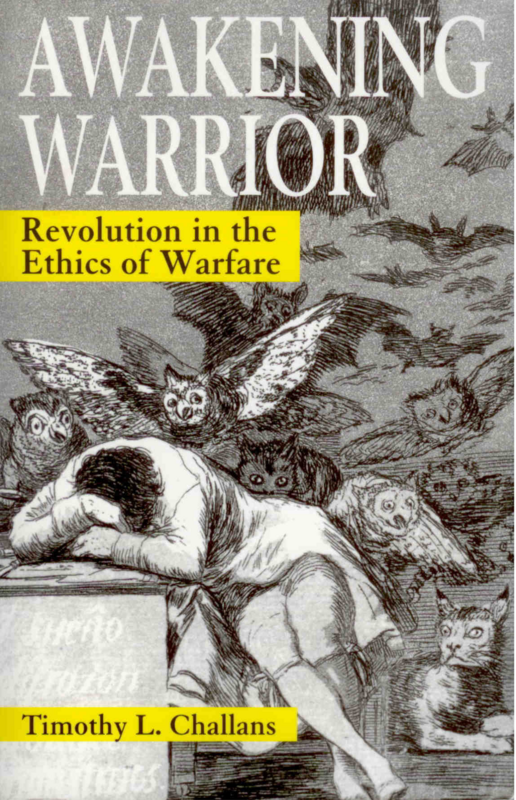 The topic below was originally posted yesterday, on my blog the Intrepid Liberal Journal, as well as the Independent Bloggers Alliance and Worldwide Sawdust.
Remember the pride Americans felt in its military following the first Gulf War in 1991? Prior to that conflict we had the “Vietnam Syndrome” tainting our military with the stench of defeat and shameful atrocities such as the My Lai massacre. Supposedly, a reformed military culture debunked the legacy of Vietnam, liberated Kuwait with honor while safeguarding America’s interests in Saudi Arabia.
Among those who initially embraced that myth is Timothy Challans, who served in the Army as a career infantry officer and retired in 2002 as a lieutenant colonel. Challans writes in his new book, Awakening Warrior: A Revolution In the Ethics of Warfare (State University of New York Press) that,
“For years after Desert Storm I wanted to believe, like many Americans, that the U.S. military had completed a moral transformation. Those of us who had been duped by our own propaganda wanted to believe that the indiscriminate killing in Vietnam had been replaced by precision munitions in Desert Storm and beyond, that the repugnant crimes of war so prevalent in the degenerate destructive fighting in Indochina had been replaced by consciously clean conventional fighting in the Gulf, and also that the psychotic psychologies of a bankrupt former generation had been swept away by a reformed professional military that fought with moral clarity and certainty. But the progress that I and many others had imagined was a myth.”Challans completed the manuscript for much of his book in the summer of 2001, before most Americans had ever heard of Osama Bin Laden or al Quaeda. Prior to the abuses of the Bush/Cheney Administration, Challans diagnosed the ills of what he describes as the “warrior ethos” and the “American War Machine” which encompasses those political and military institutions that engage the world with physical force
In a thoughtful book that blends philosophy and history, Challans focuses on the systemic, institutional level of morality rather than bemoaning the moral shortcomings of individuals. And he poses the following questions for the American War Machine: What are the limits of an individual moral agency? What kind of responsibility do individuals have when considering institutional moral error? How is that neutral or benign moral actions performed by individuals can have such catastrophic morally negative effects from a systemic perspective?
In addressing those questions, Challans postulates that “America’s War Machine” creates more conflict than it prevents and endangers the citizens it’s supposed to protect. He therefore argues that America’s survival is contingent upon replacing the current warrior ethos with a new paradigm guided by ethics.
Challans, a native of Colorado, is a West Point graduate and earned masters and doctorate degrees in philosophy at the The Johns Hopskins University. For more than ten years he taught over a thousand military students from the rank of cadet to colonel, at West Point (USMA), the Command and General Staff College (CGSC), and the School for Advanced Military Studies (SAMS). He has spoken widely and presented numerous papers pertaining to the ethics of warfare. Challans was the principal author for the Army’s 1999 doctrinal manual leadership, FM 22-100, Army Leadership. His troop experience includes the 172nd Infantry Brigade at Ft. Richardson, Alaska and the 10th Mountain Division at Ft. Cambell, Kentucky.
Challans agreed to a telephone interview with me about his book and unique perspective. Our conversation is transcribed below.
ILJ: Timothy, the first thing that grabbed my attention about your book was the title itself, Awakening Warrior. For the benefit of those reading this who did not read your book, why did you choose that title and what do you hope to accomplish with this book?
Challans: I was looking at Francisco De Goya’s etching entitled the “Sleep of Reason” as I was writing this book and I wanted to entitle it “The Sleep of Reason.” I thought that was a little bit too negative because while I think that we’ve been asleep in terms of our moral consciousness as we engage in conflict, I think some of us are waking up and the time is ripe for some critical evaluation of what we’ve done and where we can go.
And so I wanted to give a positive note that some warriors are waking up and are the vanguard of a revolution in the ethics of warfare for the good.
ILJ: I suspect many reading this who are like me, liberal and largely anti-war, are confused about the concept of integrating ethics and warfare. Tim is it really possible to wage the brutality of war ethically and why does that matter?
Challans: I think that’s a very good question. And whenever we do go to war that’s a huge failure when our politicians are not successful at diplomacy. We have engaged in a tremendous ethical failure. But the reality is at times we will have to fight. And so while I think that ethically fighting and war is going to have some very bad things about it … that we have two questions that people in this business think about:
The first one is, when should we go to war?
And the second one is how should we fight it once we’re in it?
And these two questions, once we think about them are important ethical questions that we have to explore in order to minimize the horror. I am not a pacifist myself although I am largely antiwar. I think we’ve been involved in far too many wars, more than we should. And that the leadership, both political and military doesn’t know how to engage in this kind of moral dialogue and we need to get a lot better at it.
ILJ: A reoccurring theme in your book is that for the military means become ends. Yet I can’t help but wonder how it could be otherwise for the military mind. Shouldn’t thinking about the bigger picture, consequences and morality be in the bailiwick of civilian leadership while the military focuses on tactics and winning?
Challans: That is the traditional division. That the politicians answer that first question, when do we go to war? And then the military is supposed to answer the second question, how should we fight it? The reality of this over the last several decades and actually the last several centuries, is that the division between political and military thought has merged.
There was a medieval distinction, that of invincible ignorance that is pretty much the idea that the soldier can go to war with a clear conscience and doesn’t have to worry about the political decisions. But the reality is our political leaders depend on our military leaders for advice and especially at the highest levels. Especially the Chairman of the Joint Chiefs. And the Chairman of the Joint Chiefs and his staff and every other headquarters and command where there is political/military interface there should be a dialogue between both groups of people: military and political as far as the morality of warfare given its gravity, potential destruction and the cost in terms of money and lives.
So, going back to your questions about means and ends, my book is primarily a challenge to the traditional structures and methods of thinking of ethics – and the way we think about means and ends, the very structure of reasoning about means and ends needs to be re-evaluated. For a very long time it has been inadequate for the military to think only about victory, winning the nation’s wars.
ILJ: In the second chapter of your book, you argue that the promotion of religion is undermining the ethics of our military and you even write that army chaplains “should get out of the ethics business in the military.” Why do you regard religion as a dangerous influence to the military’s moral compass?
Challans: If we’re looking at the three main religions in the world: Judaism, Islam and Christianity, the sacred texts for these religions really offer us very little if nothing when we go to answer these two questions,
1) When should we go to war?
2) And how should we fight it once we’re in it?
So I think the background that chaplains bring with them does not really help us in thinking about the moral questions that are at stake. And particularly the Bible is uninformative in this way. It tells us “Thou shall not kill.” OK, what do you do with that? What does the soldier do with that when he finds himself in war?
Additionally, since we’re working with the rest of the world now, I think we need some kind of ethical interoperability with the rest of the world. The rest of the world, the rest of the Western World … Europe, for example does not think of ethics in these terms. So if we’re going to be able to have a common conception of ethics, in a profession that is part of governmental structure in a democratic republic then it may be enough to think in terms that are not religious and that there are plenty of ideas out there where you don’t have to go to religion to understand respect for persons, rule of law and ethical ideas such as those.
My book also controversially challenges the Just War Tradition, the just war thinking that thinkers from Augustine to Michael Walzer defend. I believe we need a totally new conception, one reason being that our Just War Tradition has developed hand-in-hand with theological thought. For example, what good does it do to say the “legitimate authority” is a just war principle? Has there ever been a case in history when the leaders of any nation would say that they did have legitimate authority to go to war? Moral authority, especially religious moral authority, is one of the root problems of our muddled thinking about the ethics of warfare. I offer an original set of ethical principles of war, reasoned from some of the most profound ethical theories.
ILJ: Your book poses many important philosophical questions challenging what you describe as the “warrior ethos.” Yet for me, the nitty gritty of your book comes down to these two sentences in Chapter Four. You write, “The great paradox is that America goes to war against forces that it plays a large role in creating, and each war spawns new threats of largely its own creation.” That’s a harsh assessment. Do you really believe American militarism is responsible for the rise of radical Islam for example?
Challans: It may not be directly responsible if we’re thinking in the direct cause and effect relationship that you would see on a billiard table, one pool ball running into the next. But things connect up in a systemic way. And these forces are at work in ways that we really don’t sit back and reflect about.
So yes our approaches in solving problems at certain times will create the conditions for future problems. Just as in medicine today’s cures for certain diseases create tomorrow’s diseases. So, yes I do think there is this concept of blowback that the way we go about not only militarization but our economic expansion has tremendous systemic effects. An invisible hand kind of interaction where nobody is consciously intending or making something bad happen. But all these forces are at work, they’re at play in ways we don’t really think about and actually do create worse conditions making the world more dangerous year after year.
ILJ: In making your case for an ethics revolution in military culture, you challenge America’s moral standing over some of its proudest moments in history. One of them being, America’s victory over Japan in World War Two. Specifically, you accuse America of unjustifiably dropping atomic bombs on Japan when the war was essentially over. Growing up I was taught that even though the outcome was not in doubt, diehard Japanese soldiers would’ve kept fighting and taken many more American lives had President Truman not given the OK to bomb Hiroshima and Nagasaki. Couldn’t one argue that using atomic weapons was ethical because it minimized American casualties?
Challans: Here is a great example of how the military pursuit of victory – at any cost, by the way created more dangerous conditions. Our policy of unconditional surrender—an American invention in the annals of warfare beginning with Grant in the Civil War— put the Japanese Empire on notice that we were the ones who were not going to give up and accept a defeat. And here is the problem with the warrior ethos. It sounds good to us when we espouse the notion that we will never give up. But what happens when others take the same stance? It is precisely the warrior ethos existing on both sides in that war that escalated the brutality in the Pacific theater. The warrior ethos challenges the conventions of winning and losing. What does victory even mean is our enemy will never accept defeat? This is such a deep question at such a fundamental level that it does not even register in the minds of most warriors. And for a long time now it is not just the soldiery that refuses defeat but whole populations. The talk of victory in the current war against terror is nonsensical given that people won’t let another power achieve victory.
I mention in the book the irony of ending the war by attacking the Japanese population at large in order to bring about a military victory. And I juxtapose that against Japan’s entry into the war that was the attacking of an American military base in Hawaii at a time before Hawaii was a state.
That should symbolize our presence in the Pacific and our interference with Asia’s designs in their own region. So this goes back to your further question how our actions can create more dangerous situations. When we talk about setting the example for the world and then engage in wholesale destruction of a population, I think that while we may want to justify that for ourselves I don’t think we would want the rest of the world kind of picking up that example. And I’ll just mention Ramzi Yousef, the ’93 bomber of the World Trade Center who wanted to exact revenge on the World Trade Center symbolically for the destruction we brought against Japan at the end of World War Two.
Now, many sources will define terrorism as the threat or use of force against non-combatants for some kind of political objective. It’s inconsistent for us to use that definition when we want to define terrorists who are attacking us but we will not allow that definition the way we describe what we do. Now if we go so far as to say well, all of the Japanese citizens were combatants – then the problem with that is if everyone is being consistent about that, I think that’s pretty much what the attackers on 9/11 said about the occupants of the World Trade Center. Consistency is important here. And we need to think these things through very clearly.
ILJ: In fairness to President Truman though, wasn’t he being told by his military advisors we’re going to shed a lot more American blood unless we use these weapons? Occupying the Japanese mainland would’ve been a very tough proposition. And given the war weary American population at that point, did Truman really have another choice at that moment in time?
Challans: That’s a very interesting question because that’s not just a single choice at that point in time but things had degraded over time. So it’s really a series of decisions that take place over time. And so as we go back we can sympathize with Truman in terms of the choices he made on successive days. For example, why would they think atomic weapons were that much worse than the fire bombing of sixty other cities in Japan by that time? It may have seemed like a difference in degree but not a difference in kind.
In retrospect we can see that more clearly. But this should give us even greater pause in trying to think through the choices we make. As a series of decisions over time where we can potentially make thinks more dangerous than they need be.
ILJ: You also cite dropping the atomic bomb as the start of the cold war as an example of American military excess creating more conflict for it to fight. In fairness to America, Stalin brutally consolidated his Iron Curtain over Eastern Europe and since the Soviets were developing atomic weapons themselves, wasn’t the Cold War inevitable?
Challans: Well, yes. In some ways it had unfolded, maybe yes. And this goes back to my previous comment – that something like the Cold War unfolded as a result of thousands of decisions and hundreds of things that were happening. And many historians will now say we dropped the bombs more to keep Russia out of sharing a victory with us in Japan than the traditional rationale. But this may also be reason to think that we if reword McArthur’s most famous line, we should think about the role of diplomacy. Maybe its more important to say there is no substitute for diplomacy.
ILJ: Another proud moment in American history was the first Gulf War in 1991, when a supposedly new professional military liberated Kuwait, kept the Iraqis out of oil rich Saudi Arabia and conducted itself with honor – debunking the Vietnam syndrome. You reference two very serious allegations in your book however about the First Gulf War. The first is that independent satellite photos do not show the buildup of the Iraqi Army at the Saudi Arabian border before Operation Desert Shield was implemented in 1990. As a source you cite John MacArthur’s 1993 book, Second Front: Censorship and Propaganda In the Gulf War. If MacArthur’s right, why did King Fahd of Saudi Arabia allow the American military to set up shop in their country and anger Islamic radicals such as Osama Bin Laden? It doesn’t make any sense.
Challans: We’ve been involved in Saudi Arabia since the late thirties. There was certainly much more of an American military presence throughout the eighties in the Middle East. So the entry and the buildup of American forces in Saudi Arabia I think is a natural consequence of this relationship we’ve had with certain countries in the Middle East. Yes the buildup I think was exaggerated and this may help explain why the war only took 100 hours … that the forces that were reported to be there may not have actually been there. Now this is a serious allegation and I would love to see more exploration here but I really doubt the military is going to open itself up for this kind of investigation.
ILJ: Is there anything that civilians can do to explore these allegations, pressure politicians, especially in light of the past six years? Maybe people will want to dig further back into the history of our entire involvement in the Gulf.
Challans: I think that’s a great suggestion. The two conflicts are not separate. There needs to be some exploration and some interpretations that include Dessert Storm and Operation Iraqi Freedom. And I think that would be a fascinating topic to look at the whole thing rather than just the first part and the second part separately.
ILJ: The second allegation you reference is against Major General Barry McCaffrey. McCaffrey would later serve as President Clinton’s drug czar and he’s been a television commentator for NBC in recent years. You write that two days after the shooting stopped in March 1991, McCaffrey had his 24th Division completely destroy an entire Iraqi Republican Guard Unit after falsely claiming he responded to an antimissile attack – and you cite the reporting of Seymour Hersch, a credible reporter as a source – he’s very credible in my opinion. Do you believe McCaffrey acted looking for glory? Or was he cooperating with higher ups that wanted a pretext to wipe out another a division of Saddamn’s elite Republican Guards?
Challans: I would go with A. That this was primarily McCaffrey’s action. I think that from General Schzwartkopf and higher that the action was pretty much over. This was a cease fire. Cease fires have very technical legal strictures which are greater than say armistices. So this is a much more serious incident … and it’s an incident we let go because of McCaffrey’s stature and later political appointment — I think this was kind of ignored. But this would be part of that overall story that I think we need to go back and look at more seriously.
ILJ: I’d like to get your thoughts on two recent developments. One, what do you make of the federal appeals court in Washington that on Friday, ordered the government to turn over all information on Guantanamo detainees who are challenging their detention?
Challans: I think this is a move in a positive direction because I have never thought that any of the talk of detention and talk of tribunals had anything to do with bringing anybody to trial but that it always had everything to do with interrogation and getting information.
There was never any procedural or substantive law that had been developed to deal with the detainees, especially in this bogus category of enemy combatants. We are operating somewhere in limbo between a war paradigm and a crime paradigm, legally. And I think this is a case of the courts imposing itself to force the White House to show its hand. There are virtually no substantive charges against the vast majority of detainees. The one they stick on everybody, which is really a false charge, is that of conspiracy. Conspiracy while a crime in terms of criminal law is not a war crime.
So to try to charge all these detainees with the war crime of conspiracy is just not going to work. I think this is part of the oversight that the judicial system should have over the executive branch. And this really is good news in my view. It’s democracy at work.
ILJ: Do you think it might cause chaos if all these detainees are able to challenge their detention?
Challans: I think it will be chaotic. And there may not be any good answers once all this is exposed. Even so I don’t think the potential chaos is a reason not to do it. Nor would it be a reason to justify what’s been done. It may be that we have to face the very painful consequence of exposing something that is really bad news for America. It’s bad news because we used bad reasoning in terms of means and ends, using questionable means to achieve certain ends.
ILJ: And what do you think about the White House announcing on Friday that it had given the CIA approval to resume its use of some severe interrogation methods for questioning terrorism suspects in secret prisons overseas?
Challans: This is the executive branch trying to flex its muscle back at the judicial system. I think that is not a good idea. All of those heavy-handed measures have turned out to backfire in the past. For a long time I didn’t understand why the White House would be acting this way. But I’ve come to understand that there is a school of law out there, the John Yoo and Alberto Gonzales school of law which is to push the limits, to do something that is perhaps illegal. And if that sticks then they’ve actually succeeded in changing the law. And I really think that’s what they’re up to. This is particularly troubling to me for public servants take an oath to support and defend the Constitution. It is an outright contradiction to violate the very document that public officials have taken an oath to preserve.
ILJ: Timothy your book largely deals with reforming the ethics of the institutions of what you call America’s “war machine.” However, increasingly operations of America’s war machine are outsourced to private contractors such as Blackwater who essentially have their own army in Iraq and are not beholden to any government standards. Is it possible to have an ethical war machine if private contractors aren’t reformed as well and how can that be done if they’re not under the chain of command?
Challans: This is a huge problem and perhaps the greatest challenge that we’ll have in the future. As Smedley Butler, the Marine back in the early 20th century told us: “war is a racket,” war is business. And there are business forces at work that if the average American understood how profits are made off of people being killed I think they would be appalled. The rise of Blackwater, and the contractor force being the second largest army in the Middle East right now, is a tremendously problematic, not only because they can operate outside the law but they also operate outside of any consciousness of morality or ethical code that a military would have. So I think this issue of contractors on the battlefield is one we need to rethink seriously about.
ILJ: Do you think it’s possible assuming the military can reform its own ethical standards they can then mandate if you want to get any contract work from us, this what you have to adhere to? Is that a reasonable objective?
Challans: That could be a way to help solve the immediate problem. I think that’s a good idea actually. But it’s a world that’s really hard to control, unaccountable. Far more so then the blackest operation in our black ops world.
ILJ: Timothy you’ve been very generous with your time, a final question if I may. What sort of feedback, if any, have you received from the military establishment about your ideas in this book?
Challans: The feedback has been positive, from students and colleagues. Nobody has approached me to challenge me on anything I've said. I think the time is right for a moral dialogue of the sort I'm trying to carry out, one that can be critical enough to help us better understand where we've been, what we're doing, and where we're going.
Saturday
Justice at Stake
By Shahid Buttar, AlterNet. Posted July 20, 2007.
Right before the public kicked out the GOP in the 2006 elections, the Republicans succeeded in passing a law that could keep prisoners in the "war on terror" from ever facing a fair trial. It's time to rescind that law.
Critics of the War on Terror have argued since 9/11 that the Bush administration's multifaceted betrayal of human rights and constitutional freedoms poses a greater threat to our society than the threat it means to address. From domestic spying to Guantanamo Bay, torture by U.S. authorities to kangaroo courts, our prevailing practices have undermined the notion that we operate according to the rule of law, leaving the War on Terror looking more like a War of Terror. The Military Commissions Act of 2006 (MCA) is an especially egregious case in point.
The MCA was ill-considered legislation passed in haste by a right-wing Congress that the American people have since rejected. Its most problematic provisions have drawn worthy criticism, but those provisions should not be repealed piecemeal. Instead, the MCA should be rescinded in its entirety. To the extent it offers any legitimate tools to law enforcement authorities, they should face calm, considered debate in the light of day.
Among the rights desecrated by the MCA are the right to representation and access to judicial review. The MCA rescinded habeas corpus for detainees at the president's whim, while Pentagon regulations have long restricted access by lawyers and the Red Cross to detention facilities. Not only have we condoned torture, we have muzzled lawyers seeking justice for its survivors.
The suspension of habeas rights is especially terrifying, for its original emergence heralded a world-historical shift in the tension between individual autonomy and rights versus arbitrary state power. Historically, the sovereign could act at will. "Off with his head" may seem a garish thing for the queen in Alice In Wonderland to say, but it was a decidedly less amusing edict for the subjects of pre-Magna Carta monarchs. Habeas was among the earliest and most fundamental bulwarks against such avarice, and our nation should pause before discarding it -- especially in the race to address a largely imaginary terror threat created by the idiocy of Republican presidents who armed and trained our current antagonists.
Without the right to demand that authorities "produce the body" of someone in their detention, U.S. authorities could -- like the Latin American paramilitaries they have long helped train -- simply make people disappear. When it still applied universally, habeas was a crucial check on the state's power to casually destroy people's lives.
On the one hand, the MCA suspended habeas only for some, namely "unlawful enemy combatants." And the first two military commissions conducted under its provisions -- as well as a panel of the U.S. Court of Appeals for the Fourth Circuit that recently ruled on the case of Ali al-Marri -- rejected the government's attempt to apply the MCA to the particular defendants before them. Finally, the Supreme Court recently agreed to hear the habeas appeal of Guantanamo detainees, reversing its prior decision to decline the appeal.
But on the other hand, the decision that halted the military commissions at Gitmo did so on the basis of a formalistic distinction between Congress' language in the MCA and the Bush administration's classification of detainees. That discrepancy will be either excused on appeal, or rectified by the administration -- which classified the detainees however it wished in the first place. Rigged Combatant Status Review Tribunals (CSRTs) offered a pretense of justice, while denying detainees even minimal procedural protections like the opportunity to challenge witnesses and contest evidence. And the Fourth Circuit ruling was exceedingly narrow, covering only enemy combatants living legally in the United States when captured. Finally, the Supreme Court is an unlikely source of relief, given that it rebuked the administration in the Hamdan case only because Chief Justice Roberts was ethically barred from hearing the case -- which he previously judged while interviewing for his Supreme Court nomination as a judge on the D.C. Circuit -- a second time.
Moreover, the denial of habeas rights is merely part of the story. In addition to rescinding rights that have long served as cornerstones of our democratic Republic, the MCA authorizes torture, while immunizing the authorities responsible for it from prosecution for human rights violations.
While the contemporary debate often reflects vitriolic outrage at the seemingly sudden and unprecedented betrayal of our nation's legacy as a promoter of human rights, it tends to overlook that torture has actually been a longstanding instrument of U.S. policy. Our nation's history includes massacring entire villages in an imperial invasion of Vietnam that left millions dead; targeting Japanese civilians with weapons of mass destruction and slaughtering over a quarter of a million of them within just four days; and committing genocide against the indigenous natives of an entire continent ... from which we now seek to exclude newcomers. It should come as no surprise that we have long violated the same human rights principles that, at more reflective times in our history, we helped promote.
Torture in the United States started long before 9/11. Over the same period that draconian criminal sentencing laws have left a greater proportion of our population in prison than any other country in the world (including China), laws enacted to stem a rising tide of prisoner lawsuits have denied inmates access to justice for abuse such as beatings or even rape. And since the beginning of the Cold War, the U.S. military has played a leading role as a violator of human rights in Latin America. The Army continues to operate a school at Fort Benning, Ga., that trains Latin American militaries in torture techniques, enabling state-sponsored terror campaigns against their own citizens. What differentiates the School of the Americas (now known as the Western Hemisphere Institute for Security Cooperation, or SOA / WHINSEC) from the al-Qaeda camps bombed by U.S. warplanes in Afghanistan? Seemingly little, apart from the flags flying over each facility.
Many victims of American torture policies are innocent of any wrongdoing, like Sister Dianna Ortiz, the American nun who was captured, beaten, raped and tortured in Guatemala nearly 20 years ago before discovering that her torturers were trained at the SOA/WHINSEC and that she was abused in a facility run with the active complicity of the CIA. Canadian Gitmo detainee Omad Khadr may not be the most savory character, but he was only 15 years old when captured.
Before one of the first military commissions rejected his prosecution for war crimes (on the relatively weak, formalistic theory that the CSRT classified him only as an "enemy combatant," without ruling as to whether he was also "unlawful"), American University law professor Muneer Ahmad said, "The U.S. will be the first country in modern history to try an individual who was a child at the time of the alleged war crimes." Nor are we the first to be confronted with the choice: The prosecution of child soldiers "did not happen in the former Yugoslavia, it didn't happen in Rwanda and it didn't happen in Sierra Leone, where kids were involved in all sorts of horrific war-crime activities."
Yet reprehensible rights violations -- even those as barbaric as a CIA agent allowing soldiers he oversaw to extinguish cigarettes on the breasts of a 29-year-old American nun whom they had raped -- will go unpunished, because the MCA affirmatively insulates human rights abusers from facing justice. It includes an extraordinary retroactive provision ensuring immunity for U.S. officials who commit torture or war crimes. According to his former colleague Henry King, Supreme Court Justice Robert Jackson was "the architect of Nuremberg, [and] would turn over in his grave if he knew what was going on at Guantanamo." Even well before 9/11, the United States refused to ratify participation in the International Criminal Court, fearing that doing so would expose our own soldiers, as well as their elected civilian commanders, to prosecution.
Our torture policy has been reaffirmed on several occasions: by every Congress to approve funding for the SOA/WHINSEC over the last 40 years; in the infamous "Torture Memo," by then-Justice Department lawyers Jay Bybee (who now holds a lifetime seat on a federal appellate court) and John Yoo (who, according to recent reports, acted at the behest of Vice-President-Run-Amok Dick Cheney); and once again in revised interrogation guidelines released this June. While the president's dictatorial approach was briefly constrained by the Supreme Court's four moderates in the Hamdan decision, the Republican-led Congress quickly passed the MCA to restore the authority struck down by the Court.
Congress is currently debating several bills, notably proposals by Sen. Christopher Dodd, D-Conn., and Rep. Jerome Nadler, D-N.Y., that would restore habeas and repeal some of the MCA's most heinous provisions. But these legislative half-steps are not enough to redeem the practices that would remain. Sister Ortiz, who after surviving her torment went on to establish the only organization in the United States run by and for torture survivors, notes that "this law's sole purpose is to create an atmosphere permissive of torture," and "demand[s] a full repeal of the MCA."
Our country's post-WWII legacy entailed generosity to our former foes, the creation of inspired international institutions and an age of relative global peace. Faced with the chance to honor that legacy or ratify its ongoing betrayal, lawmakers should remember our nation's bloody past. We today can restore the ongoing American legacy of human rights, or cast it aside in favor of our longer, more consistent narrative of abuse and arbitrary violence. Members of Congress should recall the political mandate with which they were entrusted public office, heed the voices of those who have lived through the horrors of torture and repeal the MCA in its entirety.
Shahid Buttar is a poet, hip-hop MC, lawyer, scholar, media activist and grassroots community organizer based in Washington, DC. To read more articles or to listen to his music, visit his website.
Thursday
right wing bravery
i have asked a few why, being young enough, they haven't gone to protect america-as they are fervent supporters of the war in iraq- and oh, the excuses that have flown. apparently, i am not the only one.
generation chickenhawk
Help keep lifesaving medicines affordable
Wednesday
Tuesday
tuesday post for peace
make no mistake, the current american regime- bushco and the corporate elite- are not interested in peace in iraq. they are not interested in anything other than profits now and profits in the future. there's a reason that halliburton moved to dubai. we, the people, cannot trust our government to do the right thing. we cannot trust them to make decisions that are in our best interest as a nation or as a part of the greater world. they are clearly out for themselves.
now is the time to fight harder to take back our country. we have unleashed a civil war in iraq, and there is no way to ever make amends- although we should spend our lives making the attempt. we have to be the peace that we seek and we have to fight for peace- as oxymoronic as that sounds. if we don't, thousands more iraqi civilians will die and/or be displaced. thousands of kurds will be killed or displaced by possible impending war with turkey. we have to care- because it is obvious that our fellow americans- the people in government- do not. peace in our time is possible- if we work together.
iraq


views of iraq
crossposted at the sirens chronicles, life's journey, the peace train.
LinkWithin
