Showing posts with label Afghanistan. Show all posts

Sunday

Our Final Frontier: Keep Space for Peace


Their goal is cosmic: to keep the arms race out of the heavens. That's why October 3-10 is worldwide "Keep Space for Peace Week: International Days of Protest to Stop the Militarization of Space," announced the Global Network Against Weapons & Nuclear Power in Space.

Events this year focus on Unmanned Aerial Vehicles (UAVs) that fly over Afghanistan and Pakistan but are controlled by pilots at computer terminals on bases in the US. Death at a distance is still blood on our hands, the group contends. The technology produces massive civilian casualties.

Satellite communication technology drives the remote-control robots that devastate targets around the globe, according Dave Webb, Global Network chairperson. "We must not allow these technologies to go unchallenged. Indeed we must do all we can to stop the spread and rule of violence and destruction," he says. The week reminds the public "what kind of a destabilizing future these systems could create."

Protests are planned throughout the world at city centers and key space related factories and military bases. Groups will hold educational forums featuring space videos throughout the week. The actions are co-sponsored by the Women's International League for Peace & Freedom, International Network for the Abolition of Foreign Military Bases, and the World March for Peace & Non-Violence. Space Week protest sites are listed at http://www.space4peace.org/actions/ksfpw09.htm

Actual Pentagon Space Command plans for "control and domination" of space are available for public viewing at http://www.gsinstitute.org/gsi/docs/vision_2020.pdf Below is one illustration from the document, a Star Wars-mimicking graphic, captioned: "US Space Command-dominating the space dimension of military operations to protect US interests and investment. Integrating Space Forces into warfighting capabilities across the full spectrum of conflict"

The 2009 Space Week poster

Source: Press release, Global Network Against Weapons and Nuclear Power in Space.

Contact: Bruce Gagnon (207) 443-9502. No copyright restrictions.

Saturday

Afghanistan


Welp, it looks like more and more Dems are coming around to Senator Russ Feingold's point of view on Afghanistan. And none too soon, given the recent news of rowdy fratboy misbehaviour by U.S. citizens in this deeply conservative Islamic nation.

What the hell are we doing in Afghanistan, anyway? It's a pointless war. The idea was to go in, get bin Laden and whoever else is in charge in al-Qaeda, and get the fuck out. But now, General Stanley McChrystal, top American commander in Afghanistan, is asking for more U.S. troops. And NATO is purportedly planning to increase its commitment to Afghanistan, according to Anders Fogh Rasmussen, secretary-general of NATO. "As long as it takes," says Rasmussen. As long as WHAT takes, sir? What are you hoping to accomplish?

Afghanistan is a pathetically poor nation, historically torn by fighting. Everyone seems to want a piece of that poverty-stricken land, beginning with Sikandar (Alexander the Great to you Greco-Romanists), and moving through Britain and Russia to the United States, and now an alliance of Western powers fronted by NATO. So far, no one's had much luck winning a war there. The British gave up after multiple defeats. The defeat of the Russians occurred within our own lifetimes. And now the US/NATO Coalition of Teh Stupid is getting ground to dust.

Clausewitz has this, among other things, to say about war:
War is not an independent phenomenon, but the continuation of politics by different means.
Given that Clausewitz is somewhat of an authority on war, it would behoove both NATO and the US to remember that. And what are the politics of Afghanistan?

Historically, Afghanistan has been a land of warring tribes, fierce and intransigent, deeply committed to a harsh version of the Muslim faith it adopted circa 650 AD. United for a little over a century into a kingdom comprising multiple dynasties and tribal alliances, these tribes have long resisted any semblance of comity, being more likely to invest their energies in settling grievances with each other by whatever means and having long since grown adept at manipulating foreigners against each other for their own survival and vengeance.

Thus, the question restates itself: What are the political aims of the U.S. and NATO in Afghanistan? Uniting the country? That seems laughable. There is no "country of Afghanistan," only a series of tribes that have fought each other for hundreds, possibly thousands, of years and will continue to fight each other long after the latest in a series of invaders has been crushed into exhaustion by the hostile climate, terrain, and natives. (READ MORE)

Alleviating the lot of the natives? Well, war is the worst possible way to go about that. We appear to be killing lots of innocent, and possibly also not-so-innocent, civilians. In the event, a country torn by war, poverty, corruption, crime, and suffering does not allow democracy to take root in its bitter soil. Democracy requires the active participation of informed people. The people of Afghanistan are too busy fleeing bombs, being killed and maimed, and attempting to stay alive to spend time gathering information. And our presence there, far from alleviating their lot, is killing them.


It doesn't help to have the examples of other failed wars in Asia: Japan's war in China, and the U.S. involvement in Korea, and VietNam. To quote Bernard Viscount Montgomery,

[...] Rule 2 of war [...] is: "Do not go fighting with your land armies in China". It is a vast country, with no clearly defined objectives.
In the House of Lords, 30 May 1962 (Hansard, Col. 227)
And subsequently, upon the involvement of the U.S. in the VietNam conflict:
The US has broken the second rule of war. That is, don't go fighting with your land army on the mainland of Asia. [...]
As is always the case, corruption is rife in a land torn by war. No one seems to care about what the Afghanis themselves think about the Taliban, or the puppet dictator, Hamid Karzai, that we have foisted on them.

What exactly are we hoping to achieve in Afghanistan? Because if our aim is to ensure that natural gas flows from the rich fields around the Caspian Sea to ports where it can be transhipped to countries hungry for this rich natural resource, then perhaps we ought to be less hypocritical about it and either sterilize the entire nation of its inhabitants, or just buy it outright and pay the Afghanis to settle elsewhere.

Inhumane, you say? Of course it's inhumane. But how humane is it to prop up a corrupt, American-owned dictator who watches and pockets our riches anyway even as little girls and boys have their arms and legs blown off?

This is a problem that requires a political, not a military solution. So far, 21,000 troops have been sent there to fight and kill and be killed.

Photo by Julie Jacobson, AP

No more. Let's bring them home, people. Supporting the troops means not using them in the Gee, Dumb? Yeah! war of convenience. The Afghanis don't want us there. They want us to give them the training to become adept at defending themselves and then get the fuck out. What the fuck are we waiting for?

Crossposted over at ThePoliticalCat

Sunday

Howard Dean, M.D. Supports the War Drug


JUAN GONZALEZ: In terms of the—to get back again to other issues right now, I’d like to ask you about the continuation and expansion of the American war in Afghanistan. Do you have concerns about—that this is becoming really President Obama’s war—

HOWARD DEAN: It is.

JUAN GONZALEZ: —and the impact on our country in the future?

HOWARD DEAN: Look, again, you know—and I don’t have to say anything nice; I’m not in the administration. But I’m with Obama on his conduct of the war. I always said, when I was running against the Iraq war, that Afghanistan was different.

Let me tell you what the stakes are now. And what I find incredibly refreshing about this president is he uttered words that Lyndon Johnson never said, which is that we cannot win this war militarily. He knows that from the get-go. Here’s what’s at stake. It’s not just the Taliban. I think we could probably control the Taliban and the al-Qaeda in the Northwest territories by doing some of the things we’re already doing—drones and air power and so forth. Roughly 50 percent of the Afghan people are women. They will be condemned to conditions which are very much like slavery and serfdom in a twelfth century model of society where they have no rights whatsoever. So, I’m not saying we have to invade every country that doesn’t treat women as equal, but we’re there now. We have a responsibility. And if we leave, women will experience the most extraordinary depredations of any population on the face of the earth. I think we have some obligation to try and see if we can make this work, not just for America and our security interests, but for the sake of women in Afghanistan and all around the globe. Is this acceptable to treat women like this? I think not.

AMY GOODMAN: We just interviewed an Afghan parliamentarian, Dr. Wardak. She said the opposite. She said, yes, she agrees with you on the way women are treated, but that this is worsening the treatment, that the increased number of civilian deaths in Afghanistan, the huge number of troops that are coming in right now, are alienating the Afghan population.

The above is an extract from an interview last week on Democracy Now! with Howard Dean, former Governor of Vermont and establishment Democratic celebrity. It was also included in a post at Ten Percent, which I also recommend to readers of The Peace Tree for further context on the escalating, brutal war in Afghanistan.

Cross posted at Antimedius and Blazing Indiscretions.

Photo: Ghazni protest in February against an attack on civilians by coalition forces.

Thursday

A Thousand Splendid Suns


A breathtaking story set against the volatile events of Afghanistan’s last thirty years—from the Soviet invasion to the reign of the Taliban to the post-Taliban rebuilding—that puts the violence, fear, hope, and faith of this country in intimate, human terms. It is a tale of two generations of characters brought jarringly together by the tragic sweep of war, where personal lives—the struggle to survive, raise a family, find happiness—are inextricable from the history playing out around them.


Monday

Winning Dead Hearts and Minds


Mike Whitney tells us 93 children and 25 adult women were killed in an U.S. airstrike on the Afghan village of Bala Baouk.

The youngest was an eight-day-old baby.

Whitney notes that, “Neither Obama nor anyone in his administration has acknowledged that 93 children were killed,” because they're too busy winning hearts and minds to notice.

That’s progress for you. Now we conduct a My Lai from the air. It’s neater that way.

It helps that our supine media doesn’t bother to rush any photojournalists into the area to record the carnage.

What carnage?

--Case Wagenvoord


Sunday

14 Protesters of Drone Use in Afghanistan, Pakistan Arrested at USAF Base


Friday afternoon fourteen peace activists were arrested at Creech Air Force Base in Nevada. These arrests occurred in the context of the activists' ten day vigil at the base to raise public awareness about the increasing use of unmanned drones in the Afghanistan and Pakistan war zones. Air Force personnel based at Creech control the Predator and Reaper drones that are used to launch offensives in Central Asia.

The activists provoked their arrest by walking through the base's open main gate shortly after 3:00 p.m. in an attempt to dialogue with the Air Force service members controlling the drones. In a gesture of good will, they offered share pizza with Air Force personnel. Air Force security personnel blocked them.


The Nevada State Highway Patrol and Las Vegas Metro Police Department responded to the intrusion. Activists were arrested on the charge of trespass and transported to the Clark County Detention Facility where they were booked and processed.


Those arrested include Kathy Kelly (twice nominated for the Nobel Peace Prize; Illinois), John Dear, S.J. (author, speaker; New Mexico) and activists from AZ, IA, NY, CA, IL, and Washington DC.

The group, calling themselves Ground the Drones, provide information on the drones and on their opposition to the use of that drone technology at the website http://NevadaDesertExperience.org.

An interactive map of US airstrikes in Pakistan is found: http://www.americanprogress.org/issues/2009/03/pakistan_map.html

image credit: CREECH AFB, Nev. -- As seen from an MQ-1B Predator, Close Air Support Subject Matter Experts for the 11th Reconnaissance Squadron coordinate via radio with a Predator student for a simulated Hellfire strike on a building while smoke is used to simulate missile impact on a building. One important aspect of Predator Initial Qualification Training is students receiving live Joint Terminal Attack Controller training. In order to enhance their training capabilities, Air Combat Command recently hired contracted Close Air Support Subject Matter Experts. (Courtesy photo)

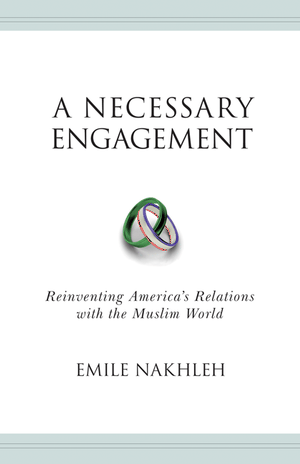
Reinventing America's Relations With the Muslim World: An Interview With Former CIA Analyst Emile Nakhleh

The topic below was originally posted on my blog, the Intrepid Liberal Journal.

Building consensus within America’s body politic and national security establishment for a new way forward with Muslims worldwide is a formidable challenge. Many Americans still don’t appreciate the complex nuances of Muslim society and remain stubbornly Islamophobic almost seven and half years after 9/11. Equally formidable is earning the goodwill of Muslims worldwide following the Iraq War as well as American atrocities perpetrated upon Islamic detainees at Guantanamo Bay and Abu Ghraib. Hopefully, President Obama’s historic election has finally opened a path for constructive conversation about how America can most effectively engage the Muslim world.

The CIA’s former point man on Islam, Emile Nakahleh, has vigorously entered this conversation with his new book, A Necessary Engagement: Reinventing America’s Relations With the Muslim World (Princeton University Press). From 1991 to 2006, Nakahleh served as the director of the Political Islam Strategic Analysis Program in the Directorate of Intelligence at the CIA. He holds a PhD in international relations and is a member of the Council on Foreign Relations.

Nakhleh’s book combines a revealing memoir with in-depth analysis and proposals for the future. Ever since his retirement from the CIA in 2006, Nakhleh has been a vociferous critic of the Bush Administration’s legacy with respect to American-Muslim relations. Indeed, in September 2006, Nakhleh told Harper’s Magazine that because of Bush’s policies,
“We've lost a generation of goodwill in the Muslim world.”
Nakhleh's proposals for improving American-Muslim relations stems from his conversations with Muslim "interlocutors" spanning three decades. These conversations include government ministers, Islamic activists, academics and radicals. Nakhleh also examined and analyzed considerable polling data of Muslims worldwide.

Read More +/-
Overall, Nakhleh contends that the vast majority of Muslims and America have common interests and values. His blueprint includes robust dialogue with mainstream Islamic political parties as well as a tangible commitment towards democracy in the Muslim world, even if we don’t always like the short-term electoral results. His book is an accessible 160 pages and divided into four chapters: (Chapter 1) Political Islam and Islamization, (Chapter 2) Intelligence, Political Islam, and Policymakers, (Chapter 3) Public Diplomacy: Issues and Attitudes and (Chapter 4) Public Diplomacy: A Blueprint.

Nakhleh was born in Galilee, north of Nazareth in Palestine and raised a Greek Catholic. He emigrated from Israel to the United States approximately 50 years ago and attended a Benedictine university in Minnesota for his B.A., a Jesuit university in Washington, D.C., for an M.A. and was awarded a Ph.D. from the American University in Washington, D.C. Prior to joining the CIA he taught at a catholic college in Maryland for 26 years.

Nakhleh agreed to a telephone interview with me in podcast format. Among the topics we discussed was whether he believes the surge in Iraq worked, the proxy war between Saudi Arabia and Iran inside Iraq, President Obama’s new strategy in Afghanistan, Hamas and America’s role in resolving the Israeli-Palestinian conflict and his argument that American commitment to democracy in the Muslim world is imperative to our long term interests.

Some of Nakhleh’s answers and views may surprise many listeners. Our conversation was just over 47 minutes. Please refer to the flash media player below.


Either searching for the “Intrepid Liberal Journal” or “Robert Ellman” can also access this interview at no cost via the Itunes Store.

Please not that I erred in audio introduction when I said Emile Nakhleh worked for the CIA between 1991 and 1996. I meant to say he worked for the CIA between 1991 and 2006. Also, my apologies for the echo on Emile Nakhleh's side. Sometimes technology has its limits.

Some Thoughts on Obama by David Rovics

David Rovics is a singer/songwriter and unashamed socialist based in
Portland, Oregon. I'm on his email list. He recently sent the following letter, which Pagan Sphinx's 11/13 post has encouraged me to reprint here:


Friends around the world keep asking me questions. Are you excited? What do you think of Obama? Others are simply congratulating me. And I must say, it was a thrilling moment.

As a teenager, in 1984, I volunteered for the Mondale/Ferraro campaign, mostly pushing bumper stickers. An anti-nuclear group was doing this, in the belief that Mondale would be less likely to cause Armageddon. I grew up in an overwhelmingly white, Republican town. I was a news junky from an early age, though, and politically active in one way or another. Of the Democratic candidates my favorite was Jesse Jackson, but looking around me I reasoned he had a slim chance of getting elected.

As an adult, living in urban areas all over the US, I saw little to dispel this illusion. There were more African-Americans getting elected to political office, but usually we were talking about mayors of majority-Black cities or Congresswomen from hotbeds of progressivism like Berkeley. But here I was, hanging out with my toddler, listening to my favorite local band, the Pagan Jug Band, sitting in a pub in Portland, hearing that Barack Obama has been elected President.

My initial reaction was that of Jesse's. I got a lump in my throat, and tears came to my eyes, thinking about the insanity of all the suffering that has gone down for so many centuries, the homes, dreams, and bodies broken by slavery and racism. And in fact until very recently, on the news broadcasts when they would mention the number of Black people in the Congress, in order to be factually accurate they always had to include the caveat, "since Reconstruction." More than that is rarely said about this ten-year period of Union Army occupation that allowed something approximating democracy, and even serious land redistribution, to exist in the South, before the Union withdrew and the South was plunged into at least a century of Apartheid rule.

Whether South or North, the prisons are filled with mostly dark-skinned people from places where you can graduate from high school without having learned how to read, where you can get asthma from breathing the air, where the police shoot first and ask questions later. They're in prison, but Barack Obama's not, he's on the TV giving a humble victory speech, quoting Lincoln. And this crowd of mostly young white people around me at the pub are all cheering at the TV screen, shouting his name, laughing, crying, and drinking. I'm pretty sure they all voted for him. Or if some of them were slacking too much to get around to it, they would have voted for him.

I had just gone there to hear the music, but it turned into a spontaneous Obama party, at that pub and at pubs and sidewalks and streets in cities all across the US, and apparently in other parts of the world as well. I remember being near the front of a march of tens of thousands of people back in 1985 or so, seeing Jesse Jackson at the front of the march with many of his volunteers lining the marchers, all wearing football-style shirts that read "88" on them, for his next Presidential campaign effort. I remember seeing on the faces and the placards of this mostly white crowd of marchers, an admiration and affection for the man at the front of the march, and I was wishing the whole country could be more like this crowd. And I feel so gratified that all the people talking about the so-called Bradley effect were wrong, that a majority of our eligible voters(not counting those millions of ineligible felons) would really end up voting for Obama.

There was one black-clad young man from Olympia who happened to be at the crowded pub, which was more crowded than I had ever seen it before. He bummed a light from me and started to talk. "This is great, you know, but I just can't help but think, 'meanwhile, in Afghanistan...'"

Every party needs a spoiler, and here he was. Too cynical to be entirely swept up in the moment, he was worried about the possibility that Obama might actually follow through with his campaign promises and send more troops to Afghanistan. And then over the past few days, the news gets more and more grim. Rahm Emanuel, a zealous supporter of Israeli Apartheid for Secretary of State. Larry Summers, Clinton's chief advocate for the World Trade Organization and deregulation of the financial sector, is being suggested as an economic advisor. Joe Biden, who voted for the war in Iraq, is already his VP.

Expand the post +/-


Obama is surrounding himself with folks from Bill Clinton's administration. I remember those eight years well, I was protesting his policies the whole time. Welfare was reformed and social spending was gutted even more. The prisons became even more crowded with nonviolent drug offenders. The sanctions and ongoing bombing campaign in Iraq that happened on Clinton's watch killed hundreds of thousands of children, and his Secretary of State said the price was worth it. NAFTA was passed and then the WTO was formed, all with Clinton's blessings. These trade deals that Clinton and most of his party supported plunged millions of people around the world into poverty and an early death. Yugoslavia and Iraq will glow for thousands of years because of the nuclear waste littering the land that fell during the Clinton years.

Of course, Clinton inherited the mess in Iraq, and Clinton certainly did not invent neoliberal economics, nor did Clinton start the process of the de-industrialization of the US, the growth of Mexican sweatshops, or the support of the death squad regime in Colombia. But he embraced all of that, and much, much more.

On the other hand, in previous generations, things were different. Before the export of America's manufacturing base, before all the free trade agreements, before real wages in the US lost half their value, the US was run by liberals. Liberals like FDR and Nixon. Nixon? Yes, well, I studied economics a little, and social spending in the US actually continued to increase from the time of FDR to the time of Nixon. It was under Nixon that the EPA, the NEA and other such institutions were born. It was after Nixon that the budget-cutting began in earnest. From FDR to Nixon, whether the administration was Democratic or Republican, social spending increased. Since Nixon, under Democratic and Republican administrations, social spending has decreased.

There have, of course, been variations. FDR enthusiastically bombed Japan into the stone age, killing millions of innocents. Eisenhower was a Republican president, he preferred to bomb Koreans and Vietnamese. Johnson bombed them a lot more, killing millions. Nixon did it, too, of course. All along the way, by and large, there was overwhelming bipartisan support for these policies. Not among the population, but among the elite who rule it.

Several days ago I was exchanging email messages about the state of the world with my good friend Terry Flynn, a professor of economics and the social sciences at Western Connecticut State University. In one email he wrote, "a damn interesting time. The hegemon is rocked. I'm sure we're witnessing a re-configuration of the global order on par with the post-WW2 period." I asked what kind of reconfiguration did he see happening, and this was his eloquent reply:

It's a shift from one hegemonic era to another. The U.S. took over from the U.K. after the war. But our time is up. Don't know which country or alliance will dominate in the next cycle. The major contenders are China and India. But Russia is working very hard to leverage its massive geopolitical presence, natural resources, and techno-military culture, despite huge demographic deficits in comparison with the former countries. Russia has Europe by the balls due to, e.g., Germany's utter dependency on Russian natural gas. And it's far superior to India and China in many important ways. It's still a fucking wreck in terms of law and economic and social policies. But this whole transition is probably a 20 year affair. I just think that the catastrophic U.S. response to 9/11 and the current financial crisis push the regime change hard against the U.S.

If Obama wins the election, he might very well be a fine negotiator for the new, diminished role for this country. He can sell it as enlightened internationalism, not the decline of the American Empire. Of course, the patriots here will insist on waving the flag and encouraging the barbarians to bring it on. They won't go down without a fight. However, the U.S. simply can't afford to sustain its customary role. And there's no reason that China will continue to lend money for us to do so.

Anyway, that's a taste of my thinking on this matter. Oh, by the way, I don't for one minute expect that the new regime will be any kinder to the working classes. They'll still be global capitalists with a lust for power. In principle, no better or worse than the present crew. But as our country is diminished we might start talking seriously about peace and environmental degradation, etc. That could be ironic.

The Democrats have gotten more corporate donations than the Republicans in this last election cycle. The corporate elite has mostly decided that the Dems are better for business now. Better to send them in to clean up the mess. Obama is most definitely his own man, and an extremely intelligent, eloquent, youthful, good-looking and well-organized one at that. He has a brilliant background in community organizing and a first-hand familiarity with reality, the realities, for starters, of poverty, racism and US foreign policy -- those realities that, among others, so desperately need to be changed. Not only is he his own man, but he's the man of the people, of so many people, who so enthusiastically have supported his campaign, going door to door as part of his well-oiled campaign machine, giving him hundreds of millions of dollars in small donations, packing stadiums around the country and around the world, and waiting in line for hours to vote for him in the polls.

But he is also the man of the corporations, of the banks, of the insurance industry, who have funded his campaign massively, and are expecting a dividend for their investments. And they're getting it already, in the form of the appointment of those "liberals" (whatever that means) who supported Clinton's wars, sanctions and neoliberal economic reforms.

Obama has promised to raise taxes on the rich back to what they were under Clinton. I haven't carefully studied the numbers, but I believe we are talking about increasing the income tax on anything above $100,000 from 35% to 38%. Nobody is talking about returning it to what it was when the Progressive Income Tax was formed -- 90%. He is talking about taking soldiers out of Iraq and sending them to Afghanistan -- not bringing them all home and cutting military spending by 90%, in line with international norms, and doing away with this rapacious empire. He is talking about the middle class, and sure, he had to do that to get elected, but when does he ever talk about the poor, the imprisoned millions, the thousands of homeless walking cadavers haunting the streets of every major American city? Every politician talks about building schools, but what about free education through graduate school like they have in most European countries?

No, the scope of debate is far more limited than that. It is a scope defined by that increasingly narrow grey area in between "conservative" and "liberal." There are distinctions, some of them important. That 3% tax increase will do good things for many people, I hope. Perhaps we won't start any new wars, I don't know. Perhaps we'll withdraw from Iraq, but I'll bet no reparations for what we've done there will be forthcoming. Perhaps there will be no new wars on our civil liberties in the next few years, but I'll bet the prison population will not get much smaller.

I hope I'm wrong. But if I am to be proven wrong and there are to be serious changes in the welfare of people in the US and around the world, it will only be as a result of a popular uprising of people calling for a real New Deal for the 21st century, an end to the empire, housing, health care and education for all, and so on. Because even if Obama secretly wants all of these things, as so many of us would desperately like to believe, he's going to need plenty of popular pressure to point to if any of these things are going to become reality. If he really is the socialist wealth redistributor his opponents said he is, he's going to need massive popular support just to avoid being impeached for treason by those corporate stooges who dominate both parties in the Congress.

And if, on the other hand, he really believes his own campaign promises of meager tax increases for the rich, raising the salaries of teachers a bit, fighting terrorism, passing more free trade agreements, being Israel's best friend, and so on, then what we have in store is another Democratic administration. Different kind of like Starbucks is different from McDonald's -- they both pay poverty wages and feed you shit, but Starbucks includes health insurance.

Thursday

IN THEIR BOOTS


IN THEIR BOOTS is a compelling new magazine show about the dramatic impact the wars in Iraq and Afghanistan are having on us - the people here at home. The show will feature our Iraq and Afghanistan service men and women, and their families, in stories that have universal appeal.

Funded by a grant from the Iraq Afghanistan Deployment Impact fund (IADIF) and produced by Brave New Foundation, IN THEIR BOOTS will be streamed exclusively online.

In Their Boots will be hosted by Jan Bender, a veteran of the war in Iraq who served as a rifleman/combat correspondent in Iraq with 3rd Battalion, 1st Marines from 2004 to 2005.

Every week a live episode will be built around a dramatic and emotional IN THEIR BOOTS "Real Story," a non-fiction narrative about how our service people, their families, and their communities have been profoundly changed by the nation's campaigns in Iraq and Afghanistan. Then, in a live forum, Jan Bender, our host, will interview the participants and lead a discussion that includes experts, service-providers and individual viewers in an interactive discussion of the issues raised.

Wednesday

Afghanistan: Downgraded From Quagmire To FUBAR

Things have now reached such a sorry state of affairs in Afghanistan, that if one would wish to cherry-pick failures over "successes" simply could not do so - however much one would try.

For before, failures "only" overwhelmingly outnumbered small, inconsequential "successes". Now, even such small, inconsequential "successes" have become a full fledged rarity.


Things have to be bad and out of control when the Taliban can waltz in and free some 1200 prisoners - including some 400 fellow Talibs - from Kandahar's Sarposa prison.

This, not counting the usual fare regularly occurring in Afghanistan (you know - business as usual and all that).

And as Canadian, American and other fellow N.A.T.O. soldiers provided "intelligence support" (say what?!?) for Afghan forces in hunting down the escaped prisoners, one "top general" (Gen. Denis Thompson, the Canadian commandeer in Afghanistan) could not help but state the painfully obvious on the consequences of the spectacular jailbreak:
"Eventually it may impact us in the field."
Eventually?

The commandeer was actually overly optimistic. Case in point: hundreds of Taliban fighters took over several villages in a district just north of Kandahar City - a mere two-three days after the Sarposa jailbreak.

In between, Afghan senior officials are beginning to be scared ... really scared:
Walid Karzai, brother of President Hamid Karzai, told The Canadian Press on Monday that he's also worried the Taliban could mount attacks within Kandahar.

"There are also strong rumours that they will attack Kandahar city at certain strategic points. My house, the governor's house (and) the police station," he said.

"Whenever they get close to Kandahar city, there could be problems. Every one in Kabul is very much concerned," said Karzai, who serves as president of the provincial council.
In fact, senior Afghan officials are so scared nowadays, that the Mayor of Kabul President of Afghanistan, Hamid Karzai, went as far as issuing the threat of sending troops into Pakistan to battle the Taliban (you know - who keeps hiding there).

Shit hitting the fan, indeed.

The response from N.A.T.O. following the Sarposa jailbreak? Same old dissembling "all is well" and "we're ready!" bullshit:
NATO spokesperson Mark Laity said NATO and Afghan military officials are sending troops to the district to "meet any potential threats."

Laity seemed to link the jailbreak with the Taliban push into Arghandab.

"It's fair to say that the jailbreak has put a lot of people (rebels) into circulation who weren't there before, and so obviously you're going to respond to that potential threat," he said.
Obviously - that they did.

Now, how long will this last? Remember the last time N.A.T.O. had to "do it again"?

(Answer: it is always going on - N.A.T.O. pushes Talibs away from one place and they come back another place another day, and eventually return to the first place they were pushed from to begin with, and on and on and on and on. That is how things have been since the resurgence of the Taliban back in 2003)

And in between, those incompetent politicians who keep on cheering, supporting and defending this war could not help themselves in laying the blame for the Sarposa jailbreak squarely at the feet of the Afghan authorities - of course:
Defence Minister Peter MacKay tried to distance Canada from blame in the Kandahar jailbreak that freed hundreds of prisoners – including 400 pro-Taliban insurgents – saying the Afghan government must answer for failing to prevent it.

“Let's not forget this is an Afghan lead. It's not a Canadian-run prison,” Mr. MacKay told CTV's Question Period, adding later that the Afghans “have obviously a lot to account for as to what happened.”
Alternately, blame your N.A.T.O. allies for being inefficient - even if you were the ones responsible for this mess to begin with.

And never mind that the Afghan government is inept and corrupt, thanks in good part to your own incompetence (emphasis added):
(Sarah) Chayes’s input has become regarded as a vital source of intelligence for those stakeholders trying to get a full picture of the situation on the ground without many eyes and ears outside the wire. She supports a continued NATO presence in Kandahar but is highly critical of the political strategy and combat tactics of the coalition forces.

"I was very happy to see NATO come (to Kandahar) but disappointed that NATO hasn’t altered their policy of using corrupt Afghan officials," she said. "They have given a blank cheque to the local government authorities and you simply can’t do that. Fighting corruption is a daily process. You can’t just remove a few officials and consider the task complete."

According to Chayes, NATO’s killing of insurgents is negated by the unchecked corruption of the local government, which is causing an even greater number of volunteers to take up arms and join the resistance.

(...) "These corrupt Afghan officials will respond to foreign pressure because they know they are in power thanks to NATO," Chayes said. "If NATO wasn’t here, the Karzai regime wouldn’t last five days, or five minutes, because the people are so upset."
And never mind as well the fact that N.A.T.O. troops do not even have the proper means, let alone any comprehensive plan, to actually train competently Afghan police and soldiers.

Hell, they don't even have translators to interact properly with Afghanis.

No wonder this is a hopeless clusterfuck, a lost cause.

And if things weren't bad enough, Taliban insurgents use profits from the sales of opium as their prime source of revenue - Afghan opium traffic is now a $4 billion/year business, as Afghanistan has become the premier world supplier of illegal opium, while the never-ending Taliban insurgency is giving way to the idea of N.A.T.O. actually fighting the Taliban in Pakistan, an idea which seems to get increasing traction.

Wanna bet how this will make things even worse? I mean, much worse?

Oh wait - now we learn that U.S. abuse of detainees was routine at Afghanistan bases, and that Afghan soldiers apparently like to indulge in sexual assaults, while Canadian soldiers allegedly had to turn a blind eye and stay silent on such matters.

I have previously endeavored to make the case that the war in Afghanistan has turned out to be absolutely for nothing, namely because:
For indeed, each one of the prime justifications/objectives for the Afghanistan war have now been either completely disavowed ("defeat the taliban"), more or less abandoned ("defeat al-Qaeda"), or outrightly dismissed/ignored ("bring freedom and democracy"), by the very same people who have been pushing and supporting said justifications and this war.

In essence, the core-reasons for going into Afghanistan are being put aside in lieu of political salvage operations of appearances - with the price continuing to be exacted with the lives of N.A.T.O. soldiers and Afghan civilians in the meantime.

To put it in other words: people and soldiers have been dying over the last seven years for nothing more than what in the end has amounted to a needless and ludicrous political exercise on the part of incompetent "deciders" as their response to 9/11.

The idea of military intervention as the crux of the strategy behind the Global War on Terror(TM) was wrong-headed to begin with and has proven itself to be wrong-headed ever since - if only because one does not wage war on a method/technique of fighting. In this respect, it is now safe to say that the Global War on Terror(TM) has been a colossal failure so far, in addition to fostering more terrorism and extremism than prior to its implementation.

And Afghanistan will forever constitute grave testimony to that effect.
Indeed, Bush lied about the Taliban refusing to hand over Osama bin Laden, the "official" prime reason for waging war in Afghanistan.

And what about removing the Taliban for good? Why, we now want to negotiate with them!

Furthermore, there was also this seldom-mentioned matter of oil pipelines needing to go through Afghanistan at the time - which of course brought forth the suspicion that the war in Afghanistan may have been first and foremost about oil.

Well, guess what? Canadian troops would help (if asked) the Afghan army defend a proposed $7.6-billion U.S.-backed natural gas pipeline running from Turkmenistan, through Afghanistan, to Pakistan and India.

I guess it is now official: Afghanistan has now devolved from quagmire to genuine FUBAR.

Talk about "signposts of success".

So my question (again and again) is: what the Hell are we still doing there?

When will we wake up to the sheer inanity of this "mission"?

How can there be anyone out there of the mind to keep on justifying this utter, ludicrous waste of lives, resources and money?

"What war?" fucking indeed.


(Cross-posted from APOV)

al-Qaeda In Pakistan/Afghanistan: Potential Solutions?

Much has been made (and rightly so) about Gen. Petraeus's and Amb. Crocker's frank admission a month or so ago that al-Qaeda’s main base of operation and greatest threat come from Pakistan/Afghanistan - not Iraq.

Of course, that was stating the obvious known all along.


Indeed, many (including yours truly) have been clamoring the same said obvious - however, that this simple fact is at last admitted openly in testimony before Congress, and that said admission was actually proded out by elected representatives, constitutes nevertheless a significant moment.

In order to fully appreciate such significance, let us first go back to the core-reasons for the Afghanistan War (emphasis added):
At the time, President Bush justified the launching of the Afghanistan War as a response to 9-11 and the failure of the Taliban to meet his demands concerning terrorists, including delivering Osama bin Laden. Following the trauma and outrage brought by 9-11, an overwhelming majority of Americans supported the War in Afghanistan - and President Bush was believed at face value when he claimed that the replacement of the Taliban regime was a requirement for keeping the U.S.A. safe from another al-Qaeda attack.
However, and despite President Bush's "convictions", a lot did not sit well with his invasion of Afghanistan (emphasis added):
(...) there was a rather meek international support for such justifications initially, especially since: 1) the U.S.A. had turned a convenient blind eye when the backward, fundamentalist Taliban regime seized power in 1996 (after all, the U.S.A. had supported the Taliban); 2) although the Taliban was indeed characterized by its parochial, fundamentalist and theocratic-driven ruthless rule, it was never a terrorist organization to begin with; 3) the Taliban was certainly not involved in 9-11; 4) the Taliban had agreed to extradite bin Laden to Pakistan for trial (10/01/2001, but Pakistan refused); 5) the Taliban then offered to try bin Laden themselves (10/07/2001, but the offer was rejected by Bush); and 6) the Taliban thereafter offered to hand him over to the U.S., provided that proof was shown that bin Laden was responsible for 9-11 (10/14/2001, but this offer was likewise flatly rejected by Bush).

Hence, the Taliban regime was not a terrorist organization and had made a significant number of overtures to deliver Osama bin Laden - however, all such overtures were rejected.

Why? Because of the expedient desire to go to war - which happened on 10/07/2001, when American and British forces undertook an aerial bombing campaign targeting Taliban forces and al-Qaeda in Afghanistan - thus marking the beginning of the Afghanistan War.
From then on, the rest was history - including how it turned out (emphasis added):
By the summer of 2002, the Taliban had been removed from power and its remnants, like those of al-Qaeda, had gone into hiding. By the end of spring 2003, then-still U.S. Defense Secretary Donald Rumsfeld declared major combat operations over. However, the Taliban and al-Qaeda, by then fully allied by necessity, had already regrouped along the Afghani-Pakistani border, recruiting heavily while training in guerrilla warfare tactics - thanks to consistent funding seemingly transiting through Pakistan. Then, the Taliban insurgency followed - which has been lasting to this day.

(...) Osama bin Laden got away and is still in hiding, along with most of the al-Qaeda leadership - even if he and his organization were the prime justification for going into Afghanistan in the first place.
How could this have happened? Simply this way:
The Powell Doctrine was already established and demonstrated after Operation Desert Storm. But then the resident incompetents in the White House (Bush, Cheney, Rumsfeld, Wolfowitz et al.) tossed it aside when they went into Afghanistan - especially because, as it has been revealed, they already had their sights on Iraq. So, they went in Afghanistan without massive deployments, made those stupid deals with the Afghan Warlords and their militias, contented themselves with routing the Taliban and al-Qaeda away from Khabul (and for the life of me, I never understood why no one figured out that the remnants of al-Qaeda and the Taliban would run into Pakistan and, consequently, take strategic steps to block off the border in order to prevent this - then again, they never had enough boots on the grounds to enact such a basic strategy to begin with - but I digress), and then they asked for U.N./N.A.T.O. help because they had begun occupying themselves with Iraq.
Conclusion: the Taliban and al-Qaeda have been back in force after being essentially allowed to flee to Pakistan and regroup, thanks to the mind-boggling incompetence of the Bush administration.

Or, in other words: this has been a policy of retreat from bin Laden and Afghanistan.

At the same time, this has also been a policy of not only ignoring the Pakistan problem, but actually coddling to it (emphasis added):
Pakistan has often been praised by the Bush administration, among others, for its role in the Global War on Terror(TM). President Bush even once proclaimed a broad and lasting strategic partnership with Pakistan to this effect.

Despite evidence to the contrary:

A) Although initially helping to round up remnants of al-Qaeda and the Taliban (after their defeat in the summer of 2002) on its own side of the Pakistan-Afghanistan border, the Pakistani army quickly found itself in a sub-war (dubbed the Waziristan War) which began in the spring of 2004 and ended in the summer of 2006, being pitted against al-Qaeda and other militants joined by local rebels and pro-Taliban tribal forces - all believed to be connected with the Taliban insurgency. A peace agreement was signed in September 2006 between the Pakistani government and the pro-Taliban militants, encouraged by the Tribal Elders in power in the region.

B) The provisions of this peace agreement included, among others, a significant reduction of Pakistani troops in the Waziristan region and the release of some 2500 al-Qaeda and pro-Taliban militants previously captured. Consequently, al-Qaeda and the Taliban have free reign at hiding within Pakistan.

C) Since then, Pakistan's "help" against al-Qaeda and the Taliban has been going downhill. Osama bin Laden was ascertained all along of being in hiding in Pakistan, whereby the Pakistani "lost his trail" quite a while ago. Furthermore, al-Qaeda funding still goes through Pakistan.

and D) Despite previous claims (see above), members of the Bush administration have begun this year to call upon Pakistan to "step up" further with its help in fighting al-Qaeda and the Taliban, even going as far as to threaten military strikes within Pakistan's side of the border with Afghanistan, without Pakistan's permission.

In between, there has been a resurgence of terrorist attacks in Pakistan, as well as clashes and confrontations between Pakistani forces and pro-Taliban/al-Qaeda forces - in fact, Pakistan is deemed likely to face a civil war should it presses on further in the areas where al-Qaeda and the Taliban are hiding. Furthermore, President (dictator) Musharraf may yet declare martial law, even if he has so far publicly rejected the option. Meanwhile, the only solution that President Bush could come up with in solving this dire problem is by seeking a $2 billion Pakistan aid package from Congress, in order to help financing tribal paramilitary groups in the semi-autonomous region of Waziristan in Pakistan (where al-Qaeda and the Taliban have gained such a foothold) as part of an American-Pakistani joint counterinsurgency effort designed to wrest the region from extremist militants.
The preceding was written in August 2007. Since then, Musharraf did declare martial law in November 2007 (which he lifted about one month later, but not before making himself President until 2012 - with congratulations from President Bush), opposition leader and staunch al-Qaeda opponent Benazir Bhutto was assassinated (apparently by none other than al-Qaeda), and a new Prime Minister intent on restoring full democracy in Pakistan (and a close associate of Benazir Bhutto) was elected.

In the meantime, Pakistan remains very much volatile as al-Qaeda, Taliban and tribal allies continue to sow chaos, while U.S./N.A.T.O. forces have stepped up their unilateral strikes into Pakistan from Afghanistan against al-Qaeda and its allies.

In short, terrorism and extremism have remained so far beyond the control of Pakistan, having painted itself in a corner to this effect long before 9/11 and the launch of the Afghanistan War.

So here we are, with two full-fledged quagmires - one (Afghanistan) brought about by incompetence-driven desire to rush to war along with botched pre-war and post-war planning, and the other (Iraq) brought about by incompetence-driven desire to wage a war of choice ... along with botched pre-war and post-war planning (violence is the last refuge of incompetence and incompetence is nothing but consistent with itself - so state the 6th and 7th Principles of Incompetence, respectively). In addition, we have a country (Pakistan) with nuclear weaponry which ever hangs precariously on the razor's edge of civil war and anarchy.

Oh - and to top it all, Osama bin Laden and al-Qaeda are still alive and well in Pakistan ... as they have always been.

The idea of military intervention as the crux of the strategy behind the Global War on Terror(TM) was wrong-headed to begin with and has proven itself to be wrong-headed ever since - if only because one does not wage war on a method/technique of fighting. In this respect, it is now safe to say that the Global War on Terror(TM) has been a colossal failure so far, in addition to fostering more terrorism and extremism than prior to its implementation.

Or, in other words: anti-terrorism is not a matter of troops and tactics, but rather one of diplomacy and strategy - at home and abroad.

Another fact which was obvious all along, to which incompetent warhawks, chickenhawks and fear-driven fools have ever been blind to (we all know who and what they are).

Consequently, the very à propos question which should have been asked from the begining and which is to be asked again and again, especially in light of the aforementioned admission by Gen. Petraeus and Amb. Crocker, remains this one: what should we do about al-Qaeda in Pakistan?

I have found some potential answers (emphasis mine):
- implementation of a new guarded, yet effective, counterinsurgency strategy in Pakistan. This means relying on credible human intelligence, winning over local support, and coordinating with American trainers and intelligence and military personnel in Afghanistan. The Pakistanis were able to bring Swat – a former Al-Qaeda stronghold in northern Pakistan – under state control using such a comprehensive strategy.

- in addition to a desire to "talk" to moderate Taliban, more needs to be done to endorse counterinsurgency strategies over brute-force counter-terrorist measures. Pakistani politicians are eager to take charge – but they must know that simply cutting deals with al-Qaeda or Taliban will not guarantee security. Before hastily signing another truce with the "moderate Taliban" in the tribal areas, the new government must investigate past failures of similar agreements.

- measures that promise better governance, more constitutional autonomy and socioeconomic opportunities to the tribal areas pending expulsion of terrorists will only succeed if Pakistani politicians guarantee consistent engagement. That includes, for example, asking the military to support Provincial Reconstruction Teams (PRTs) – similar to International Security Assistance Force’s (ISAF) role in Afghanistan – over large-scale military operations.

- the current U.S. plan to increase the training of Pakistani troops – paratroopers, Pakistani Special Forces, and Frontier Corps – is a step in the right direction. U.S. training programs must be supplemented by U.S. military hardware and intelligence exchange across the Afghanistan-Pakistan border. In constrast, the current unilateral U.S. attacks on Pakistan’s rustic tribal areas are highly likely to prove devastatingly unsustainable and counterproductive (Note: actually, they have done so in the recent past already).
Once again: anti-terrorism is not a matter of troops and tactics, but rather one of diplomacy and strategy.

Only by taking a long, hard and sober look at was done horribly wrong will we be able to formulate the policies and strategies to combat terrorism that should have been devised to begin with.

If only because (emphasis adeed):
A stable nuclear-armed Pakistan is crucial for any successful effort to bring stability to the region. It holds the potential for intelligence exchange and military support, and holds a strategic geographic location next to Afghanistan. Al-Qaeda and the Pakistani Taliban know this too well. With time running out, Washington should provide smart and targeted military, economic and diplomatic aid to all willing and capable Pakistani civilian and military leaders and institutions. Changing the counterterrorism-counterinsurgency calculus by focusing on active socioeconomic engagement over excess use of brute force is essential to achieving victory in the Global War on Terror.
Looks like the table has been set after all.

Do we have the courage and competence to pull up a chair and sit down to it?

Que sera, sera.


(Posted originally at APOV)

Afghanistan: All For Absolutely Nothing

(Note: I thought it would be very à propos to repost this older post of mine here, at The Peace Tree.)


**********


It is now official: every single justification behind the Afghanistan War and its seeming never ending occupation have been disavowed - by the very politicos that have been not only responsible for the lauching and conduct of this war, but likewise by those who have been staunchly supporting this conflict.

In other words: the Afghanistan war was absolutely for nothing.


Let us re-visit the main justifications/objectives for the Afghanistan war, which began in October 2001:
1) Defeat the Taliban;
2) Defeat al-Qaeda;
3) Bring freedom and democracy to Afghanistan.
Over the span of seven years since this war began, major combat operations have kept on going and going in Afghanistan - despite the proclamation in May 2002 that major combat operations were over and in the face of repeated claims that this war has been a big success.

Defeat the Taliban? Whether fueled by drug trade or corrupted misappropriations of U.S.A. funds to Pakistan (!), the Taliban insurgency shows no signs of wavering - not only in the South of Afghanistan where it has been most active but slowly spreading to the North of the country as well - all the while profiting from Pakistan's ineptitude (or incompetence, or fear?) to deal with them on their own side of the border. Just recently, Pakistan released a senior Taliban leader on his pledge to cease attacks in Pakistan - proving once again that Pakistan looks out for itself first and foremost, despite being a much touted "ally against terrorism". In the meantime, there have been repeated calls to negociate with the Taliban, going as far as to promise them a significant presence in the Afghanistan government - with the tacit approval of the U.S.A., Canada (for which the Afghanistan war has pretty much become its war) and other N.A.T.O. allies. Why, even after a much publicized recent attack by the Taliban on Afghani officials and foreign dignitaries (of which the Afghani government had been warned about), Afghani President Hamid Karzai went as far as to demand that N.A.T.O. "leave the Taliban alone" in order to stop "undermining negociations" with them! And guess what? N.A.T.O. forces are apparently following suit by putting the word out to Taliban fighters that they want to talk!

"If we don't succeed in Afghanistan, the Taliban will return" indeed. Interestingly, many Afghanis are not unhappy to see the Taliban returning!

Yes siree, the Taliban has lost - definitely.

(To learn more about the Taliban and "how much" they know about us and hate our freedoms and whatnot, I strongly suggest that you to read/watch the series Talking to the Taliban, via Red Tory: part I, II, III, IV, V, VI and VII - but I digress).

Defeat al-Qaeda? Osama bin Laden got away and is still in hiding, along with most of the al-Qaeda leadership, quite alive and well - thank you very much. In the meantime, Pakistan is once again of little help here - not only are bin Laden and al-Qaeda hiding in Pakistan, Pakistan freed suspected al-Qaeda members in 2006, whereas al-Qaeda funding keeps going through Pakistan. At one point, Pakistan even "lost" the trail of bin Laden - and recently, Pakistani President Musharraf declared that Pakistan was "not particularly looking" for him. All well and good, considering that al-Qaeda presumably assassinated opposition leader and staunch al-Qaeda opponent Benazir Bhutto, while continuing to cause much chaos in Pakistan alongside Taliban fighters. And through it all, the now-infamous "on and off" hunt for bin Laden by the U.S.A., Canada and other N.A.T.O. allies still goes on (or not) ... in Afghanistan! No wonder such a wild goose chase will be a very long one ...

Meanwhile, al-Qaeda keeps fighting alongside the Taliban in the continuing insurgency in Afghanistan, and is poised to launch more terrorist attacks around the world ... from Pakistan. That, in addition to the fact that al-Qaeda continues to be a source of inspiration for would-be extremists - especially in Iraq.

Yes siree, al-Qaeda is on the run - definitely.

Bring freedom and democracy to Afghanistan? Yes, there have been some positive steps towards democracy in Afghanistan - but such gains are far from being faits accomplis. Rampant corruption and the booming drug trafficking (and the Drug Lords behind it) are but two of the prevailing problems which keep undermining said gains. The biggest problem of them all lies with the remaining powerful, brutish Warlords. Although having been elected in 2004, President Karzai holds power in Kabul only ... with the consent of said Warlords who hold power practically everywhere else in the country, thanks to more short-sighted, expedient incompetence on the part of the Bush administration. It doesn't help either when one of the Warlords declares allegiance to Osama bin Laden. And Karzai's government remains hardly stable, thanks to the ongoing insurgency. Last, but not least, what of the Afghani women? Little has changed since 2001 and things are in fact worsening in this respect, while laws are slowly but surely returning to the "old style" Taliban ones. On a related note, freedom of the press is not that free just yet and is likewise worsening - all of this thanks to seven years after Afghanistan's liberation from the "Taliban Regime".

Yes siree, the Afghanis have freedom and democracy - definitely.

So all in all, after looking closely at the main justifications/objectives for the war in Afghanistan and how "successfully" they have been achieved, it is safe to conclude that for all the boasts from the Bush administration, as well as those coming from Canada's Harper government (and from the British, and the Australians, and the French, and so on and so forth), soldiers and civilians have been dying in Afghanistan over the last seven years for absolutely nothing.

But we know all too well why we've arrived to this point, which is more or less right back where the Afghanistan war began on all accounts, despite all the empty rhetoric of touting all the progress achieved "over there": botched pre-war planning, botched post-war planning and the disastrous diversion of the Iraq war.

This war is indeed a veritable catalogue of errors.

No wonder Afghanistan is a quagmire. No wonder it's damn hard work. No wonder the situation is grim. No wonder the Afghanistan "mission" is in trouble, if not actually in crisis. No wonder Afghanistan has been assessed as a 30-years long marathon "mission" while we keep running in circles.

For indeed, each one of the prime justifications/objectives for the Afghanistan war have now been either completely disavowed ("defeat the taliban"), more or less abandoned ("defeat al-Qaeda"), or outrightly dismissed/ignored ("bring freedom and democracy"), by the very same people who have been pushing and supporting said justifications and this war.

In essence, the core-reasons for going into Afghanistan are being put aside in lieu of political salvage operations of appearances - with the price continuing to be exacted with the lives of N.A.T.O. soldiers and Afghan civilians in the meantime.

To put it in other words: people and soldiers have been dying over the last seven years for nothing more than what in the end has amounted to a needless and ludicrous political exercize on the part of incompetent "deciders" as their response to 9/11.

The idea of military intervention as the crux of the strategy behind the Global War on Terror(TM) was wrong-headed to begin with and has proven itself to be wrong-headed ever since - if only because one does not wage war on a method/technique of fighting. In this respect, it is now safe to say that the Global War on Terror(TM) has been a colossal failure so far, in addition to fostering more terrorism and extremism than prior to its implementation.

And Afghanistan will forever constitute grave testimony to that effect.

Hip, hip, hooray.


(Posted originally at APOV)

Friday

Civilian Death Statistics in Iraq & Afghanistan Compared

Interesting Statistical Comparisons

Every 9.62 days, there is an equivalent amount of casualties in Iraq & Afghanistan as September 11th.

There are 9.65 Virginia Tech shootings in Iraq & Afghanistan everyday.

There are 1.61 Madrid bombings in Iraq & Afghanistan everyday.

In 11 days as many Iraqi & Afghani civilians are killed as the entire amount of American military personnel killed since the invasion of Afghanistan in 2002 and the invasion of Iraq in 2003.

Note: There is some discrepancy between various sources on the amount of civilian casualties since the US-led invasion in March 2003. A study in October of 2006 listed over 650,000 killed (see Washington Post article below) while other sources vary from 400,000 to just over 60,000 (see British-government funded Iraq Body Count below). I computed 250,000 by averaging several sources, though I personally feel this is a low number.

Update: The differing methodologies among these studies led to these wide variations. For example, the lowest figure from IBC is based solely on media reports of violent deaths, while the Lancet study surveyed random families in Iraq and includes non-violent war related deaths, such as those dead to lawlessness and collapsed infrastructure. I computed 250,000 to use as a useful estimate by averaging these sources, though I personally feel this is a low number when talking about the impact of the US invasion on Iraq.

Sources

Forgotten victims by Jonathan Steele, the Guardian. http://www.guardian.co.uk/afghanistan/comment/story/0,11447,718647,00.html

Civilian Casualties in Afghanistan, Wikipedia. http://en.wikipedia.org/wiki/Civilian_casualties_of_the_U.S._invasion_of_Afghanistan

Iraq Body Count, http://www.iraqbodycount.org/.

Iraq death toll 'soared post-war', BBC News. http://news.bbc.co.uk/2/hi/middle_east/3962969.stm

Casualties in Iraq: The Human Cost of Occupation, Antiwar. http://www.antiwar.com/casualties/

Study Claims Iraq's 'Excess' Death Toll Has Reached 655,000 by David Brown, Washington Post. http://www.washingtonpost.com/wp-dyn/content/article/2006/10/10/AR2006101001442.html

July 7 London Bombings, Wikipedia. http://en.wikipedia.org/wiki/7_July_2005_London_bombings


Originally posted on PBH.

LinkWithin

Related Posts with Thumbnails