Showing posts with label Barack Obama. Show all posts

Wednesday

Right before Yom Kippur, too

A mitzvah this ain't. From Politico -
A White House official told Jewish leaders on a conference call today that the U.S. will use its veto in the U.N. Security Council, if necessary, to block the international body from acting on a report accusing Israel of war crimes in Gaza, according to two people on the call.

[Jay V edit: it's the 575-page Goldstone report by a fact-finding mission organised by the Geneva-based UN Human Rights Council.]

The National Security Council's Dan Shapiro said President Obama assured the Israeli Prime Minister yesterday of the U.S stand on the Goldstone Report to the U.N. Human Rights Council, which has been a source of major concern for the Israelis. Shapiro said the U.S. agrees with the Israeli view that the report is one-sided, and would block a referral to the International Criminal Court.

The U.S. pledge comes as the Israeli side was already declaring victory in avoiding a total freeze on settlements, and it's likely to further alienate Palestinian leaders whom the U.S. is simultaneously trying to lure to the negotiating table.

The JTA, which broke the news, has more background on the subject.

Cross posted at Antimedius and Blazing Indiscretions.

STBU!

A man who has every right to have air-time.
Fine.
A man who abuses the airwaves with hate-speech and fear mongering.
Not so much.
A man who uses the airwaves to surely bring about ignorant violence.
NO!
So do something. Beck speaks for the hoodwinked.
Which are you?

Monday

Help Prevent Medical Errors

Target: President Obama & HHS Director Kathleen Sebelius
Sponsored by: Consumers Union

When deadly medical errors are kept secret, the underlying problems that cause them don't get fixed. These errors, including hospital infections, kill an estimated 200,000 Americans each year, and cost us $51 billion. Yet they aren't required to be tracked or made public. By bringing medical errors to light, effective action can be taken to prevent them.

It's time to get serious about stopping preventable medical errors. Make it known to the Obama Administration to make error rates public so we know what to do to prevent them in the first place. Sign the petition...

Thursday

Connections Count in Obamaland

Cross posted at Antemedius and Blazing Indiscretions.

According to the website of the Dutch Royal House (Dutch), U.S Ambassador to The Netherlands, Fay Hartog-Levin, has presented her credentials to the queen today. NRC/international reports today that Ms. Hartog-Levin has traveled a very interesting road indeed. She has Dutch roots.
Hartog-Levin's parents were Dutch Jews who lived in The Hague and owned a meat-processing factory in Oss. When World War II broke out, they fled to Suriname, then a Dutch colony, where her father served in the Dutch army. In 1948 the family emigrated to the US, where daughter Fay was born shortly afterwards.
Those Dutch family roots notwithstanding, the newspaper highlights her connections to the Chicago elite and US pols.

Hartog-Levin became acquainted with Obama through her membership on the board of Chicago's Field Museum of Natural History.
She is also connected to the president through her husband, Daniel Levin, who founded a real estate firm, The Habitat Company. Habitat's CEO until recently was Valerie Jarrett, a good friend of the Obamas and currently a senior adviser to the president for public engagement and intergovernmental affairs. Jarrett was also on Obama's transition team.

Levin, who is a cousin to both senator Carl Levin and congressman Sandy Levin, was also on the board of the Chicago sports club where president Obama often worked out and played basket-ball. The Hartog-Levins were contributors to Barack Obama's campaigns for both the US senate and the presidency.
Not surprising at all, Hartog-Levin's new position is typical of US ambassadorial appointments. Even Obamafreaks who rallied for his message of change will find that money trumps merit.

From the sidebar in the NRC report, a list of previous ambassadors to The Netherlands:

All the president's men and women

  • Most US ambassadors to the Netherlands have come from a business background and were involved in fundraising for their respective presidents' election campaigns.

  • Fay Hartog-Levin replaces James B. Culbertson as US ambassador. Culbertson was only in office for six months; he replaced his predecessor Roland Arnall who suddenly died in March last year. Arnall left the Netherlands after two years just weeks before his own death because his son had taken seriously ill. Arnall was controversial because his company, Ameriquest, was the market leader in the high-risk subprime mortgages which led to the current economic crisis.

  • Arnall's predecessor Clifford Sobel was a donor to former president George W. Bush's campaign.

  • The last female US ambassador to the Netherlands was Cynthia Schneider (1998-2001), an art historian specialised in Rembrandt, and a personal friend and fundraiser to president Bill Clinton.
  • Wednesday

    Tell Obama: The public option is not optional.

    CREDO!
    If we don't make a stand now for a public option, the Obama administration may hedge on its plan for health care reform.

    This weekend, the Obama administration indicated that it might be open to passing health care reform without any provision for a public insurance option similar to Medicare that could compete with private insurance companies.

    President Obama said that a public option was just a "sliver" of his plan. Secretary of Health and Human Services Kathleen Sebelius went so far as to say that the public option was not an "essential" part of reform.

    The comments this weekend by the president and Secretary Sebelius rhetorically pave the way for the Obama administration to cave on a meaningful public option and instead accept toothless regional health care co-ops that would be unable to compete with insurance companies and keep them honest.

    Please remind President Obama that part of the reason he won the presidency was his plan to enact major health care reform that included a public option, a provision that 76% of Americans support.

    Sign the petition asking him to pledge only to sign a bill with a robust public option similar to Medicare.

    Barack Obama Letter


    Dear Friend,

    If you’re like most Americans, there’s nothing more important to you about health care than peace of mind.

    Given the status quo, that’s understandable. The current system often denies insurance due to pre-existing conditions, charges steep out-of-pocket fees – and sometimes isn’t there at all if you become seriously ill.

    It’s time to fix our unsustainable insurance system and create a new foundation for health care security. That means guaranteeing your health care security and stability with eight basic consumer protections:
    • No discrimination for pre-existing conditions
    • No exorbitant out-of-pocket expenses, deductibles or co-pays
    • No cost-sharing for preventive care
    • No dropping of coverage if you become seriously ill
    • No gender discrimination
    • No annual or lifetime caps on coverage
    • Extended coverage for young adults
    • Guaranteed insurance renewal so long as premiums are paid
    Learn more about these consumer protections at Whitehouse.gov.

    Over the next month there is going to be an avalanche of misinformation and scare tactics from those seeking to perpetuate the status quo. But we know the cost of doing nothing is too high. Health care costs will double over the next decade, millions more will become uninsured, and state and local governments will go bankrupt.

    It’s time to act and reform health insurance, drive down costs and guarantee the health care security and stability of every American family. You can help by putting these core principles of reform in the hands of your friends, your family, and the rest of your social network.

    Thank you,
    Barack Obama

    Saturday

    Tell Reid: No vacation for the Senate before health care reform passes.


    TAKE ACTION!!!
    President Obama has made it very clear that passing meaningful health care reform is his top priority this summer - but on July 23, Senate Majority Leader Harry Reid said the full Senate wouldn't vote on a bill until the fall.

    This is not only disrespectful to the millions of Americans who can't afford private insurance, it's bizarre considering Speaker Nancy Pelosi announced just days prior that she would keep the House in session through it's August recess if that's what it takes to pass a bill.

    So what's the problem in the Senate?

    The problem is Montana Democrat Max Baucus.

    We already have a good health care bill in the Senate from Sen. Kennedy's HELP Committee - a bill that includes a public option. We need the Finance Committee to pass a bill that will fund the HELP Committee bill, and Baucus says he needs time.
    Time is one thing. But it's well known that Baucus is planning to pass a bill that won't include a public option. And Reid shouldn't let him.
    Sen. Reid shouldn't give Sen. Baucus the time he needs to eviscerate real health care reform - not when Americans' lives are on the line.


    Tuesday

    Skeptical Eye for an Eye


    Historic Bible pages put online
    Will this tell us what we yearn to know;
    Ancient text translated into languages
    Unknown to the earth’s mortal choir,
    Source of so much grief and slaughter?


    Friday

    BEFORE/BEGINNING/NOW

    BEFORE OBAMA


    BEGINNING OBAMA


    NOW OBAMA

    Support a Cautious Response to the Iranian Election


    I am turning the lights out now
    A heavy summer heat hovers over the ground.
    Before the morning sun lifts this crimson boil
    Many will have marched in solidarity on far off streets
    While others watch with bewilderment, a mini shock and awe.

    ~
    Support a Cautious Response to the Iranian Election

    President Obama has faced pressure from some members of Congress and voices in the media to take sides in the internal dispute in Iran over their recent presidential election. While the events that have transpired in the wake of the election are disturbing, an aggressive response by the United States could make the situation for Iranians – and the future of U.S.-Iran relations – even worse.

    So far, President Obama has responded cautiously, neither endorsing the election result nor the opposition claims of fraud, and re-affirming his intent to engage Iran diplomatically, regardless of the election result. Would you thank President Obama for his cautious response and urge him to continue his efforts to engage Iran diplomatically?

    Thank you, President Obama, for your display of caution in addressing the situation in Iran following the disputed Presidential election. We agree that the U.S. must avoid the appearance of meddling in Iran’s internal affairs and we urge you to continue your efforts to engage Iran diplomatically, as you have pledged to do.


    Sunday

    Billy Graham & the Rise of the Republican South: An Interview With Historian Steven P. Miller

    The topic below was originally posted on my blog, the Intrepid Liberal Journal.

    In the age of Barack Obama, both the Republican Party as well as the South appear marginalized and out of step with the rest of America. Yet it wasn’t so long ago that the South represented the foundation of America’s conservative hegemony. Starting with Dwight Eisenhower in 1952, the Republican Party prevailed in nine out of the next fourteen presidential elections with a reliable Southern base.

    Specifically, the Republican Party exploited white Southern resentment against the cause of civil rights and integration. The "Southern strategy" as it was later called, enabled Republicans to end the Democratic Party's previous domination of the South following the Civil War. A key figure in that realignment was the renowned evangelist Billy Graham.

    Historian, Steven P. Miller, first explored Billy Graham’s role in this realignment with his doctorate thesis entitled, “The Politics of Decency: Billy Graham, Evangelicalism, and the End of the Solid South, 1950-1980.” Miller later converted that thesis into his current book, Billy Graham and the Rise of the Republican South, recently published by the University of Pennsylvania Press. Miller’s book delineates how Graham allowed his iconic celebrity to be used by national politicians so they could make inroads into the South. His book also details how Graham capitalized on his leverage as a regional heavyweight to influence presidents and policy.

    With President Dwight Eisenhower, Graham had an ideological soul mate as both valued “moderation” between segregationists and those who championed integration. Graham believed that racism could not be overcome through legislation and the heavy hand of federal power. Instead, he advocated changing the hearts and minds of people “one soul at a time” through his integrated “crusades” where he preached his love thy neighbor gospel.

    Under the presidencies of Truman, Eisenhower, Kennedy, Johnson and Nixon, Graham straddled the fence between promoting racial tolerance and preserving local southern autonomy or “states rights.” In that regard, Graham was an intimate part of Richard Nixon's inner circle after he became president in 1968. Graham’s defenders argue that he helped the South transition from its shameful past while preserving stability. His critics claim that Graham was a cowardly apologist for white privilege who didn’t do nearly enough to advance the cause of civil rights. Personally, like many liberals, I'm partial to the latter argument.

    Ross Douthat writes in his April 19th review of Miller's book in the New York Times that,
    “Neither story is the whole truth, but both are true. And it’s a credit to Steven P. Miller that his ‘Billy Graham and the Rise of the Republican South,’ a study of the evangelist’s relationship to the cause of civil rights on the one hand and the cause of conservatism on the other, does justice to the tensions and complexities involved — for Graham, for the South and for the country. In Miller’s account, one of 20th-century America’s most important religious leaders emerges as a representative political actor as well, whose example is worth pondering less because he was courageous than because he often wasn’t.

    The story of the civil rights era is usually told as a collision between heroes and villains: the marchers on one side and the K.K.K. on the other; the Martin Luther Kings and Lyndon Johnsons making the way straight for justice, and the George Wallaces and Bull Connors standing sneering in their way. But the movement’s successes and failures were ultimately determined by the choices of more unheroic men — men like Billy Graham.”
    Miller, who earned a PH.D degree in history from Vanderbilt University and has taught at numerous institutions, including Washington University, Webster University and Goshen College, agreed to a telephone podcast interview with me about his book and our conversation was just under thirty-six minutes.

    Among the topics covered is the difference between hard core fundamentalism and evangelicalism, Graham’s role in facilitating Republican inroads into the previously reliable Democratic South, whether his middle ground on civil rights was courageous or cowardly, Graham's alliance with Eisenhower, his friendship with Lyndon Johnson, the intimate collaboration with Richard Nixon and the legacy he left behind.

    Please refer to the flash media player below.


    This interview can also be at accessed at no cost via the Itunes Store by searching for either the “Intrepid Liberal Journal” or “Robert Ellman.”

    Saturday

    PTSD Personal to President Obama's family


    Some of my Republican friends just don't know what to think of me. I have a habit of getting on their nerves at times. What we all have to remember is that no matter what side of the political debate they arrive on, they do care about the men and women serving this country. I see it in what they do everyday. While their elected have a habit of saying they support the troops, the fact is, they vote against them all the time when they need the government and the congress to step up, fund the VA and make sure the DOD are taking care of the wounded, instead of just tossing them over. Republican voters don't know this. They thought McCain support the troops and the veterans even though he voted against them all the time. They just assumed he did because he said so, much like they thought he supported the GI Bill, even though he campaigned against it and then didn't bother to show up for the vote. That kind of lip service support is what got our wounded troops and veterans into the mess they're in right now.

    Aside from that, one of the other issues I have getting the facts across to them is President Obama and Michelle. Michelle has taken on military families and has been trying to bring their issues into the spotlight. She's met with probably hundreds of military families. President Obama, well, aside from the biggest VA presidential budget request before congress, he also served on the Veterans Affairs Committee, which was also responsible for the biggest VA increase in over 30 years. Not bad at all. But they think he hates veterans. Go figure that one. All they have to do is look up the facts and know what reality is. The other thing is that aside from the funding requests he's been responsible for, the man has paid attention.

    Read about what he just said about PTSD and know, when it comes to this invisible wound, President Obama has his eyes and his heart open.

    PTSD Personal to President Obama's family
    When I tell people that President Obama has been paying attention to PTSD since he was a Senator, they don't believe me. They don't believe me when I tell them that he's so informed on the problems associated with this wound, that he picked the best program to address it. He went to the Montana National Guard to find out about their program. I track all of this everyday, usually with 70 hours a week invested in it, so for me to know this program was one of the best, what I've invested in learning about it brought me to it. For Obama, able to pick any program across the nation including the failure programs the government came out with, he picked one that works. That proved something to me right there. He has to care to even know about it. Well, now maybe the rest of the people in this country I've been trying to get thru to will finally understand why it is that they now have more hope of healing than at any other time. To President Obama, PTSD is personal, familiar and family.


    Veterans and Post Traumatic Stress Disorder
    By Maggie Vespa
    Story Published: Jun 5, 2009 at 9:55 PM CDT
    It was somewhat unexpected. In the middle of his highly publicized trip to Germany this morning, President Obama got personal."Because my great uncle, my grandmother's brother, was part of the unit that first liberated Buchenwahl," said the president this morning. But for some, what may be an unexpected anecdote, for others may be much needed recognition. Because while it's a disease that's plagued many for generations, it's only recently been brought out into the open."He suffered what we now know, what we call Post Traumatic Stress Disorder."Over twelve-hundred veterans in Illinois alone suffer from P.T.S.D.,and while treatment for it is at an all time high, experts say, for many returned from duty, it's still vastly under diagnosed."Oftentimes, they're in denial and don't want to seek help. They feel like if they ask for help, that they're weak," said Kathy Thomas, clinical social worker for the Department of Veterans Affairs.go here for more
    http://www.week.com/news/local/47110497.html


    Sunday

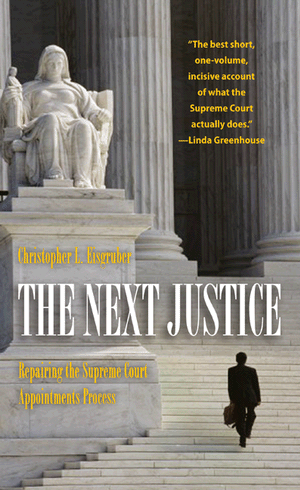
    The Next Justice: An Interview With Legal Scholar Christopher L. Eisgruber

    The topic below was originally posted on my blog, the Intrepid Liberal Journal.

    President Obama will soon announce his nominee to replace retiring Justice David Souter on the Supreme Court. It’s a critical nomination with long-term ramifications for civil liberties, executive power, management-labor relations, the environment and consumer rights. Hence, it is vital the public know whether the judicial philosophy and ideology of any prospective nominee to the court is compatible with their sensibilities and values. Ideally, all nominees would be forthcoming about their philosophy as the senate either confirms or rejects them with full knowledge of the sort of justice they’re likely to be.

    Regrettably, that hasn’t occurred since the 1987 Senate confirmation hearings for Robert Bork. At the time, Bork scared the hell out of me and I’m grateful his nomination was not approved. Even so, I always respected how Bork was upfront about his ideology and judicial philosophy. Bork didn’t hide what he was and the American public and the Senate had a clear picture of what sort of justice he would be.

    Sadly, since the Bork nomination fight, our Supreme Court appointments process has become a Kabuki dance existing in an alternate reality. Nominees are conditioned to reveal as little as possible about their judicial philosophies or even avoid acknowledging they have one. A pitiful example is Chief Justice John Roberts who famously compared Supreme Court justices with baseball umpires during his 2005 Senate confirmation hearings:
    “Judges are like umpires. Umpires don't make the rules; they apply them. The role of an umpire and a judge is critical. They make sure everybody plays by the rules. But it is a limited role. Nobody ever went to a ballgame to see the umpire.”
    Contrary to John Roberts’ testimony, a Supreme Court justice has a unique and expansive role in our society. The Constitution contains too many abstract references and clauses for any justice to merely adhere to the rules based on a strict interpretation of the text. An example is the Constitution’s Equal Protection Clause. As the highly regarded legal scholar, Christopher L. Eisgruber, observes in his 2007 book, The Next Justice: Repairing the Supreme Court Appointments Process (Princeton University Press) the Equal Protection Clause reads,
    “’No state shall deny to any person within its jurisdiction the equal protection of the laws.’

    How should judges interpret this clause? Presumably, they must ask what it means for the laws to protect people equally. Yet that question takes judges straight to the nerve center of American ideological controversy. Liberals and conservatives disagree passionately about what it means for the laws to protect groups equally and about when it is appropriate for the laws to treat one group better than another.”
    Overall, Eisgruber argues that due to the Constitution’s many vague abstractions, a Supreme Court justice is disproportionately influenced by their individual values and ideology in determining when it’s appropriate for the court to intervene and even overrule our country’s prior laws. How could it be otherwise when the Constitution’s text is frequently subject to broad interpretation as with the Equal Opportunity Clause? Hence, it is imperative the senate determines if the judicial philosophy of a Supreme Court nominee is representative of the country.

    Some legal scholars such as Yale law professor Stephen Carter have argued that nominees to the Supreme Court should simply stay home because their testimony has ceased to contribute anything substantive. There is definitely merit to Carter’s point of view. Nominees since Robert Bork typically speak only in vague platitudes about practicing “judicial restraint” and are ultimately voted up or down based upon their reassuring television appeal.

    Eisgruber however argues in his book that the senate should ask more open-ended questions of prospective nominees about their judicial philosophies. Too often senators attempt to trap nominees with “gotcha” questions or ask about specific issues such as abortion that that can easily be deflected to “preserve their integrity” prior to joining the Supreme Court. Ultimately, little is learned and unless opposition interest groups get any traction or a scandal emerges, the nominee is likely to sail through without defending or explaining their ideology.

    One example of the sort of question Eisgruber suggests asking is,
    “The late Chief Justice William Rehinquist wrote that ‘manifold provisions of the Constitution with which judges must deal are by no means crystal clear in their import, and reasonable minds may differ as to which interpretation is proper.’ Could you tell us something about the values and purposes that will guide you when you interpret provisions like the Equal Protection Clause? How do those values and purposes distinguish your approach from those taken by other justices?”
    Eisgruber contends this approach has a better chance of determining the sort of justice a nominee is likely to be. He also argues that it will facilitate more moderate nominees and discourage stealth extremists.

    Eisgruber, who previously clerked for U.S. Court of Appeals Judge Patrick E. Higginbortham (a conservative) and Supreme Court Justice John Paul Stevens (a liberal), agreed to a podcast interview with me over the telephone about his book. Among the topics discussed were the insights he gained clerking for two ideologically different judges, the importance of justice’s philosophy about judicial review, President Obama’s desire for a justice with “empathy” and whether we might have a justice who did not serve in the appellate courts. I also asked him numerous questions from my liberal perspective, including whether ideological balance on the court would be better served by appointing assertive liberals instead of moderates.

    Please refer to the flash media player below.


    This interview can also be accessed at no cost via the Itunes store by searching for either the “Intrepid Liberal Journal” or “Robert Ellman.”

    Thursday

    An Amazing Speech...


    President Obama delivered the commencement address at Arizona State University on Wednesday night.
    1.

    2.

    3.


    Friday

    Help Keep Obama's Military Budgets Clean!

    1.
    The full Pentagon budget hasn't even been drafted yet. But some members of Congress are already trying to slip billions of dollars of pork-barrel weapons projects - including C-17 transport planes the air force doesn't want - into the supplemental budget request for Iraq and Afghanistan.

    We need Congress to keep this supplemental vote clear of pork-barrel spending if we're going to change America's priorities for good. Tell Congress to pass the President's Supplemental, and hold the pork.


    Sunday

    That 100 Days Leadership Thing


    The topic below was originally published on my blog, the Intrepid Liberal Journal. Also, I hope readers here will consider voting for my blog for the 2009 Chapeau Blog Awards. My appreciation as always for being allowed to X-Post here. I love the new format!

    A charismatic president assumes power in a time of unprecedented turmoil after his hapless predecessor becomes a hated symbol of inertia. Financial institutions previously trusted for their forbearance are exposed as reckless stewards while the global economy implodes and regular folks who did nothing wrong are ruined. As job losses mount, unscrupulous demagogues at home and abroad exploit the chaos for nefarious objectives.

    Discredited conservatives accuse the new president of socialism while anarchists under the guise of populism are determined to expropriate and redistribute private capital’s wealth no matter what the consequences. Yet the nation rallies to the new president even as progress is slow, uneven and plagued with setbacks. Critics on the left, including his wife, believe the new president is overly cautious while conservatives view him as akin to the anti-Christ.

    The public discourse is volatile as the new president confounds his critics and towers over the body politic. Sound familiar? Generation-Y liberals may assume I’m referring to President Barack Obama’s first 100 days that we’ll be reading about next week. I am of course referring to President Franklin Delano Roosevelt, who first established the 100 days benchmark in 1933. FDR’s first 100 days were the foundation of twenty-years of Democratic Roosevelt/Truman administrations that forever changed American society and its place in the world.

    FDR himself was brilliant and flawed as he navigated the country through perilous waters domestically and internationally. His leadership enabled America and its allies to prevail in World War Two and establish an enduring middle class. Yet there was also a dark side to the FDR years as the “imperial presidency” was launched and Japanese civilians were “relocated.” The imperial presidency later metastasized during the cold war following the 1947 National Security Act under Harry Truman.

    Ultimately, the FDR years, like any presidency was a product of its time. Skirmishes between labor and business were violent. The gap between rich and poor was grotesque. Much of rural America didn’t have electricity and whites routinely murdered their black neighbors. Anti-Semitic demagogues such as Father Charles Coughlin polluted the airwaves. Industrial leaders like Henry Ford as well as national hero, aviator Charles Limburg, openly expressed their admiration for Adolph Hitler.

    Capitalism as well as the concept of democracy itself seemed to be retreating as Hitler in Germany, Josef Stalin in Soviet Russia and Italy’s Benito Mussolini maneuvered for global domination. The Japanese Empire brutally worked to establish their “Asian Co-Prosperity Sphere and carved up the Chinese mainland in the 1930s. Americans hoped to avoid foreign wars and FDR promised to keep us out as he plotted behind the scenes to save civilization.

    In any era, leadership is not for the meek or faint of heart. FDR projected jaunty confidence and empathy for the downtrodden as he defined America’s center of political gravity on his terms. His leadership style was one of calculated confrontation and FDR skillfully utilized his political capital to take on conservative agents of the status quo at home while inspiring an international alliance against implacable enemies abroad. Seventy-five years after his first inauguration many historians regard him as America’s greatest president.

    Photobucket

    President Obama’s current challenges and leadership style is understandably compared to FDR – especially has we approach his 100 day benchmark. His support remains notably impressive in spite of the plutocratic dynamic duo of Larry Summers and Timothy Geithner or his waffling with respect to prosecuting crimes committed by the Bush Administration.

    Every week we set new records for unemployment claims and the Wall Street bailouts continue. Yet the public continues to believe in his leadership. I do too even as I fret over Obama’s handling of the banking crisis and worry his presidency will be consumed by efforts to stabilize Afghanistan and Pakistan.

    My interpretation of President Obama’s political standing is that his support is partly attributed to a conservative minority that is bereft of ideas and maturity. There is the faux populist outrage of “tea parties” to the sniveling temper tantrums of conservatives when Obama shakes hands with Hugo Chavez. Newt Gingrich and Rush Limbaugh look like fools as they critique Obama’s handling of the Somali Pirates hostage crisis while the administration initiates a successful rescue operation. Republicans in Texas and Georgia speak openly of secession while a more sophisticated majority wants to come together and solve problems.

    The public face of conservatism is angry, xenophobic, homophobic, shrill and insipid and no longer taken seriously. It's not just that conservative ideology is thorougly discredited as it was in 1933. Sarah Palin, Rush Limbaugh, John Boehner and Newt Gingrich are almost cartoonish in their political opposition. Hence, the real debate with respect to public policy about issues ranging from the potential fall of Pakistan, engaging Iran, addressing global warming, strengthening public education, rebuilding infrastucture, renewable energy and health care is between the center and the left. The center of political gravity is being redefined by Barack Obama because Republicans don't belong at the grownups table.

    On the left, people like me critique the administration so he will seize the moment and push the envelope further. We want accountability for the Bush Administration’s crimes, a swift reversal of the Wall Street centric economy that has placed millions of Americans on the abyss of destitution and a public option for health care. The end result of impatient liberal/left critics and America’s puerile conservatives is that President Obama owns the political center just as FDR did.

    Whether Obama takes full advantage of his unique stature will take far longer than 100 days to know. This is only the end of the beginning.

    Thursday

    Take Action Today...

    1. Fox News Crosses the Line
    For news coverage to be "fair and balanced," there has to be a line separating news from political activism – a clear boundary between legitimate commentary and demagoguery.
    Fox News Sunday host Chris Wallace repeatedly characterizes his network as "fair and balanced" – a source of news that should be taken seriously. However, several recent actions on Fox News illustrate that the network is contributing to a culture of conservative paranoia and anti-Obama political activism.
    For example, since launching his Fox News show, Glenn Beck has engaged in increasingly outrageous rhetoric that promotes a culture of conservative paranoia – from imitating President Obama pouring gasoline onto the "average American" to mocking Obama's aunt's "limp."
    If Wallace wants to continue to portray his network and influential Sunday show as a credible source of news, he owes it to his viewers to speak out publicly against Fox News' recent behavior. So please ask Chris Wallace to publicly denounce Fox News' recent actions and repair the damage done to his network's credibility.


    2. Bob Marshall, staff writer for the New Orleans Times Picayune covered the story of Dr. van Heerden's leadership investigating the levee failures. In a recent opinion piece, Marshall said, "... I always thought the state should be rewarding van Heerden, not chasing him away, because metro area residents -- indeed, citizens of any U.S. community currently relying on federal levees to keep them safe -- owe Van Heerden a huge debt."


    3. Obama: Lift the Cuban Embargo
    On Monday, President Obama announced a shift in US policy on Cuba, but Latin American leaders and US members of Congress are urging him to take further steps -- to talk to the Cuban government and end the almost 50 year failed embargo.
    This weekend Obama is participating in his first Americas Summit in Trinidad and Tobago. We have a unique chance to influence him with a strong international call to initiate a new constructive era of engagement with Cuba.
    Add your name to the petition -- and Avaaz members will sail a boat with the number of signatures painted on its sail in the harbour where the summit is being held this weekend.
    We urge the United States government to move from isolation to constructive engagement with Cuba--initiating dialogue and lifting the embargo.

    Sunday

    The Democracy Index: An Interview With Law Professor Heather Gerken

    The topic below was originally posted on my blog, the Intrepid Liberal Journal.

    On January 1, 2007, Yale Law School professor Heather Gerken published a widely read article in the LegalTimes entitled, “How Does Your State Rank on The Democracy Index.” Gerken argued that just as the Environmental Performance Index (“EPI”) shamed countries such as Belgium to upgrade their environmental practices, a “Democracy Index” would embarrass state and localities into reforming their electoral administration through competition.

    Since Bush vs. Gore in 2000, the debate about electoral reform has been dominated by anecdotes and overheated abstractions. Liberals like me have long suspected that states such as Ohio and Florida were deliberately disenfranchising minority voters sympathetic to Democratic candidates. Conservatives complained that voter fraud and urban political machines were allowing ineligible voters to cast ballots at the expense of Republican candidates. With her article, Gerken contended that a Democracy Index would replace a debate dominated by shouting with data driven arguments instead:
    “This index should take what Ohio State University law professor Daniel Tokaji calls a ‘moneyball approach.’ The word ‘moneyball,’ of course, refers to Michael Lewis’ book of the same name about the success of the Oakland A’s after management substituted hard numbers and empirical research for the gut-level judgments of baseball scouts in making hiring decisions.

    Similarly, the Democracy Index could change the terms of the debate by giving voters something new: moneyball politics. It would offer cold, hard numbers and comparative data in place of atmospherics and anecdotes. It would provide bottom-line results in place of subjective judgments. It would let reformers talk like corporate executives, not starry-eyed idealists. And, most important, it would enable the voters to hold election officials accountable for their missteps.

    In the end, a ranking system would work for a simple reason: No one wants to be at the bottom of the list.”


    Read More +/-

    Gerken further described her Democracy Index proposal and identified the major obstacles to good election practices with her new book, The Democracy Index: Why Our Election System Is Failing and How To Fix It (Princeton University Press). Her book is an accessible 181 pages and postulates that we need more facts about our election practices and that a ranking metric is our best hope to facilitate accountability and reform. Gerken also contends that our broken electoral system has less to do with intended malice than “deferred maintenance,” a term typically applied to failed infrastructure such as broken bridges.

    Shortly after Gerken’s LegalTimes article was published, Both Barack Obama and Hillary Clinton, put her concept into proposed legislation and within a year, Congress set aside $10 million to fund model data collection programs in five states and the Pew Center. Other foundations also sponsored conferences and initial research. On March 1, 2007, Obama referred to these initiatives on the Senate floor as,

    “an important first step toward improving the health of our democracy. We are all familiar with the problems that have recently plagued our elections: Long lines, lost ballots, voters improperly turned away from the polls. These are basic failures of process. Until we fix them, we run the risk in every election that we will once again experience the kind of chaos and uncertainty that paralyzed the nation in 2000. We can do better. We must do better. But to do better, we need more than anecdotal information. We need better, nonpartisan, objective information.”
    Hence, Gerken's efforts illustrated at least the potential for action from the body politic to facilitate electoral reform but obviously, more needs to be done.

    With respect to electoral law, Gerken is among the most authoritative voices in the country. In 2006, Gerken joined the Yale Law School faculty where she teaches election and constitutional law. Previously, Gerken clerked for Supreme Court Justice David Souter and was an assistant professor at Harvard Law School, where she was granted tenure and won the Sachs-Freund teaching award. She has also written for the New Republic, Roll Call, and Legal Affairs and has been a frequent media commentator.

    Gerken was among several commentators who appeared on Charlie Rose’s program the very evening the Supreme Court rendered its fateful decision in Bush vs. Gore. During the 2008 presidential election, Gerken served on Barack Obama’s election protection team.

    Gerken agreed to a podcast interview with me over the telephone about her book and proposal for a Democracy index. Our conversation was just over seventeen minutes and can be accessed via the flash media player below.


    This interview can also be accessed at no cost via the Itunes Store by searching for either “Intrepid Liberal Journal” or “Robert Ellman.”

    Placebo Economics

    The topic below was originally posted yesterday at the Intrepid Liberal Journal.

    How many of you read the financial investor’s blog Seeking Alpha? Well, their March 30th post entitled “Exclusive: Big Banks' Recent Profitability Due to AIG Scam?,” is a must read that ought to embarrass the hell out Senate banking chairman Chris Dodd and his House counterpart, Barney Frank.

    Here is how Seeking Alpha summarized what they learned from an anonymous inside trader they call "Lou" in laymen terms:

    Read More +/-

    “AIG, knowing it would need to ask for much more capital from the Treasury imminently, decided to throw in the towel, and gifted major bank counter-parties with trades which were egregiously profitable to the banks, and even more egregiously money losing to the U.S. taxpayers, who had to dump more and more cash into AIG, without having the U.S. Treasury Secretary Tim Geithner disclose the real extent of this - for lack of a better word - fraudulent scam.

    In simple terms, think of it as an auto dealer which knows that U.S. taxpayers will provide an infinite amount of money to fund its ongoing sales of horrendous vehicles (think Pontiac Azteks): the company decides to sell all the cars currently in contract, to lessors at far below the amortized market value, thereby generating huge profits for these lessors, as these turn around and sell the cars at a major profit, funded exclusively by U.S. taxpayers (readers should feel free to provide more gripping allegories).

    What this all means is that the statements by major banks, i.e. JP Morgan Chase (JPM), Citi (C), and BofA (BAC), regarding abnormal profitability in January and February were true, however these profits were a) one-time in nature due to wholesale unwinds of AIG portfolios, b) entirely at the expense of AIG, and thus taxpayers, c) executed with Tim Geithner's (and thus the administration's) full knowledge and intent, d) were basically a transfer of money from taxpayers to banks (in yet another form) using AIG as an intermediary.”
    Is any of this true? If so, the implications are frightening and suggest economist and New York Times columnist Paul Krugman is correct in warning that banks are insolvent and the administration’s plan to stabilize financial institutions nothing but smoke and mirrors. For damn sure I find this report far more believable than the recent stock market bump reflecting the profit statements of these fraudulent institutions.

    Congress has a duty to provide vigorous oversight on the public’s behalf. Specifically, Senator Chris Dodd and Representative Barney Frank need to utilize their subpoena power as well as demand that Treasury Secretary Tim Geithner come clean with what he knew and when he knew it. If their investigation proves that Geithner knowingly endorsed the scheme then at minimum he needs to be replaced immediately. If President Obama refuses to fire him than Eric Holder’s Justice Department should read Geithner his rights.

    Click here to contact Senator Dodd’s office and here for Representative Barney Frank’s and demand that they do their jobs. Lax oversight of the executive branch was supposed to end in 2006.

    Placebo economics will not rescue either America or the world from this depression. Accounting gimmicks will not sugarcoat the dislocation, pain and yes poverty people worldwide are experiencing because of the reckless conduct of financial institutions allowed to run amok. It is incumbent upon our leaders that today’s pain results in a better socio-economic paradigm tomorrow. Enabling banks to inflate their quarterly statements for a good day on the stock exchange is precisely how we got into this mess in the first place.

    Yet again I insist that hyper-sized financial institutions be nationalized or as William Black suggests, put into a receivership as the law mandated following the 1980s Savings & Loans crisis. That should be followed by comprehensive anti-trust legislation that permanently ends the chokehold these large institutions have on our economy. And we as citizens need to think globally by banking locally.

    I support the administration’s bold initiatives with respect to their budget and am more than willing to help them as an activist take on Blue Dog Democrats such as Senator Evan Bayh, who double cross their constituents for campaign contributions under the false guise of “fiscal responsibility.” Also, I believe, Obama has the makings of a magnificent international statesman.

    But the administration’s approach to the banking crisis is inadequate at best and perhaps criminal at worst. Unless Obama takes charge and gets realistic about the banking crisis, none of the good intentions outlined in his budget proposal will come to fruition.

    Secretary Geithner's approach is a metastasizing cancer on the administration. And certainly not change I can believe in.

    LinkWithin

    Related Posts with Thumbnails