Showing posts with label war on drugs. Show all posts

Sunday

What a Better "War on Drugs" Could Look Like


The Merida Initiative, a 3-year, $1.4 billion counternarcotics aid package, is the US's current program of assistance to combat the drug-fueled violence that has turned Mexico into a war zone. It tries to help Mexico take the offensive and win the fight against the powerful drug cartels by strengthening the Mexican police and military. That is the same sort of strategy as is Plan Columbia, a strategy reaffirmed by Bush in the 2008 National Drug Control Strategy.

However, the Merida Initiative won't likely have a meaningful, long-term impact in restraining the drug trade and drug-related violence as it is currently set up, according to a paper published by the US Army War College entitled "Mexico's Narco-Insurgency and U.S. Counterdrug Policy." Because it focuses primarily on security, enforcement, and drug prohibition issues, the Merida Initiative fails to give adequate attention to the deeper structural problems that fuel the situation.

Those problems include

* official corruption,
* widespread poverty and inequality,
* weak governance,
* high demand for illegal narcotics in the United States, and
* the flow of illicit arms across the U.S. border into Mexico.

Because these factors have frustrated Mexican attempts to rein in the cartels so far, it's quite likely that they will also limit the effectiveness of the Merida Initiative.

To make U.S. counternarcotics policy fully effective, it is absolutely necessary, the study says, to create a more holistic and better-integrated approach to the "war on drugs." This would go beyond the politically popular aspects of counternarcotics-like drug prohibitions--and attend to the root issues: honing in on more controversial issues like guns and the US demand for street drugs.

The focus needs to include

* anti-corruption initiatives,
* economic and social development,
* institution building, and
* efforts to restrict U.S. domestic demand and lessen illicit arms trafficking into Mexico.

Because international drug trade is so entrenched, even a "perfect" counternarcotics strategy will not work in the short-run. Results will be seen only on a long-term basis.

Summary of the paper: "Mexico's Narco-Insurgency and U.S. Counterdrug Policy"

Author: Hal Brands. You can download the PDA of the paper here.


Government Lies About the Drug War: A Podcast Interview With Criminal Justice Professor Matthew Robinson

The topic below as originally posted on my blog, the Intrepid Liberal Journal as well as the Independent Bloggers Alliance and Worldwide Sawdust.

The “war on drugs” doesn’t consume as much oxygen in the public square as it used to. In September 1989, President George Herbert Walker Bush, spoke from the Oval Office, held up a plastic bag filled with white contents and announced,

“This is crack cocaine seized a few days ago in a park across the street from the White House . . . It could easily have been heroin or PCP.”
For Bush this speech was public relations homage to an issue that dominated the media and politics during the 1980s. It also impacted Bush’s 1988 presidential election campaign. The near hysteria about the “crack” epidemic in particular resulted in the Anti-Drug Abuse Act of 1988. This act established The White House Office of National Drug Control Policy (ONDCP). According to their website,
“The principal purpose of ONDCP is to establish policies, priorities, and objectives for the Nation's drug control program. The goals of the program are to reduce illicit drug use, manufacturing, and trafficking, drug-related crime and violence, and drug-related health consequences. To achieve these goals, the Director of ONDCP is charged with producing the National Drug Control Strategy. The Strategy directs the Nation's anti-drug efforts and establishes a program, a budget, and guidelines for cooperation among Federal, State, and local entities.”
The General Accounting Office reported that as of 2000, ONDCP’s annual budget was almost $20 billion. Depending on whether one factors local incarcerations and law enforcement costs we continue to spend billions annually. So as tax payers, how are we to assess the ONDCP’s performance? Are they having any success at achieving their goals? Do they have the right goals? Is ONDCP accomplishing anything useful or simply justifying its own existence and sustaining the prison industrial complex?

Understandably, we have other things on our minds these days. The “war on terror” has dwarfed the “war on drugs” in recent years and unlike 1988, receiving little attention from presidential candidates this time around. However, given the health repercussions of drugs on society as well as the impact on our justice system, foreign policy, and economy, a thorough analysis of the ONDCP’s efforts are in order.

One interesting cost-benefit analysis of the drug war was posted online by Brian C. Bennett, who in 2005 concluded that,

“trying to stop people from using drugs is still costing us more than three times as much as the drug abuse itself.”
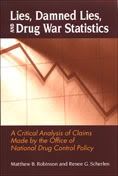
Two Appalachian State University professors provide another sobering analysis: Matthew B. Robinson, Associate Professor of Criminal Justice and Renee G. Scherlen, Associate Professor of Political Science. Their book, Lies, Damned Lies, and Drug War Statistics: A Critical Analysis of Claims Made by the Office of National Drug Control Policy (State University of New York Press) primarily focuses on data published by the ONDCP from 2000-2006. They also provide an instructive historical overview about America’s war on drugs dating back to 1875 and illustrate the common themes of racism, media hyperbole and bureaucratic self-interest that have helped define this country’s drug policies.

Robinson, an author of six books, including most recently, Death Nation: The Experts Explain Capital Punishment, agreed to a podcast interview with me about his book and the war on drugs. Please refer to the media player below. This interview is just over thirty minutes and can also be accessed at no cost via the Itunes Store by searching for "Intrepid Liberal Journal."


LinkWithin

Related Posts with Thumbnails